
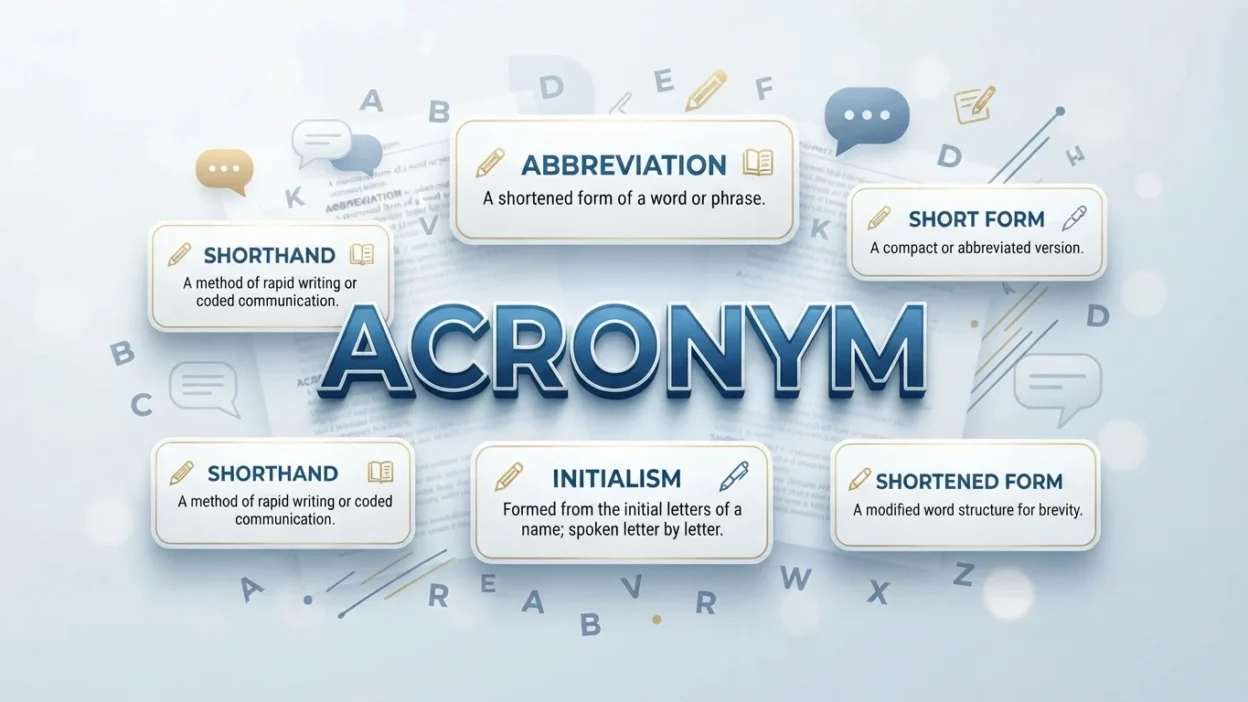
If you are looking for synonyms of acronym, it is important to understand that not every alternative has exactly the same meaning. An acronym is a shortened form made from the initial letters or parts of a longer name or phrase, often pronounced as a word, such as NASA, NATO, or UNESCO.
Different words such as abbreviation, initialism, and shorthand are closely related to acronym, but they are not always interchangeable. Understanding these small differences can help students, ESL learners, writers, and content creators choose the most accurate word for their sentence.
What Does “Acronym” Mean?
An acronym is a shortened name or phrase created from letters or parts of the original words. It is commonly pronounced as a single word.
For example:
- NASA = National Aeronautics and Space Administration
- NATO = North Atlantic Treaty Organization
- UNESCO = United Nations Educational, Scientific and Cultural Organization
- RADAR = Radio Detection and Ranging
In simple English, an acronym is a shorter form of a longer name or phrase.
The word can also be used more generally when talking about shortened expressions. However, technically, an acronym is different from an initialism because an initialism is usually pronounced letter by letter, such as FBI or BBC.
30 Synonyms and Related Alternatives for Acronym
Below are 30 useful words and expressions related to acronym. Some are close synonyms, while others describe a particular type of shortened form.
1. Abbreviation
Meaning: A shorter version of a word or phrase.
Example: “Dr.” is an abbreviation of “Doctor.”
Best usage: Use this as the broadest and safest alternative to acronym.
2. Initialism
Meaning: A shortened expression made from initial letters and usually pronounced letter by letter.
Example: “FBI” is an initialism for Federal Bureau of Investigation.
Best usage: Use it when the letters are spoken individually.
3. Shortened Form
Meaning: A shorter version of a word, name, or phrase.
Example: “Information technology” has the shortened form “IT.”
Best usage: Useful in general and beginner-friendly writing.
4. Short Form
Meaning: A brief version of a longer expression.
Example: “Advertisement” is often shortened to “ad.”
Best usage: Good for everyday English.
5. Shorthand
Meaning: A quick or shortened way of representing something.
Example: “ASAP” is commonly used as shorthand for “as soon as possible.”
Best usage: Useful when discussing informal communication.
6. Shortening
Meaning: A form created by making a word or phrase shorter.
Example: “Lab” is a shortening of “laboratory.”
Best usage: Use when focusing on the process or result of making something shorter.
7. Condensation
Meaning: A shorter version that keeps the main meaning of the original.
Example: “The title is a condensation of the organization’s full name.”
Best usage: More appropriate in formal or academic writing.
8. Contraction
Meaning: A shortened form created by combining or removing parts of words.
Example: “Can’t” is a contraction of “cannot.”
Best usage: Use for grammatical shortened forms rather than most acronyms.
9. Clipping
Meaning: A word formed by removing part of a longer word.
Example: “Exam” is a clipping of “examination.”
Best usage: Useful in linguistics and vocabulary discussions.
10. Abridgment
Meaning: A shortened version of something longer.
Example: “The book was published in an abridgment for younger readers.”
Best usage: Best for books, texts, and longer written works.
11. Abbreviated Form
Meaning: A version that has been made shorter.
Example: “The abbreviated form of the organization is WHO.”
Best usage: Formal writing and explanations.
12. Abbreviated Name
Meaning: A shorter name used instead of a complete name.
Example: “The abbreviated name is commonly used in news reports.”
Best usage: Helpful when discussing organizations, companies, and institutions.
13. Shortened Name
Meaning: A shorter version of a person’s, organization’s, or place’s full name.
Example: “The shortened name is easier to remember.”
Best usage: Simple and clear everyday English.
14. Initial-Letter Form
Meaning: A shortened expression created from the first letters of words.
Example: “DIY is an initial-letter form of ‘do it yourself.’”
Best usage: Useful when explaining how an acronym or initialism is formed.
15. Initial-Letter Abbreviation
Meaning: An abbreviation made using the first letters of several words.
Example: “UN is an initial-letter abbreviation for United Nations.”
Best usage: Good for educational and linguistic explanations.
16. Letter Abbreviation
Meaning: A shortened form created with letters from a longer expression.
Example: “The report uses several letter abbreviations.”
Best usage: Suitable for general discussions of shortened terms.
17. Verbal Shortening
Meaning: A shortened expression used as a spoken term.
Example: “The organization is usually referred to by its verbal shortening.”
Best usage: Useful when discussing spoken language.
18. Compressed Form
Meaning: A shorter form containing the essential information.
Example: “The acronym provides a compressed form of the organization’s full name.”
Best usage: Best for formal explanations.
19. Compact Form
Meaning: A shorter and more convenient representation.
Example: “The compact form is easier to use in headlines.”
Best usage: Useful for writing, media, and technical communication.
20. Condensed Form
Meaning: A reduced version of a longer phrase or expression.
Example: “The condensed form is used throughout the report.”
Best usage: Appropriate in formal and academic contexts.
21. Reduced Form
Meaning: A version that has been shortened or simplified.
Example: “The reduced form appears in the document’s headings.”
Best usage: General descriptive writing.
22. Shortened Expression
Meaning: A brief version of a longer expression.
Example: “The shortened expression is easier for readers to remember.”
Best usage: Helpful for ESL learners because it clearly explains the idea.
23. Abbreviated Expression
Meaning: A phrase represented in a shorter form.
Example: “The abbreviated expression is widely recognized.”
Best usage: Formal explanations of language.
24. Word Initialism
Meaning: A shortened expression based on the initial letters of words.
Example: “The term functions as a word initialism in the organization’s name.”
Best usage: Linguistic or technical discussions.
25. Initial-Letter Word
Meaning: A word or expression created from the initial letters of other words.
Example: “The new term became an initial-letter word used by employees.”
Best usage: Use when explaining how a shortened term was created.
26. Name Abbreviation
Meaning: A shortened version of a full name.
Example: “The name abbreviation is commonly used online.”
Best usage: Useful for organizations, institutions, and long names.
27. Organizational Abbreviation
Meaning: A shortened form of an organization’s name.
Example: “The organization’s abbreviation appears on official documents.”
Best usage: Use when specifically discussing institutions or organizations.
28. Technical Abbreviation
Meaning: A shortened term commonly used in a specialized field.
Example: “CPU is a technical abbreviation used in computing.”
Best usage: Useful for science, technology, medicine, and professional writing.
29. Terminological Short Form
Meaning: A shorter version of a specialized term.
Example: “The terminological short form is widely used by researchers.”
Best usage: Best suited to academic or professional contexts.
30. Acronymic Form
Meaning: A form created or used as an acronym.
Example: “The acronymic form is easier to remember than the full organization name.”
Best usage: Use when specifically discussing the structure or formation of an acronym.
Quick Comparison: Acronym vs. Related Words
Not all synonyms of acronym work in exactly the same situation. The following guide can help you select the right word.
| Word | Main Meaning | Best Context | Example |
|---|---|---|---|
| Acronym | Short form pronounced as a word | General | NASA |
| Abbreviation | Any shortened form | General | approx. |
| Initialism | Initial letters pronounced separately | Formal/general | FBI |
| Shorthand | Quick shortened representation | Informal/notes | ASAP |
| Clipping | Part of a word removed | Linguistics | ad |
| Contraction | Words shortened grammatically | Grammar | can’t |
| Abridgment | Shortened longer text | Books/documents | abridged novel |
| Short form | Brief version | Everyday English | ad |
| Condensed form | Reduced version | Formal writing | condensed title |
| Technical abbreviation | Specialized short form | Professional fields | CPU |
Acronym vs. Abbreviation: What Is the Difference?
Acronym and abbreviation are closely related, but abbreviation has a broader meaning.
An abbreviation can be almost any shortened form of a word or phrase. For example:
- Dr. = Doctor
- etc. = et cetera
- Jan. = January
An acronym is a specific type of shortened expression, usually formed from initial letters or parts of words and pronounced as a word.
For example:
- NASA → pronounced as one word
- NATO → pronounced as one word
Therefore, you can usually describe an acronym as an abbreviation, but not every abbreviation is an acronym.
Acronym vs. Initialism
This is another important distinction for students and writers.
An acronym is generally pronounced as a word.
Example:
NASA → “nassa”
An initialism is pronounced letter by letter.
Example:
FBI → “F-B-I”
Both are made from letters associated with a longer phrase, but their pronunciation differs.
How to Choose the Right Synonym
Choosing the best alternative depends on what you want to communicate.
For General Writing
Use:
- abbreviation
- shortened form
- short form
- shortened expression
- abbreviated form
These choices are easy to understand and work in many situations.
For Linguistics
Use:
- initialism
- clipping
- shortening
- contraction
- initial-letter form
These words are better when discussing how language is formed.
For Formal Writing
Use:
- abbreviated expression
- condensed form
- compressed form
- abridgment
- abbreviated name
These alternatives sound more formal and are useful in academic or professional contexts.
For Technical Writing
Use:
- technical abbreviation
- acronym
- initialism
- terminological short form
- organizational abbreviation
These are especially useful when explaining specialized vocabulary.
For Informal Communication
Use:
- shorthand
- short form
- shortened expression
- abbreviation
These words work well when discussing texting, messaging, notes, and casual communication.
Examples of Acronyms in Everyday English
Acronyms are everywhere in modern communication. You may encounter them in education, technology, business, government, medicine, and everyday conversation.
Here are some familiar examples:
- NASA — National Aeronautics and Space Administration
- NATO — North Atlantic Treaty Organization
- UNESCO — United Nations Educational, Scientific and Cultural Organization
- RADAR — Radio Detection and Ranging
- LASER — Light Amplification by Stimulated Emission of Radiation
- SCUBA — Self-Contained Underwater Breathing Apparatus
These examples show why acronyms are useful: they make long names easier to remember, pronounce, and use.
Why Are Acronyms Useful?
Acronyms make communication faster and more convenient.
They are particularly useful when a long name or technical phrase appears repeatedly.
For example, writing World Health Organization every time can be repetitive. Once the abbreviation WHO has been introduced, it provides a much shorter way to refer to the organization.
Acronyms can also make specialized communication more efficient. Professionals in technology, medicine, science, and business often use them to save space and time.
However, writers should avoid unexplained acronyms when writing for a general audience. A reader may not understand an abbreviation without context.
Common Mistakes When Using Acronym Synonyms
One common mistake is treating every shortened form as an acronym.
For example, “Dr.” is an abbreviation, but it is not normally called an acronym.
Another mistake is confusing acronyms with initialisms. If a shortened expression is pronounced letter by letter, initialism may be the more precise term.
It is also important to consider your audience. Technical terms such as initialism and clipping may be accurate, but an ESL learner may understand shortened form more easily.
FAQs:
What is another word for acronym?
The most common alternatives include abbreviation, initialism, shortened form, short form, and shorthand. However, the exact choice depends on how the shortened expression is formed and pronounced.
Is abbreviation a synonym for acronym?
Yes, in a broad sense. An acronym is generally a type of abbreviation, but abbreviation is a wider term that includes many shortened forms that are not acronyms.
What is the difference between an acronym and an initialism?
An acronym is usually pronounced as a word, while an initialism is pronounced as individual letters. NASA is an example of an acronym, while FBI is commonly treated as an initialism.
What is the simplest synonym for acronym?
Abbreviation is probably the simplest broad synonym. Shortened form is also very easy for beginners and ESL learners to understand.
Is shorthand the same as an acronym?
Not exactly. Shorthand is a broader term for a quick or shortened way of representing information. An acronym can be used as shorthand, but not all shorthand is an acronym.
What is an acronym in simple English?
An acronym is a short name made from letters or parts of a longer name or phrase, often pronounced as one word.
Final Thoughts
Understanding the synonyms of acronym helps you choose more accurate vocabulary in academic, professional, and everyday writing. While abbreviation is the broadest alternative, words such as initialism, shorthand, shortened form, clipping, and condensed form have different meanings and uses.
The most important point is that these words are related but not always interchangeable. If you need a general term, abbreviation is usually a safe choice. If you are talking specifically about initial letters pronounced separately, initialism is more precise. For beginner-friendly writing, shortened form is clear and natural.
Learning these distinctions can improve your vocabulary, make your writing more precise, and help you communicate complex language concepts in a simple way.

Sarah Sophia is the administrator of Biblelsays.com, a platform dedicated to Bible meanings and explanations, where she helps manage content, organization, and educational resources for readers seeking spiritual understanding online.