When you ask, “what’s a synonym?”, you are asking for a word that has the same or nearly the same meaning as another word. Learning synonyms helps students, ESL learners, writers, and content creators make their English more varied, natural, and precise.
In this guide, we will focus on demure and explore 30 useful synonyms. Although these words may share similar meanings, they can have different tones and usage contexts. Understanding these small differences can help you choose the right word for essays, conversations, creative writing, and everyday English.
What Does “Demure” Mean?
Demure describes someone who is quiet, modest, reserved, and usually not eager to attract attention. It is often used to describe a person’s appearance, behavior, or manner.
For example:
In simple English, demure means politely quiet, modest, and reserved. The word can sometimes suggest a gentle or traditionally modest appearance, especially when describing someone’s behavior or clothing.
Tone and Usage of Demure
The tone of demure is generally positive or neutral, although its meaning depends on context.
It can describe someone who:
- Behaves quietly and politely
- Avoids drawing attention
- Appears modest or reserved
- Has a gentle and controlled manner
- Does not openly express strong emotions
30 Synonyms of Demure
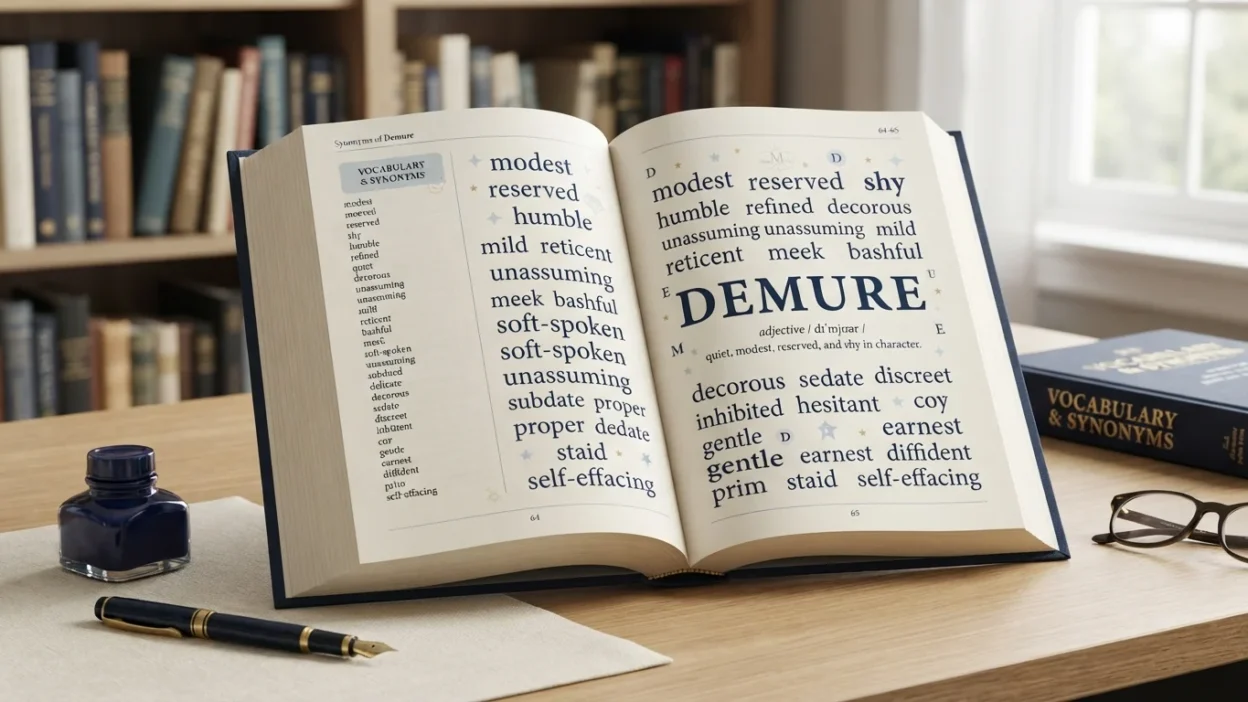
Here are 30 synonyms and closely related words that can help you understand different ways to express the idea of being quiet, modest, or reserved.
1. Modest
Meaning: Not showing off or trying to attract attention.
Example:
She was modest about her achievements.
Best usage: Use when describing humble behavior, appearance, or achievements.
2. Reserved
Meaning: Quiet and not showing feelings or opinions openly.
Example:
He is reserved when meeting new people.
Best usage: Best for personality and social behavior.
3. Shy
Meaning: Nervous or uncomfortable around other people.
Example:
The shy student rarely spoke in class.
Best usage: Use when someone lacks confidence in social situations.
4. Retiring
Meaning: Quiet and unlikely to seek attention.
Example:
She had a retiring personality and preferred small gatherings.
Best usage: Useful for describing a person who naturally avoids attention.
5. Unassuming
Meaning: Not trying to appear important or impressive.
Example:
Despite his success, he remained unassuming.
Best usage: Excellent for describing humble people.
6. Humble
Meaning: Not believing that you are better or more important than others.
Example:
She remained humble after winning the award.
Best usage: Best when discussing attitude, success, or achievements.
7. Quiet
Meaning: Making little noise or speaking very little.
Example:
She was quiet during the meeting.
Best usage: A simple everyday alternative.
8. Soft-spoken
Meaning: Speaking in a gentle, quiet voice.
Example:
The soft-spoken teacher made everyone feel comfortable.
Best usage: Use specifically for someone’s voice or speaking style.
9. Gentle
Meaning: Kind, calm, and not harsh or aggressive.
Example:
She had a gentle manner with everyone.
Best usage: Useful when focusing on someone’s calm and kind behavior.
10. Mild
Meaning: Calm and not extreme or forceful.
Example:
He has a mild and pleasant personality.
Best usage: Suitable for describing temperament.
11. Meek
Meaning: Very quiet and unlikely to argue or resist.
Example:
The meek child rarely complained.
Best usage: Use carefully because it can suggest a lack of confidence or assertiveness.
12. Subdued
Meaning: Quiet, controlled, or less energetic than usual.
Example:
She gave a subdued response to the news.
Best usage: Good for moods, reactions, colors, and behavior.
13. Discreet
Meaning: Careful not to attract attention or reveal private information.
Example:
She was discreet about her friend’s personal problems.
Best usage: Best for privacy and careful behavior.
14. Unobtrusive
Meaning: Not noticeable or not causing disturbance.
Example:
He chose an unobtrusive place at the back of the room.
Best usage: Useful for people, behavior, objects, and design.
15. Self-effacing
Meaning: Avoiding praise or attention and sometimes making yourself seem less important.
Example:
Her self-effacing humor made everyone feel relaxed.
Best usage: Best for humble personalities and communication.
16. Bashful
Meaning: Easily embarrassed or shy.
Example:
The bashful child hid behind her mother.
Best usage: Commonly used for children or someone who becomes shy when receiving attention.
17. Coy
Meaning: Pretending to be shy or reluctant, sometimes in a playful or flirtatious way.
Example:
She gave a coy smile before answering.
Best usage: Use when there is a playful, teasing, or flirtatious tone.
18. Demure
Meaning: Quiet, modest, and reserved in appearance or behavior.
Example:
She wore a demure dress to the formal event.
Best usage: Use when modesty and restrained behavior or appearance are central.
19. Unpretentious
Meaning: Simple and not designed to impress others.
Example:
The restaurant had a warm and unpretentious atmosphere.
Best usage: Great for people, places, lifestyles, and designs.
20. Unshowy
Meaning: Not intended to attract attention.
Example:
Her unshowy style was elegant and practical.
Best usage: Useful for clothing, appearance, possessions, and behavior.
21. Unassuming
Meaning: Quietly confident without trying to appear important.
Example:
The unassuming writer was surprised by her popularity.
Best usage: Ideal for describing humble people.
22. Modest-looking
Meaning: Having a simple and restrained appearance.
Example:
She chose a modest-looking outfit for the ceremony.
Best usage: Best when describing physical appearance or clothing.
23. Proper
Meaning: Behaving according to accepted social standards.
Example:
The children were expected to behave in a proper manner.
Best usage: Useful in formal or traditional contexts.
24. Ladylike
Meaning: Traditionally associated with polite, graceful, and modest feminine behavior.
Example:
Her ladylike manners impressed the guests.
Best usage: Use carefully because it has a traditional and gender-specific tone.
25. Refined
Meaning: Elegant, polished, and socially graceful.
Example:
She had a refined sense of style.
Best usage: Best for sophisticated appearance, manners, or taste.
26. Reserved-looking
Meaning: Appearing quiet, controlled, or not highly expressive.
Example:
The reserved-looking woman smiled warmly when introduced.
Best usage: Useful when describing someone’s outward appearance.
27. Restrained
Meaning: Controlled and not excessive or emotional.
Example:
His restrained response showed great self-control.
Best usage: Excellent for emotions, reactions, speech, and behavior.
28. Composed
Meaning: Calm and in control of your emotions.
Example:
She remained composed during the difficult interview.
Best usage: Best when someone stays calm under pressure.
29. Dignified
Meaning: Calm, serious, and worthy of respect.
Example:
She maintained a dignified manner throughout the ceremony.
Best usage: Ideal for formal situations and respectful behavior.
30. Demurely
Meaning: In a quiet, modest, or reserved manner.
Example:
She smiled demurely and lowered her eyes.
Best usage: Use as an adverb when explaining how someone behaves.
Quick Comparison: Demure Synonyms
| Synonym | Main Idea | Tone | Best Context |
|---|---|---|---|
| Demure | Quiet and modest | Positive/neutral | Appearance and behavior |
| Modest | Not boastful | Positive | Personality and achievements |
| Reserved | Not openly expressive | Neutral | Personality |
| Shy | Uncomfortable socially | Neutral | Social situations |
| Humble | Not proud or boastful | Positive | Success and personality |
| Coy | Playfully shy | Playful | Social or romantic situations |
| Refined | Elegant and polished | Positive | Style and manners |
| Composed | Calm and controlled | Positive | Difficult situations |
| Dignified | Calm and respectable | Positive | Formal situations |
| Meek | Quiet and submissive | Often negative | Behavior and personality |
| Discreet | Careful and private | Positive | Sensitive situations |
| Soft-spoken | Gentle voice | Positive | Speech |
| Unassuming | Not seeking attention | Positive | Personality |
| Restrained | Emotionally controlled | Neutral/positive | Reactions and behavior |
| Bashful | Easily embarrassed | Gentle | Children and social situations |
How to Choose the Right Synonym
Not every synonym of demure can be used in exactly the same situation. The best word depends on the meaning and tone you want to communicate.
For Modesty
Choose:
- Modest
- Unassuming
- Unpretentious
- Unshowy
- Humble
These words work well when someone does not try to impress others.
For Shyness
Choose:
- Shy
- Bashful
- Retiring
- Meek
These words focus more on a person’s lack of confidence or tendency to avoid social attention.
For Quiet Behavior
Choose:
- Reserved
- Quiet
- Soft-spoken
- Subdued
- Restrained
These are useful when someone speaks little or keeps emotions under control.
For Elegance and Grace
Choose:
- Refined
- Dignified
- Ladylike
- Composed
These words are better when the person appears polished, graceful, or respectable.
For Playful Shyness
Choose:
- Coy
- Bashful
- Demure
These words can describe someone who appears shy in a charming or playful way.
For Privacy and Carefulness
Choose:
- Discreet
- Unobtrusive
- Reserved
These words are useful when the person avoids attention or handles sensitive matters carefully.
Demure vs. Modest
Demure and modest are closely related, but they are not always interchangeable.
Demure usually emphasizes quiet, reserved behavior or appearance.
Modest can refer to behavior, clothing, achievements, or attitude.
For example:
- She wore a demure dress. → The dress looks restrained and not attention-seeking.
- She was modest about her success. → She did not boast about what she achieved.
Demure vs. Shy
A shy person may feel nervous or uncomfortable around others. A demure person may simply behave quietly and modestly.
Someone can therefore be demure without actually being shy.
Demure vs. Reserved
Reserved usually describes someone who does not openly express emotions or opinions.
Demure adds an idea of modesty and quietness, particularly in appearance or social behavior.
Demure vs. Coy
These words can both describe someone who appears shy, but coy often has a playful or flirtatious quality.
Demure is generally more restrained and modest.
Why Learning Synonyms Matters
Knowing synonyms does more than help you avoid repeating the same word. It allows you to communicate more accurately.
For example, saying someone is quiet, shy, reserved, humble, or demure gives a slightly different impression.
This is especially useful for:
- Students writing essays
- ESL learners building vocabulary
- Writers creating descriptive characters
- Bloggers improving readability
- Content creators looking for precise wording
- Professionals improving communication
What’s a Synonym? A Simple Answer
A synonym is a word that has the same or a similar meaning as another word.
For example:
- Happy → joyful
- Big → large
- Quiet → silent
- Beautiful → attractive
- Demure → modest
However, synonyms are rarely identical in every situation. Differences in tone, strength, formality, and context are important.
That is why learning the meaning and usage of each synonym is more useful than simply memorizing a list of similar words.
Final Thoughts
If you are wondering what’s a synonym, the simple answer is a word with the same or a closely related meaning. But good vocabulary learning goes one step further: you should understand how each synonym feels and when it should be used.
For demure, useful alternatives include modest, reserved, shy, humble, retiring, unassuming, refined, composed, dignified, discreet, and coy. Each word highlights a slightly different quality.
The best synonym depends on your intended meaning, tone, and context. Once you understand these differences, your English becomes more natural, precise, and expressive.

Henry Isaac is an author at BibleL Says, a platform dedicated to explaining Bible meanings simply. He writes clear, insightful articles to help readers understand scripture and spiritual concepts easily.