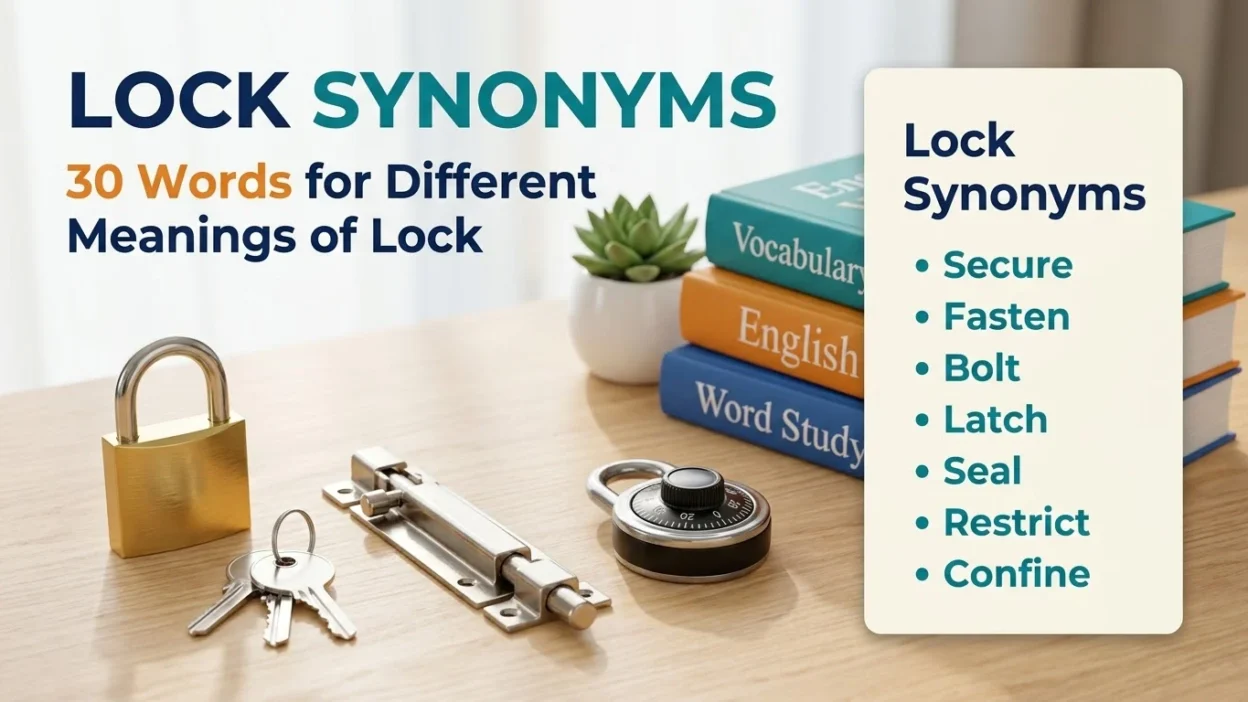
The keyword lock synonyms can refer to several words used to describe securing something, fastening a door, preventing access, or keeping an object firmly in place. Choosing the right synonym depends on the situation, the intended meaning, and the tone of your writing.
If you are a student, ESL learner, writer, or content creator, learning synonyms for “lock” can help you express ideas more clearly. For example, you might use secure when protecting a door, fasten when attaching two objects, or seal when closing something tightly.
In this guide, you will discover 30 synonyms for “lock,” with simple definitions, example sentences, and practical usage notes. You will also learn how to choose the best alternative for different contexts, from everyday conversation to formal writing.
What Does “Lock” Mean?
The word lock can function as both a noun and a verb.
As a verb, it usually means to secure something so that it cannot be opened, moved, or accessed without permission or a key. For example, “Please lock the door before leaving.”
As a noun, a lock is a device used to secure a door, gate, box, or other object. The word can also refer to a section of hair, a mechanism that controls access, or a device used to control the movement of water through a canal.
Tone and usage: “Lock” is a common, neutral word suitable for everyday conversations, instructions, professional communication, and creative writing. Its synonyms vary depending on if you mean securing, fastening, closing, restricting, or physically joining something.
30 Synonyms for Lock With Meanings and Examples
The following words are useful alternatives to “lock.” Some are direct synonyms, while others fit specific situations.
1. Secure
Meaning: To make something safe or protected from unauthorized access.
Example: Please secure the office before going home.
Best usage: Use “secure” when emphasizing safety, protection, or preventing unauthorized entry.
2. Fasten
Meaning: To attach or close something firmly.
Example: Fasten the gate before the animals leave the field.
Best usage: Best for gates, straps, belts, buttons, and objects that need to be held together.
3. Bolt
Meaning: To secure a door or gate using a metal bar or sliding fastening device.
Example: She bolted the back door before going to bed.
Best usage: Use “bolt” when a door or gate is secured with a bolt.
4. Latch
Meaning: To close or secure something using a fastening mechanism.
Example: Remember to latch the garden gate.
Best usage: Common for gates, cupboards, doors, and small enclosures.
5. Seal
Meaning: To close something tightly so that it cannot be opened easily or nothing can pass through.
Example: The workers sealed the storage room after the inspection.
Best usage: Ideal for containers, packages, rooms, and openings that need to remain closed.
6. Close
Meaning: To move something into a position that blocks an opening.
Example: Close the door when you leave the room.
Best usage: Use when the main idea is shutting something, even if no locking mechanism is involved.
7. Shut
Meaning: To close an opening or entrance.
Example: He shut the cabinet after taking out the dishes.
Best usage: A simple, conversational alternative to “close.” It does not necessarily mean securing something with a lock.
8. Bar
Meaning: To block an entrance or prevent access, often with a physical barrier.
Example: The caretaker barred the entrance to keep visitors out.
Best usage: Suitable for doors, windows, entrances, and situations involving restricted access.
9. Immobilize
Meaning: To prevent something from moving.
Example: The mechanic immobilized the vehicle during the repair.
Best usage: Use when locking or securing something means stopping its movement.
10. Restrain
Meaning: To hold something back or prevent it from moving freely.
Example: The safety strap restrained the equipment during transport.
Best usage: Appropriate for controlling movement, limiting freedom, or holding something in place.
11. Confine
Meaning: To keep someone or something within a limited area.
Example: The keeper confined the animals to a secure enclosure.
Best usage: Use when the focus is on keeping someone or something inside a particular space.
12. Restrict
Meaning: To limit access, movement, or freedom.
Example: The administrator restricted access to the private files.
Best usage: Useful in formal, technical, and professional writing.
13. Block
Meaning: To stop movement or prevent access.
Example: A fallen tree blocked the entrance to the property.
Best usage: Best when something physically or figuratively prevents entry or movement.
14. Barred
Meaning: Prevented from entering or accessing something.
Example: Unauthorized visitors were barred from the building.
Best usage: Use when describing denied access rather than the act of using a lock.
15. Fasten down
Meaning: To secure something firmly so it cannot move easily.
Example: They fastened down the equipment before the truck departed.
Best usage: Suitable for cargo, machinery, furniture, and items that need extra stability.
16. Clamp
Meaning: To hold something tightly using a device.
Example: He clamped the metal pieces together before welding them.
Best usage: Common in construction, workshops, manufacturing, and mechanical tasks.
17. Bolt down
Meaning: To attach something firmly using bolts.
Example: The team bolted down the heavy machine to the floor.
Best usage: Best for machinery, furniture, fixtures, and equipment that must remain in place.
18. Chain
Meaning: To secure something with a chain.
Example: She chained her bicycle to the rack outside the library.
Best usage: Useful for bicycles, gates, equipment, and other items secured with a chain.
19. Padlock
Meaning: To secure something using a portable lock.
Example: They padlocked the storage shed overnight.
Best usage: Use when a separate, portable lock is specifically involved.
20. Latch up
Meaning: To close or secure something with a latch.
Example: He latched up the shed before leaving.
Best usage: Suitable for informal descriptions of securing a gate, shed, or similar structure.
21. Enclose
Meaning: To surround or place something within a boundary.
Example: A tall fence enclosed the playground.
Best usage: Use when the goal is to surround or contain something rather than lock a door directly.
22. Securely fasten
Meaning: To attach or close something firmly and safely.
Example: Securely fasten the lid before carrying the container.
Best usage: Helpful in instructions, safety guidance, and formal writing.
23. Bolt shut
Meaning: To close and secure something with a bolt.
Example: The shopkeeper bolted the rear entrance shut.
Best usage: Best when describing a door or entrance secured with a bolt.
24. Seal off
Meaning: To close an area or prevent people from entering it.
Example: Police sealed off the street during the investigation.
Best usage: Common in emergencies, construction, investigations, and restricted areas.
25. Shut off
Meaning: To stop the flow or operation of something, or isolate an area.
Example: The technician shut off the water supply before repairing the pipe.
Best usage: Use for utilities, machinery, and systems. It is not a direct synonym for locking a door.
26. Engage
Meaning: To connect or activate a mechanism so it functions.
Example: Make sure the safety lock engages before using the machine.
Best usage: Appropriate for technical instructions and mechanical systems.
27. Immobilize securely
Meaning: To prevent something from moving by securing it firmly.
Example: The crew immobilized the equipment securely during transit.
Best usage: Useful in technical writing, transportation, and safety instructions.
28. Anchor
Meaning: To fix something firmly in place.
Example: They anchored the cabinet to the wall to prevent it from tipping.
Best usage: Best when stability and resistance to movement are more important than preventing access.
29. Fix
Meaning: To attach or hold something in a particular position.
Example: The technician fixed the panel in place before closing the housing.
Best usage: A broad, simple word for attaching or positioning something securely.
30. Guard
Meaning: To protect something from danger, damage, or unauthorized access.
Example: Security staff guarded the entrance throughout the night.
Best usage: Use when protection is the main idea, rather than physically fastening a lock.
Comparison Table: Which Lock Synonym Should You Use?
Different synonyms express different actions. Use this table to find the most suitable word for your sentence.
| Synonym | Main meaning | Best context |
|---|---|---|
| Secure | Protect or make safe | Homes, offices, property |
| Fasten | Attach firmly | Belts, straps, gates |
| Bolt | Secure with a bolt | Doors and gates |
| Latch | Close with a latch | Cupboards and gates |
| Seal | Close tightly | Packages, rooms, containers |
| Restrict | Limit access or movement | Accounts, permissions, rules |
| Confine | Keep within boundaries | Enclosures and limited spaces |
| Immobilize | Stop movement | Vehicles and machinery |
| Clamp | Hold tightly | Workshops and construction |
| Chain | Secure with a chain | Bikes and outdoor equipment |
| Padlock | Secure with a portable lock | Sheds, lockers, gates |
| Block | Prevent access or movement | Entrances and pathways |
| Enclose | Surround within a boundary | Fenced areas and spaces |
| Anchor | Fix firmly in place | Furniture and equipment |
| Guard | Protect or watch over | Entrances, people, property |
Quick Examples
- For a door: Bolt, latch, secure, or lock.
- For a bicycle: Chain or secure.
- For a computer account: Restrict or secure.
- For a package: Seal or fasten.
- For heavy machinery: Clamp, anchor, or bolt down.
- For an entrance during an emergency: Block or seal off.
Remember that these words are not interchangeable in every situation. For example, you can seal an envelope, but you would not normally say you bolted an envelope.
Different Meanings of “Lock”
The word “lock” has several meanings beyond securing a door. Understanding these meanings will help you choose more accurate synonyms.
Lock as a Security Device
A lock is a mechanism that prevents unauthorized access.
Example: “The lock on the front door is broken.”
Related words include latch, bolt, padlock, and fastening. These words refer to different types of securing mechanisms, so the best choice depends on the device.
Lock as an Action
As a verb, “lock” means to secure something or prevent access.
Example: “Please lock the cabinet.”
Suitable alternatives include secure, bolt, latch, and fasten, depending on how the object is secured.
Lock as Restricted Access
“Lock” can also describe limiting access to information, accounts, or systems.
Example: “The company locked the account after several failed login attempts.”
In this context, restrict, disable, or secure may communicate the intended meaning more clearly.
Lock as a Section of Hair
A “lock” can mean a strand or curl of hair.
Example: “A lock of hair fell across her forehead.”
Related words include strand, tress, and curl. These are synonyms for this particular meaning, not for a security device.
Lock in Waterways
A lock is a structure that raises or lowers boats between sections of a canal or river with different water levels.
Example: “The boat entered the canal lock.”
In this specialized context, there may be no suitable direct synonym. It is usually best to retain the word “lock” or explain its function.
How to Choose the Right Synonym for Lock
The best synonym depends on what you want to communicate. Consider the action, object, and tone before replacing “lock” in a sentence.
1. For Everyday Conversation
Choose simple words that readers understand immediately.
- Close: Shut an opening.
- Fasten: Attach or secure something.
- Latch: Secure something with a latch.
- Secure: Make something safe.
Example: “Please secure the gate before you leave.”
2. For Formal or Professional Writing
Choose words that describe the exact action or purpose.
- Restrict: Limit access or permissions.
- Secure: Protect property, systems, or information.
- Confine: Keep something within a defined area.
- Seal off: Prevent access to an area.
Example: “The administrator restricted access to confidential records.”
3. For Technical or Mechanical Writing
Use specific terms that identify how an object is held or secured.
- Clamp: Hold tightly with a clamping device.
- Anchor: Fix firmly in position.
- Bolt down: Attach using bolts.
- Engage: Activate or connect a mechanism.
Example: “Anchor the equipment before operating the machine.”
4. For Safety and Security
Select words that emphasize protection or prevention.
- Secure: Protect against unauthorized access.
- Guard: Protect or watch over something.
- Bar: Prevent entry.
- Chain: Secure with a chain.
Example: “Security staff guarded the entrance during the event.”
5. For Creative Writing
Choose words that create a clear picture in the reader’s mind.
- Bolt: Suggests a firm, decisive action.
- Seal: Emphasizes closure or isolation.
- Confine: Suggests limited freedom or space.
- Bar: Creates a sense of blocked access.
Example: “She bolted the old wooden door as the storm approached.”
6. For Describing Hair
When “lock” refers to hair, use alternatives that match the appearance and context.
- Strand: A single thin piece of hair.
- Tress: A long or flowing section of hair.
- Curl: Hair shaped into a curved coil.
Example: “A golden strand of hair rested on her shoulder.”
Common Mistakes When Using Lock Synonyms
Even words with similar meanings can create different impressions. Avoid these common mistakes when writing.
Using “close” when you mean “lock.” Closing a door does not necessarily secure it. Use “lock” or “bolt” when the door must remain secured.
Using “seal” for every type of lock. Sealing often suggests preventing air, water, or access from passing through. It does not always mean using a locking mechanism.
Confusing “restrict” with “secure.” Restricting access limits who can enter or use something. Securing something protects it from unauthorized access or other risks.
Using “confine” as a direct replacement for “lock.” Confine emphasizes keeping someone or something within boundaries. It does not necessarily describe a physical lock.
Ignoring context. A synonym that works for a door may not work for hair, software, or machinery. Always consider the intended meaning before selecting an alternative.
FAQs:
1. What is the most common synonym for lock?
Secure is one of the most versatile alternatives when “lock” means protecting something or preventing unauthorized access. Other common choices include bolt, latch, and fasten.
2. What is another word for locking a door?
You can use bolting, latching, or securing a door. The best word depends on the mechanism used.
3. What is a formal synonym for lock?
Secure, restrict, and immobilize can work in formal writing, depending on the meaning. For example, “restrict access” is appropriate when describing permissions.
4. What is the difference between lock and secure?
“Lock” often describes using a locking mechanism. “Secure” has a broader meaning and can refer to protecting something through locks, barriers, fastenings, or other safety measures.
5. What is another word for a lock of hair?
Depending on the context, you can use strand, tress, or curl. A strand is a thin piece of hair, while a tress usually refers to a longer or more noticeable section.
6. Are lock synonyms interchangeable?
No. Some synonyms describe physical mechanisms, while others describe protection, restriction, or closure. Choose a word that matches the precise meaning of your sentence.
Conclusion
Learning lock synonyms helps you express ideas more precisely in everyday conversation, academic work, technical instructions, and creative writing. Words such as secure, bolt, latch, fasten, and seal can describe different ways of closing or protecting something, while restrict, confine, and immobilize focus on limiting access or movement.
The key is to understand the context before choosing an alternative. A door may be bolted, an account may be restricted, a package may be sealed, and a bicycle may be chained. Selecting the right word makes your writing clearer, more natural, and easier to understand.

Henry Isaac is an author at BibleL Says, a platform dedicated to explaining Bible meanings simply. He writes clear, insightful articles to help readers understand scripture and spiritual concepts easily.