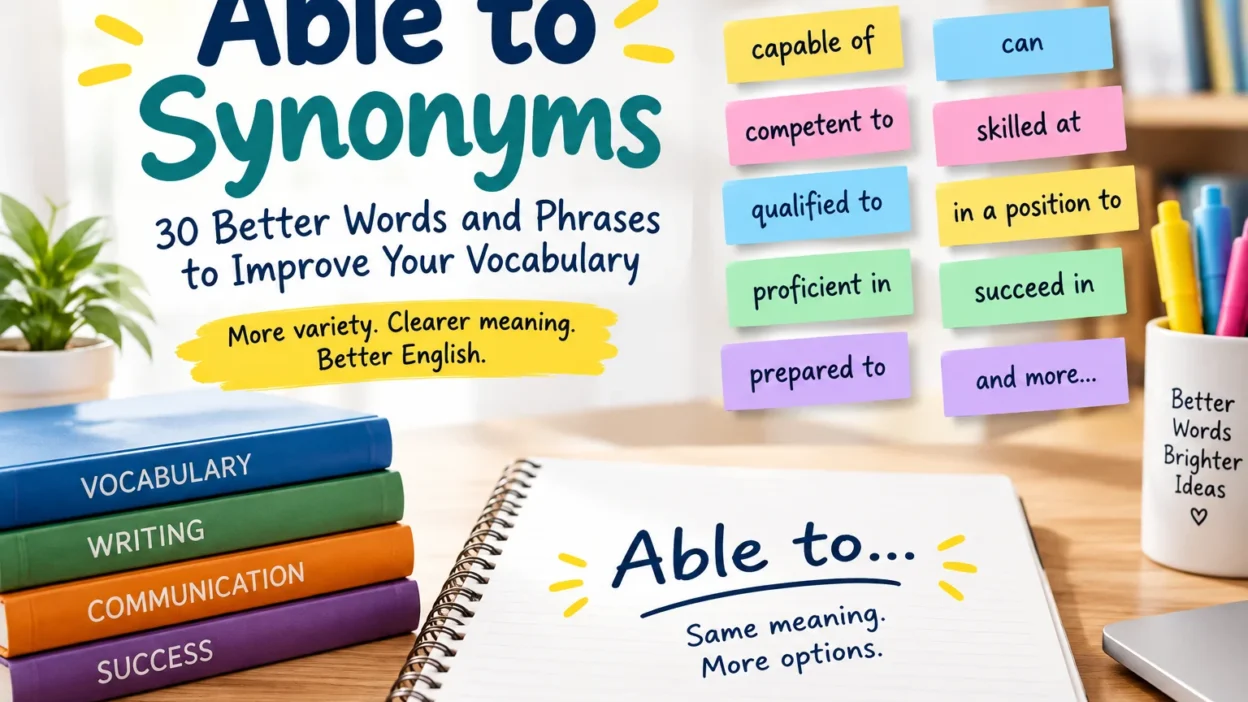
The phrase “able to” is commonly used in English to describe having the skill, power, opportunity, or capacity to do something. If you are writing an essay, preparing a professional email, or improving your everyday communication, learning synonyms for “able to” can help you express your ideas more clearly and naturally.
Although “able to” is a simple phrase, repeating it too often can make your writing sound less interesting. Using alternatives such as capable of, competent to, qualified to, or in a position to can make your sentences more precise, depending on the situation.
This guide explores 30 synonyms and alternative expressions for “able to,” with simple definitions, example sentences, and practical usage notes. It is designed for students, ESL learners, writers, and anyone who wants to build a stronger English vocabulary.
What Does “Able To” Mean?
Able to means having the ability, skill, strength, or opportunity to do something. It indicates that someone or something can perform an action.
For example:
- She is able to solve difficult problems.
- They were able to finish the project on time.
- I will be able to attend the meeting tomorrow.
The phrase can describe physical ability, mental skills, permission in some contexts, or a particular opportunity to complete an action.
Tone and Usage Context
“Able to” is a neutral expression. It works well in everyday conversations, academic writing, business communication, and professional documents.
However, the best alternative depends on what you want to communicate. For example, capable of emphasizes ability, qualified to emphasizes training or credentials, and managed to suggests successfully doing something difficult.
30 Synonyms for Able To
Below are 30 useful synonyms and alternative phrases for “able to,” along with their meanings, example sentences, and best usage contexts.
1. Capable of
Meaning: Having the ability or potential to do something.
Example: She is capable of managing a large team.
Best usage: Use it to describe someone’s skills, potential, or capacity.
2. Can
Meaning: Having the ability or opportunity to do something.
Example: I can speak three languages.
Best usage: Best for everyday conversation and simple, direct sentences.
3. Competent to
Meaning: Having enough skill or knowledge to perform a task.
Example: He is competent to handle the assignment independently.
Best usage: Useful in professional, academic, or formal settings.
4. Qualified to
Meaning: Having the necessary training, experience, or credentials.
Example: She is qualified to teach English at the school.
Best usage: Use it when education, certification, or professional requirements matter.
5. Skilled at
Meaning: Having the ability to do something well.
Example: He is skilled at solving technical problems.
Best usage: Ideal for describing practical abilities and professional strengths. It is usually followed by a noun or an -ing verb.
6. Proficient in
Meaning: Being good at a particular activity or subject.
Example: She is proficient in using spreadsheet software.
Best usage: Best for technical skills, languages, and workplace qualifications.
7. Equipped to
Meaning: Having the necessary tools, knowledge, or resources to do something.
Example: The team is equipped to handle unexpected challenges.
Best usage: Use it when preparation, resources, or training makes an action possible.
8. Prepared to
Meaning: Being ready to do something.
Example: We are prepared to discuss the new proposal.
Best usage: Appropriate when readiness is more important than natural ability.
9. Ready to
Meaning: Being prepared or willing to begin an action.
Example: The students are ready to take the examination.
Best usage: Best for everyday conversation, instructions, and situations involving readiness.
10. In a position to
Meaning: Having the circumstances, authority, or opportunity to do something.
Example: The manager is in a position to approve the request.
Best usage: Useful in business, formal writing, and discussions about authority or opportunity.
11. In a position of being able to
Meaning: Having the circumstances necessary to perform an action.
Example: With the new equipment, we are in a position of being able to complete the work faster.
Best usage: This is a wordy alternative. In most situations, simply use in a position to.
12. Have the ability to
Meaning: Possessing the skill or capacity needed for an action.
Example: Every student should have the ability to express ideas clearly.
Best usage: Useful in educational, explanatory, and professional writing.
13. Have the capacity to
Meaning: Having the mental, physical, or practical capability to do something.
Example: The organization has the capacity to support more families.
Best usage: Best for discussing potential, resources, organizations, or large-scale tasks.
14. Have the skill to
Meaning: Possessing a specific skill required for an activity.
Example: She has the skill to create effective marketing campaigns.
Best usage: Use it when emphasizing a learned or developed skill.
15. Have what it takes to
Meaning: Having the qualities or abilities needed to succeed.
Example: He has what it takes to become an excellent leader.
Best usage: Ideal for motivational writing and informal conversations about success.
16. Manage to
Meaning: To succeed in doing something, often despite difficulty.
Example: We managed to finish the report before the deadline.
Best usage: Use it when someone successfully completes a challenging task.
17. Succeed in
Meaning: To achieve a desired result.
Example: She succeeded in completing the course.
Best usage: Appropriate for achievements and results. It is generally followed by a noun or an -ing verb.
18. Be in a position to do
Meaning: To have the opportunity, authority, or circumstances to act.
Example: The company is in a position to expand its services.
Best usage: Useful for business decisions, formal statements, and discussions of opportunity.
19. Be free to
Meaning: Having permission or freedom to do something.
Example: You are free to ask questions at any time.
Best usage: Best when permission or freedom is the main idea rather than skill.
20. Be permitted to
Meaning: Having official or accepted permission to do something.
Example: Visitors are permitted to enter the building after registration.
Best usage: Suitable for formal rules, policies, and official instructions.
21. Be allowed to
Meaning: Having permission to do something.
Example: Employees are allowed to work remotely on Fridays.
Best usage: Common in everyday English and workplace communication.
22. Be competent in
Meaning: Having adequate knowledge or ability in a particular area.
Example: He is competent in basic computer operations.
Best usage: Best for evaluating skills, workplace performance, or subject knowledge.
23. Be adept at
Meaning: Being very good at doing something.
Example: She is adept at explaining complex concepts simply.
Best usage: A polished alternative for professional and academic writing.
24. Be proficient at
Meaning: Being skilled and effective at a particular activity.
Example: He is proficient at editing videos.
Best usage: Useful for describing developed practical skills. Proficient in is also common, particularly for subjects and technical areas.
25. Be up to the task
Meaning: Having the ability and readiness to complete a particular job.
Example: Despite the tight schedule, our team is up to the task.
Best usage: Ideal for encouraging someone or expressing confidence in a team’s ability.
26. Be fit to
Meaning: Being suitable or capable enough for a particular role or purpose.
Example: She is fit to lead the project after years of experience.
Best usage: Use it when suitability or readiness is being assessed. In some contexts, fit to can also mean healthy enough.
27. Be qualified for
Meaning: Having the qualifications needed for a role or opportunity.
Example: He is qualified for the senior engineering position.
Best usage: Best when discussing eligibility for a job, role, or opportunity. Unlike qualified to, it is commonly followed by a noun.
28. Be strong enough to
Meaning: Having sufficient physical or emotional strength to do something.
Example: She was strong enough to carry the heavy box.
Best usage: Use it when strength or resilience makes an action possible.
29. Be effective at
Meaning: Being able to produce good results in an activity.
Example: The new supervisor is effective at resolving conflicts.
Best usage: Best for describing performance and the ability to achieve results.
30. Be successful in
Meaning: Achieving a positive outcome in an activity.
Example: They were successful in negotiating a better agreement.
Best usage: Appropriate for achievements, professional reports, and formal writing.
Comparison Table: Which Synonym Should You Use?
Not every alternative to “able to” means exactly the same thing. Use this table to choose a phrase that matches your intended meaning.
| Synonym or phraseMain meaningBest context | ||
|---|---|---|
| Can | General ability | Everyday English |
| Capable of | Ability or potential | General and professional writing |
| Qualified to | Training or credentials | Jobs and professions |
| Proficient in | Strong skill | Technical or academic writing |
| Competent to | Adequate ability | Formal communication |
| Equipped to | Having resources | Projects and organizations |
| Prepared to | Being ready | Plans and decisions |
| In a position to | Opportunity or authority | Business communication |
| Managed to | Success despite difficulty | Personal experiences |
| Succeed in | Achieving a result | Academic and professional writing |
| Be allowed to | Permission | Everyday English and rules |
| Be adept at | High skill | Professional descriptions |
| Be up to the task | Readiness and ability | Encouragement and teamwork |
| Have the capacity to | Practical or mental potential | Reports and analysis |
| Have what it takes to | Qualities for success | Motivational writing |
How to Choose the Right Synonym for Able To
Choosing the right synonym is easier when you identify the meaning you want to express.
1. To Describe General Ability
Use can, capable of, or have the ability to when talking about what a person can do.
Examples:
- I can solve this problem.
- She is capable of working independently.
- He has the ability to learn new skills quickly.
These expressions work well in everyday conversations, school assignments, and general writing.
2. To Describe Professional Skills
Use proficient in, skilled at, adept at, or competent in when discussing expertise or workplace abilities.
Examples:
- She is proficient in graphic design.
- He is skilled at negotiating contracts.
- They are adept at managing complex projects.
These alternatives are especially useful for resumes, professional biographies, and job applications.
3. To Describe Qualifications
Use qualified to or qualified for when someone meets the requirements for a role or task.
Examples:
- She is qualified to teach mathematics.
- He is qualified for the position.
Remember that being able to perform a task and being formally qualified to perform it are not always the same thing.
4. To Describe Readiness
Use ready to, prepared to, or equipped to when someone has what they need to begin an action.
Examples:
- We are ready to launch the website.
- The team is prepared to answer questions.
- The staff is equipped to handle emergencies.
These expressions focus on preparation rather than ability alone.
5. To Describe Success After Difficulty
Use managed to or succeeded in when the action has already been completed successfully.
Examples:
- I managed to catch the last bus.
- She succeeded in completing her research.
These phrases are particularly helpful when describing achievements or overcoming obstacles.
6. To Describe Permission or Opportunity
Use be allowed to, be permitted to, or be in a position to when permission, freedom, or circumstances make an action possible.
Examples:
- Students are allowed to use the library.
- Visitors are permitted to enter after checking in.
- The director is in a position to approve the budget.
Choose the phrase carefully because permission and ability have different meanings.
Common Mistakes When Using Synonyms for Able To
Even when two expressions seem similar, they may follow different grammatical patterns.
1. Using the wrong verb form
Incorrect: She is capable to solve the problem.
Correct: She is capable of solving the problem.
Use capable of followed by a noun or an -ing verb.
2. Confusing skills with qualifications
Incorrect: He is qualified to the job.
Correct: He is qualified for the job.
Use qualified for before a role or position, and qualified to before an action.
3. Confusing ability with permission
“I can leave early” may express ability or permission depending on context. “I am allowed to leave early” specifically emphasizes permission.
4. Using formal words in casual conversation
Words such as competent, proficient, and adept can sound formal. In everyday conversations, can or good at may sound more natural.
5. Ignoring the tense
The phrase “able to” can be used in different tenses:
- Present: I am able to help.
- Past: I was able to help.
- Future: I will be able to help.
Choose a synonym that preserves the original meaning and time frame.
FAQs:
1. What is the best synonym for able to?
Capable of is a useful alternative when describing someone’s ability or potential. However, can is often the simplest choice in everyday English.
2. What is a formal synonym for able to?
Formal alternatives include competent to, proficient in, qualified to, and in a position to. The best option depends on if you mean skill, credentials, or opportunity.
3. What is another word for able to in academic writing?
Academic writing often benefits from phrases such as capable of, have the capacity to, and be proficient in. Use the phrase that accurately expresses the intended meaning.
4. Is capable of the same as able to?
They are similar, but their grammar differs. “Able to complete the task” becomes “capable of completing the task.” The word capable is followed by of and usually an -ing verb.
5. What is a simple alternative to able to?
The word can is the simplest alternative in many sentences. For example, “I am able to swim” can become “I can swim.”
6. Can I use managed to instead of able to?
Sometimes. “I was able to finish the report” and “I managed to finish the report” can both describe a completed action. However, managed to often suggests that completing it required effort or overcame a difficulty.
Conclusion
Learning synonyms for “able to” can make your English more precise, natural, and engaging. Although can and capable of work in many situations, other expressions communicate more specific meanings.
Choose qualified to when credentials matter, proficient in when describing skills, prepared to when emphasizing readiness, and managed to when describing success despite difficulty.
The most important rule is to consider the context, grammar, and meaning before replacing a phrase. A well-chosen synonym improves clarity without making your writing unnecessarily complicated.

Henry Isaac is an author at BibleL Says, a platform dedicated to explaining Bible meanings simply. He writes clear, insightful articles to help readers understand scripture and spiritual concepts easily.