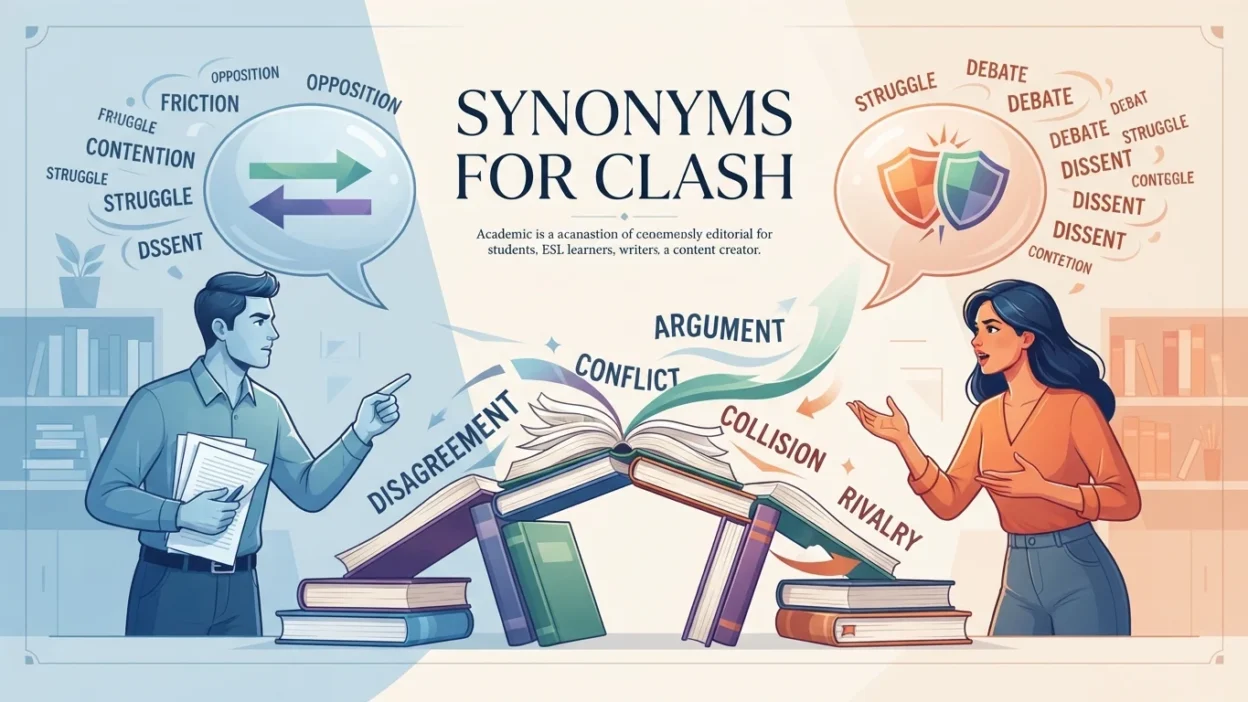
Finding the right synonyms for clash can make your writing clearer, more precise, and more interesting. The word clash can describe a physical fight, a disagreement, a conflict between ideas, or even colors and styles that do not look good together.
If you are a student, ESL learner, writer, or content creator, understanding the small differences between synonyms can help you choose the perfect word for each situation. For example, conflict sounds more serious than disagreement, while collide is usually used for physical objects.
This guide explains 30 useful synonyms for clash in simple English. Each word includes an easy meaning, an example sentence, and the best context for using it.
What Does “Clash” Mean?
Clash means to come into conflict, disagreement, or physical contact with something or someone.
It can be used in several ways:
- People: Two people clash because they strongly disagree.
- Groups: Two teams or groups may clash during a dispute.
- Objects: Two vehicles can clash or collide.
- Ideas: Two opinions may clash because they are very different.
- Colors: Bright colors can clash when they do not look good together.
Example:
The two politicians clashed over the new education policy.
What Does “Demure” Mean?
Demure is an adjective that describes someone who is quiet, modest, reserved, and not likely to attract attention.
A demure person may behave politely and calmly, especially in social situations. The word often describes someone’s appearance, manner, or behavior.
Example:
She gave a demure smile when everyone complimented her dress.
Tone and Usage of “Demure”
Demure usually has a gentle, polite, or slightly old-fashioned tone. It is often used in descriptions of someone’s behavior, clothing, or appearance.
It is not a synonym for clash. The word is included here because understanding unrelated vocabulary can sometimes help learners distinguish words with very different meanings.
30 Synonyms for Clash
Below are 30 useful alternatives to clash. Some describe disagreement, while others describe physical impact or incompatibility.
1. Conflict
Meaning: A serious disagreement or struggle between people, groups, or ideas.
Example:
The two departments are in conflict over the budget.
Best usage: Formal writing, serious disagreements, politics, business, and social issues.
2. Dispute
Meaning: An argument or disagreement about something.
Example:
The neighbors had a dispute about the property boundary.
Best usage: Formal and semi-formal situations involving a specific issue.
3. Disagreement
Meaning: A situation where people have different opinions.
Example:
They had a disagreement about how to solve the problem.
Best usage: Everyday English and general writing.
4. Argument
Meaning: A conversation in which people express opposing opinions, often angrily.
Example:
The couple had an argument about their vacation plans.
Best usage: Everyday conversations and personal conflicts.
5. Fight
Meaning: A physical or verbal struggle between people.
Example:
The two players got into a fight after the match.
Best usage: Informal English, especially for physical or heated conflicts.
6. Confrontation
Meaning: A direct and sometimes aggressive meeting between opposing people or groups.
Example:
The meeting ended in a confrontation between the two leaders.
Best usage: Serious or tense situations.
7. Altercation
Meaning: A short, angry argument or physical fight.
Example:
Police arrived after an altercation outside the restaurant.
Best usage: Formal reporting, news, and descriptions of public incidents.
8. Feud
Meaning: A long-lasting and bitter disagreement between people or groups.
Example:
The two families have been involved in a feud for years.
Best usage: Long-term personal, family, political, or social conflicts.
9. Struggle
Meaning: A difficult fight or effort against something or someone.
Example:
The workers struggled with management over their new contracts.
Best usage: Difficult situations, social issues, personal challenges, and competition.
10. Friction
Meaning: Tension or disagreement between people.
Example:
There has been friction between the two teams since the project began.
Best usage: Workplace, relationships, and situations involving ongoing tension.
11. Tension
Meaning: A feeling of stress or conflict between people or groups.
Example:
Tension grew between the two countries after the incident.
Best usage: Political, social, professional, and personal situations.
12. Opposition
Meaning: Strong disagreement with or resistance to something.
Example:
The proposal faced strong opposition from local residents.
Best usage: Politics, public decisions, organizations, and formal writing.
13. Resistance
Meaning: The act of refusing to accept or follow something.
Example:
The new policy met resistance from employees.
Best usage: Policies, changes, authority, and social movements.
14. Hostility
Meaning: Unfriendly, angry, or aggressive behavior.
Example:
The discussion was filled with hostility.
Best usage: Serious conflicts where anger or aggression is present.
15. Contention
Meaning: Strong disagreement or an issue that causes an argument.
Example:
The main point of contention was the cost of the project.
Best usage: Formal, academic, legal, and professional writing.
16. Rivalry
Meaning: Competition between people or groups who want to achieve the same goal.
Example:
The rivalry between the two schools has lasted for decades.
Best usage: Sports, business, education, and competition.
17. Contest
Meaning: A competition or struggle between opposing sides.
Example:
The election became a close contest between the two candidates.
Best usage: Competitions, elections, sports, and formal challenges.
18. Brawl
Meaning: A noisy and physical fight involving several people.
Example:
A brawl broke out after the game.
Best usage: Informal descriptions of large or chaotic physical fights.
19. Skirmish
Meaning: A small or brief fight between opposing sides.
Example:
The soldiers were involved in a brief skirmish.
Best usage: Military, historical, political, or figurative writing.
20. Collide
Meaning: To hit another person or object with force.
Example:
The two cars collided at the intersection.
Best usage: Vehicles, objects, people, and physical contact.
21. Collision
Meaning: An accident or event in which two things hit each other.
Example:
The collision damaged both vehicles.
Best usage: Traffic accidents, physics, sports, and technical writing.
22. Conflict
Meaning: A situation where two things cannot easily exist together or agree.
Example:
Their schedules conflict with each other.
Best usage: People, ideas, schedules, interests, and formal writing.
23. Contradict
Meaning: To say or show that something is not true or does not agree with another statement.
Example:
His explanation contradicts the evidence.
Best usage: Ideas, statements, evidence, and arguments.
24. Disagree
Meaning: To have a different opinion from someone else.
Example:
I disagree with her conclusion.
Best usage: Everyday English, discussions, essays, and professional communication.
25. Oppose
Meaning: To disagree with or actively resist something.
Example:
Many residents oppose the construction project.
Best usage: Policies, decisions, proposals, and formal discussions.
26. Compete
Meaning: To try to win or achieve something against another person or group.
Example:
The companies compete for the same customers.
Best usage: Business, sports, education, and general competition.
27. Butt Heads
Meaning: To repeatedly disagree or argue with someone.
Example:
The two managers often butt heads over company policies.
Best usage: Informal conversations and casual writing.
28. Quarrel
Meaning: An angry disagreement or argument.
Example:
The brothers had a quarrel over the money.
Best usage: Personal disagreements, relationships, and everyday English.
29. Discord
Meaning: A lack of agreement or harmony.
Example:
Political discord affected the organization’s progress.
Best usage: Formal, literary, academic, and political writing.
30. Incompatibility
Meaning: A situation where two things do not work well together.
Example:
The disagreement revealed an incompatibility between their goals.
Best usage: Ideas, personalities, systems, technology, and relationships.
Quick Comparison: Which Synonym Should You Use?
| Synonym | Best meaning | Tone |
|---|---|---|
| Conflict | Serious disagreement | Formal |
| Dispute | Argument over an issue | Formal |
| Disagreement | Different opinions | Neutral |
| Argument | Verbal disagreement | Everyday |
| Fight | Physical or verbal struggle | Informal |
| Confrontation | Direct hostile encounter | Serious |
| Altercation | Short angry fight | Formal |
| Feud | Long-term bitter conflict | Strong |
| Friction | Ongoing tension | Neutral |
| Tension | Stress between sides | Neutral |
| Opposition | Resistance to something | Formal |
| Rivalry | Competitive relationship | Neutral |
| Brawl | Chaotic physical fight | Informal |
| Skirmish | Small fight | Formal/Literary |
| Collide | Physical impact | Neutral |
| Quarrel | Angry personal argument | Everyday |
| Discord | Lack of harmony | Formal |
How to Choose the Right Synonym
Choosing the best synonym for clash depends on what is happening, how serious it is, and the tone of your writing.
For Everyday Disagreements
Use:
- Disagreement
- Argument
- Quarrel
- Disagree
These words are natural in conversations and simple writing.
Example:
My friends had a disagreement about where to eat.
For Serious Conflicts
Use:
- Conflict
- Confrontation
- Hostility
- Contention
- Discord
These words work well when the disagreement is intense, important, or long-lasting.
Example:
The conflict between the two organizations continued for months.
For Long-Term Conflicts
Use:
- Feud
- Rivalry
- Friction
- Tension
These are useful when the problem continues over time.
Example:
The rivalry between the teams attracts thousands of fans.
For Physical Clashes
Use:
- Collide
- Collision
- Fight
- Brawl
- Skirmish
- Altercation
These words are better when people or objects physically come into contact or fight.
Example:
The two vehicles collided on the narrow road.
For Formal or Academic Writing
Choose:
- Conflict
- Dispute
- Opposition
- Contention
- Discord
- Resistance
These alternatives often sound more precise and professional than the informal word clash.
For Competition
Use:
- Rivalry
- Contest
- Competition
- Compete
These words are appropriate when opposing sides are trying to win rather than simply arguing.
Example:
The rivalry between the two companies has intensified.
Clash vs. Conflict
Although clash and conflict are often interchangeable, there is a slight difference.
Clash can suggest a noticeable or direct disagreement. It can also describe a physical meeting or things that do not match.
Conflict usually sounds broader and more serious. It can describe an ongoing struggle between people, groups, interests, or ideas.
Examples:
- The designers clashed over the new logo.
- The two countries were involved in a long conflict.
Clash vs. Disagreement
A disagreement is usually less serious than a clash.
If two people simply have different opinions, disagreement is a good choice.
If their opposing opinions create tension or a heated encounter, clash may be stronger.
Disagreement:
We had a disagreement about the schedule.
Clash:
We clashed over how the project should be managed.
Clash vs. Collide
These words are especially important for ESL learners.
Clash can describe conflict between people or ideas and sometimes physical contact.
Collide specifically focuses on physical things hitting one another.
Example:
The two cars collided at the crossing.
You would not normally replace collide with disagree, because the meanings are completely different.
Why Learning Synonyms for Clash Matters
Learning synonyms is more than memorizing a long list of words. It helps you communicate your exact meaning.
Instead of repeatedly writing clash, you can select a more precise word based on the situation.
For example:
- Use feud for a long-lasting personal conflict.
- Use rivalry for competitive relationships.
- Use collision for physical impact.
- Use dispute for a formal disagreement.
- Use friction for ongoing tension.
- Use brawl for a chaotic physical fight.
- Use discord for a lack of harmony.
This variety makes essays, articles, stories, and everyday communication sound more natural.
Final Thoughts
There are many useful synonyms for clash, but they are not all interchangeable. The best choice depends on the type of conflict, the level of seriousness, and the tone you want to create.
For everyday situations, disagreement, argument, quarrel, and disagree are simple choices. For serious situations, consider conflict, confrontation, dispute, or contention. For physical situations, collide, collision, brawl, and altercation may be more accurate.
The key is to focus on meaning rather than simply replacing one word with another. When you understand the differences between these alternatives, your vocabulary becomes more flexible, precise, and effective.

Henry Isaac is an author at BibleL Says, a platform dedicated to explaining Bible meanings simply. He writes clear, insightful articles to help readers understand scripture and spiritual concepts easily.