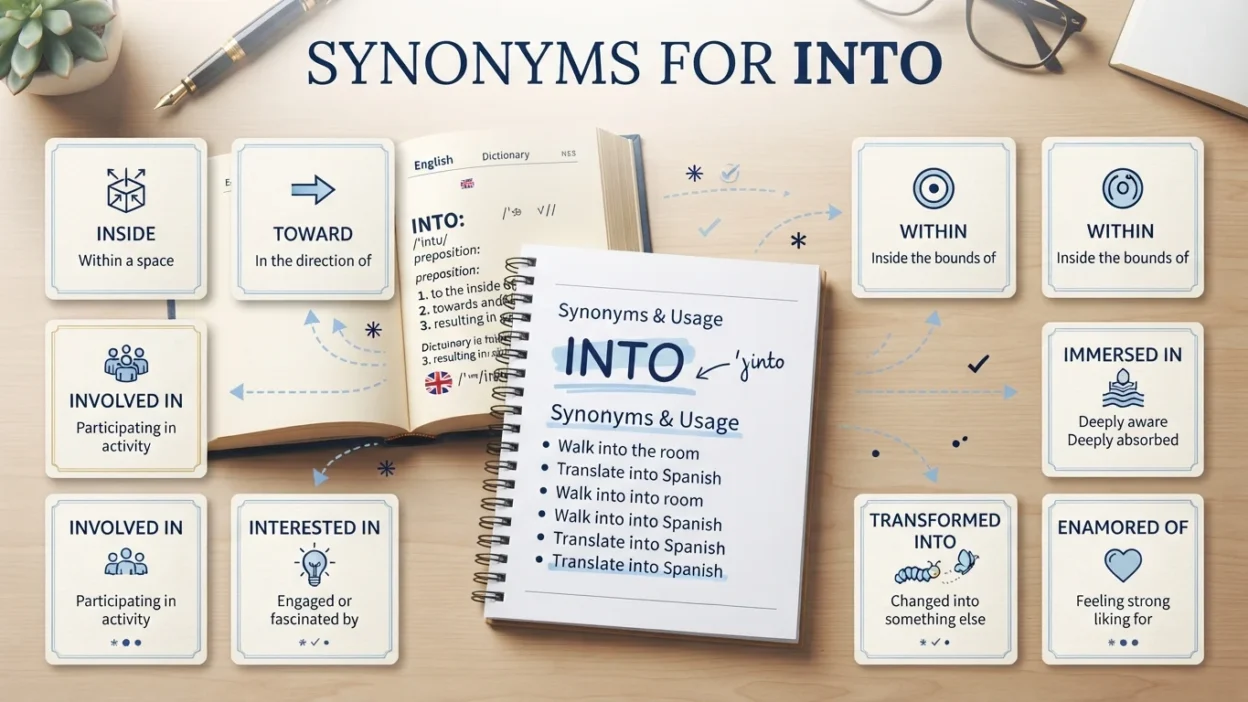
Finding the right synonyms for into can make your writing more precise, natural, and varied. The word “into” is a common English preposition, but its meaning changes depending on the sentence. It can show movement, involvement, interest, transformation, or a change from one state to another.
For students, ESL learners, writers, and content creators, understanding alternatives to “into” is useful because not every replacement works in every situation. Some alternatives describe physical movement, while others are better for interests, relationships, changes, or formal writing.
Unlike ordinary adjectives such as “demure,” into is a preposition with several different functions. Therefore, its synonyms are best understood as related words and phrases rather than exact replacements. The right alternative depends on what you want to express.
What Does “Into” Mean?
In simple English, into usually means moving toward and inside something.
Example:
- She walked into the room.
It can also describe becoming interested in something.
Example:
- He is really into photography.
Another common use is to describe a transformation or change.
Example:
- The caterpillar changed into a butterfly.
Because “into” has several meanings, its best alternative depends on the context.
30 Synonyms and Alternatives for Into
1. In
Meaning: Inside a place, area, or situation.
Example: She went in the house.
Best usage: Casual English when the meaning of movement inside is clear.
2. Inside
Meaning: Moving or being within something.
Example: The children ran inside the building.
Best usage: Physical locations where you want to emphasize the interior.
3. Within
Meaning: Inside the limits or boundaries of something.
Example: The information is stored within the database.
Best usage: Formal, academic, and professional writing.
4. Toward
Meaning: In the direction of something.
Example: He walked toward the door.
Best usage: Movement in a particular direction, especially when entering is not necessarily implied.
5. Towards
Meaning: Moving or progressing in the direction of something.
Example: She moved towards the entrance.
Best usage: British English and general descriptions of direction.
6. To
Meaning: Moving to a place or person.
Example: They went to the office.
Best usage: Simple descriptions of movement or destination.
7. Onto
Meaning: Moving to a position on a surface.
Example: The cat jumped onto the table.
Best usage: Movement that ends on top of something.
8. Among
Meaning: In the middle of or surrounded by several people or things.
Example: She walked among the trees.
Best usage: Movement or position within a group or collection.
9. Amid
Meaning: In the middle of something, especially a situation or group.
Example: He remained calm amid the confusion.
Best usage: Formal or literary writing.
10. Amidst
Meaning: Surrounded by or in the middle of something.
Example: The house stood amidst tall trees.
Best usage: Literary, descriptive, or slightly formal writing.
11. Through
Meaning: Moving from one side or part of something to another.
Example: We walked through the tunnel.
Best usage: Movement across an enclosed space or area.
12. Within the confines of
Meaning: Inside the limits of something.
Example: The work must be completed within the confines of the agreement.
Best usage: Formal and professional writing.
13. In the direction of
Meaning: Moving toward a particular place or object.
Example: The car moved in the direction of the city.
Best usage: Formal descriptions of direction.
14. Inward
Meaning: Toward the inside.
Example: The door opens inward.
Best usage: Describing movement toward an interior area.
15. Inwards
Meaning: Toward the inside.
Example: The walls slope inwards.
Best usage: British English and physical descriptions.
16. Into the interior of
Meaning: Moving toward the inside of something.
Example: The explorers traveled into the interior of the forest.
Best usage: Detailed or formal descriptions.
17. In the midst of
Meaning: In the middle of something.
Example: She found herself in the midst of a difficult discussion.
Best usage: Formal writing and descriptions of situations.
18. Involved in
Meaning: Taking part in something.
Example: He became involved in community projects.
Best usage: Activities, projects, organizations, and situations.
19. Engaged in
Meaning: Actively participating in something.
Example: The students were engaged in a group discussion.
Best usage: Academic, professional, and formal contexts.
20. Interested in
Meaning: Wanting to learn about or pay attention to something.
Example: She is interested in modern art.
Best usage: Hobbies, subjects, careers, and personal interests.
21. Enthusiastic about
Meaning: Very interested and excited about something.
Example: He is enthusiastic about learning languages.
Best usage: Strong positive interest.
22. Fond of
Meaning: Liking something or someone.
Example: She is fond of classical music.
Best usage: Personal preferences and gentle expressions of liking.
23. Passionate about
Meaning: Having very strong interest or feelings about something.
Example: They are passionate about environmental protection.
Best usage: Strong interests, causes, careers, and creative activities.
24. Absorbed in
Meaning: Completely focused on something.
Example: She was absorbed in her book.
Best usage: Situations where someone is deeply focused or occupied.
25. Immersed in
Meaning: Completely involved in an activity or experience.
Example: He became immersed in the study of history.
Best usage: Learning, work, creative activities, and experiences.
26. Converted to
Meaning: Changed from one form, system, or belief to another.
Example: The old factory was converted to a modern office.
Best usage: Physical, technical, organizational, or ideological changes.
27. Transformed into
Meaning: Changed completely into something different.
Example: The empty building was transformed into a community center.
Best usage: Major changes in appearance, purpose, or condition.
28. Changed into
Meaning: Became something different.
Example: The small stream changed into a wide river.
Best usage: Simple descriptions of transformation.
29. Developed into
Meaning: Gradually became something more advanced or different.
Example: The small business developed into a successful company.
Best usage: Gradual growth and development.
30. Evolved into
Meaning: Gradually changed into a new or more developed form.
Example: The project evolved into a larger initiative.
Best usage: Formal, academic, business, and developmental contexts.
Quick Comparison of Synonyms for Into
| Alternative | Main Meaning | Best Context |
|---|---|---|
| In | Inside | Everyday English |
| Inside | Within something | Physical locations |
| Within | Inside boundaries | Formal writing |
| Toward | In a direction | Movement |
| To | Destination | Everyday speech |
| Onto | To a surface | Physical movement |
| Among | Surrounded by several things | Groups or places |
| Amid | In the middle of | Formal writing |
| Through | From one side to another | Movement |
| Involved in | Taking part | Activities |
| Engaged in | Actively participating | Academic/work |
| Interested in | Having curiosity | Hobbies and subjects |
| Fond of | Liking | Personal preferences |
| Passionate about | Strong interest | Causes and interests |
| Immersed in | Deeply involved | Learning and experiences |
| Transformed into | Changed completely | Major changes |
| Changed into | Became different | Simple transformation |
| Developed into | Grew into something | Progress |
| Evolved into | Gradually became | Formal/developmental contexts |
Different Meanings of “Into”
One reason there are so many alternatives is that into does not have just one meaning.
Into for Physical Movement
When someone or something moves from outside to inside, “into” is very common.
Example:
- The teacher walked into the classroom.
Possible alternatives include in, inside, or within, depending on the sentence.
Into for Direction
Sometimes “into” describes movement toward a particular place or object.
Example:
- The car turned into the driveway.
In some sentences, toward, towards, or in the direction of may work, although the meaning can change slightly.
Into for Interest
In informal English, “into” can mean interested in or enthusiastic about something.
Example:
- My sister is really into photography.
Depending on the tone, you could say:
- My sister is interested in photography.
- My sister is passionate about photography.
- My sister is enthusiastic about photography.
- My sister is fond of photography.
These alternatives are not identical. “Passionate about” suggests stronger feelings than “interested in.”
Into for Transformation
“Into” is also used when one thing becomes another.
Example:
- The artist turned the old room into a studio.
Alternatives include changed into, transformed into, converted to, developed into, and evolved into.
How to Choose the Right Synonym
Choosing among synonyms for into becomes easier when you first identify the meaning of the original sentence.
For Physical Location
Use in, inside, or within when the focus is on being inside something.
- In — simple and natural
- Inside — emphasizes the interior
- Within — more formal
For Direction
Use toward, towards, to, or in the direction of when the main idea is movement.
- Toward — direction without necessarily reaching the destination
- To — destination
- In the direction of — formal and precise
For Participation
Use involved in or engaged in when “into” refers to taking part in something.
Example:
Instead of saying, “She got into the project,” you might write:
- She became involved in the project.
- She became engaged in the project.
For Interest
Use interested in, fond of, enthusiastic about, or passionate about.
The strength of feeling matters. “Interested in” is neutral, while “passionate about” expresses a much stronger level of interest.
For Deep Focus
Use absorbed in or immersed in when someone is deeply focused on an activity.
Example:
- He was absorbed in his research.
- She was immersed in the novel.
For Transformation
Use changed into, transformed into, converted to, developed into, or evolved into.
Choose according to the type of change:
- Changed into — general change
- Transformed into — significant or dramatic change
- Converted to — change of function, system, or form
- Developed into — gradual growth
- Evolved into — gradual development over time
Are These Exact Synonyms for “Into”?
Not always. This is an important point for ESL learners.
Words such as inside, toward, and within can sometimes replace “into,” but they do not have exactly the same meaning in every sentence. Other phrases, such as interested in or transformed into, replace a particular meaning or use of “into.”
For this reason, it is better to think of these words as context-based alternatives rather than universal synonyms.
Replacing a preposition without checking the meaning can make a sentence sound unnatural or change its meaning completely.
Common Examples Using Into and Its Alternatives
Physical movement:
- She walked into the kitchen.
- She went inside the kitchen.
Direction:
- He moved into the crowd.
- He moved toward the crowd.
Interest:
- She is into photography.
- She is interested in photography.
Participation:
- He got into the discussion.
- He became involved in the discussion.
Transformation:
- They turned the garage into an office.
- They converted the garage to an office.
Deep involvement:
- She was into her studies.
- She was immersed in her studies.
Why Learning Alternatives to Into Matters
Learning different expressions helps you avoid repetitive writing and communicate more precisely. This is especially useful for essays, articles, professional documents, creative writing, and everyday conversations.
For ESL learners, understanding the different meanings of “into” is particularly valuable. A single word can describe physical movement, direction, interest, participation, and transformation.
Instead of memorizing a long list, learn each alternative with its specific meaning and context. This approach makes it much easier to choose the correct expression naturally.
Final Thoughts
The best synonyms for into depend on what you want to say. For physical movement, alternatives such as in, inside, and within may be useful. For direction, toward, to, and in the direction of can work. For interest, expressions such as interested in, fond of, and passionate about are more precise.
When describing transformation, phrases such as changed into, transformed into, developed into, and evolved into provide different shades of meaning.
The key is not simply to replace “into” with another word. Instead, identify the intended meaning first, then choose the alternative that expresses that meaning most naturally. This will make your English clearer, more accurate, and more flexible.

Sarah Sophia is the administrator of Biblelsays.com, a platform dedicated to Bible meanings and explanations, where she helps manage content, organization, and educational resources for readers seeking spiritual understanding online.