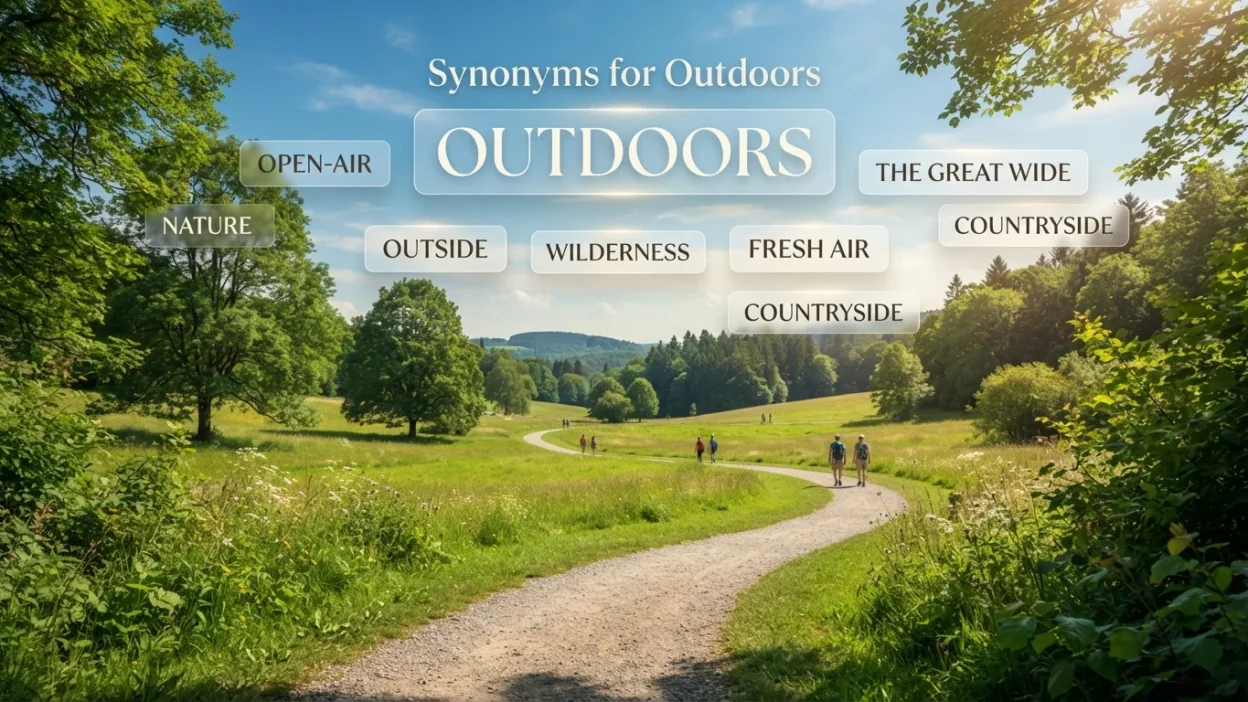
When you are looking for synonyms for outdoors, you may want a different word or phrase to describe being outside, open-air activities, nature, or an outdoor environment. Choosing the right alternative can make your writing clearer and more natural.
The word outdoors commonly refers to places or activities that happen outside rather than inside a building. Depending on your sentence, alternatives such as outside, open-air, in nature, or out-of-doors may fit better.
However, there is an important correction to the requested wording: “demure” is not a synonym for outdoors. Demure describes someone who is modest, reserved, or shy in behavior or appearance. Because your target keyword is synonyms for outdoors, the synonym list below focuses on outdoors rather than demure.
What Does “Outdoors” Mean?
Outdoors means being or happening outside, especially away from buildings or enclosed spaces.
Example:
“We spent the afternoon outdoors enjoying the fresh air.”
The word can describe both a physical location and an activity. For example, you can work outdoors, eat outdoors, or enjoy the outdoors.
30 Synonyms for Outdoors
| Word or PhraseSimple MeaningExample SentenceBest Usage Context | |||
|---|---|---|---|
| Outside | In or toward an area that is not indoors | “The children are playing outside.” | Everyday English |
| Open air | A place outside with natural air | “We had dinner in the open air.” | Dining and events |
| Out-of-doors | Outside, away from buildings | “They enjoy spending time out-of-doors.” | Formal or literary writing |
| In nature | In a natural environment | “She loves hiking in nature.” | Nature and travel |
| Al fresco | Outside, especially for eating | “We enjoyed an al fresco lunch.” | Dining and lifestyle |
| Open-air | Happening outside without an enclosed roof or space | “The town held an open-air concert.” | Events and entertainment |
| In the open | In an uncovered or exposed place | “The animals were kept in the open.” | Descriptive writing |
| Outside world | The world beyond an enclosed place | “He wanted to explore the outside world.” | General and figurative use |
| Natural environment | Surroundings found in nature | “The animals thrive in their natural environment.” | Academic writing |
| Natural surroundings | Nature around a person or place | “The cabin has beautiful natural surroundings.” | Travel and descriptive writing |
| Wilderness | Wild, undeveloped natural land | “They spent a week exploring the wilderness.” | Adventure and travel |
| Wild | Natural land not controlled or developed | “They enjoy walking in the wild.” | Nature writing |
| Countryside | Rural land away from cities | “We spent the weekend in the countryside.” | Travel and lifestyle |
| Landscape | The visible natural features of an area | “The surrounding landscape was beautiful.” | Descriptive writing |
| Nature | The natural world | “He enjoys spending time in nature.” | General use |
| Fresh air | Clean, natural air outside | “Let’s go outside and get some fresh air.” | Casual conversation |
| Open space | A large area without buildings or barriers | “The children need an open space to play.” | Parks and recreation |
| Outdoor environment | An outside setting | “The activity works well in an outdoor environment.” | Professional writing |
| Exterior | The outside part of something | “The exterior area was carefully designed.” | Architecture and technical writing |
| Outside area | An area located beyond a building | “Guests can relax in the outside area.” | General description |
| Outdoor setting | A setting located outside | “The wedding had a beautiful outdoor setting.” | Events and descriptions |
| Outdoor space | An area intended for use outside | “The apartment has a small outdoor space.” | Homes and real estate |
| Garden | An outdoor area where plants grow | “They spent the morning working in the garden.” | Homes and nature |
| Parkland | Land designed or maintained as a park | “The city has extensive parkland.” | Geography and urban planning |
| Green space | An area with grass, plants, or trees | “The neighborhood needs more green space.” | Cities and environment |
| Recreational area | An outdoor place for leisure activities | “The lake is a popular recreational area.” | Parks and tourism |
| Outdoor area | A designated place outside | “The restaurant has a spacious outdoor area.” | Business and lifestyle |
| Uncovered area | A place without a roof or covering | “The tables are located in an uncovered area.” | Practical descriptions |
| Open surroundings | An area that feels spacious and unobstructed | “The house has beautiful open surroundings.” | Descriptive writing |
| The great outdoors | Nature and outdoor environments, especially wild areas | “Camping is a great way to enjoy the great outdoors.” | Travel and casual writing |
Outdoors vs. Outside: What’s the Difference?
Outdoors and outside are closely related, but they are not always interchangeable.
Outside is more common in everyday speech and can refer to a location or movement.
Outdoors often emphasizes being in an outdoor environment or participating in outdoor activities.
A useful rule is:
- Outside → best for simple location statements.
- Outdoors → best for activities and experiences.
- Open-air → best for events, dining, and spaces.
- In nature → best when emphasizing the natural environment.
- Wilderness → best for wild, undeveloped areas.
- Al fresco → especially useful for outdoor dining.
When to Use Different Synonyms for Outdoors
| If You Mean… | Best Alternative |
|---|---|
| Simply not inside | Outside |
| Eating outside | Al fresco |
| An outdoor event | Open-air |
| Being surrounded by nature | In nature |
| Wild natural land | Wilderness |
| Rural surroundings | Countryside |
| Public natural areas in cities | Green space |
| A large uncovered area | Open space |
| Outdoor leisure | Recreational area |
| A poetic expression | Great outdoors |
How to Choose the Right Synonym
For Everyday Conversation
Use simple words that sound natural in casual speech.
Best choices:
outside, outdoors, fresh air, outside area
Example:
“Let’s go outside for a while.”
These alternatives are easy for ESL learners and work well in everyday conversations.
For Nature and Travel Writing
When describing natural places, more specific vocabulary creates a stronger image.
Best choices:
in nature, wilderness, countryside, natural surroundings, landscape
Example:
“The hiking trail takes visitors deep into the wilderness.”
For Professional or Academic Writing
Formal writing often benefits from more precise descriptions.
Best choices:
natural environment, outdoor environment, recreational area, green space, open space
Example:
“Access to green space can improve the quality of an urban environment.”
For Food and Dining
When discussing meals outside, al fresco is particularly useful.
Example:
“The restaurant offers al fresco dining during the summer.”
For Events and Entertainment
Use open-air when talking about concerts, performances, markets, festivals, and similar activities.
Example:
“The city organized an open-air music festival.”
Synonyms for “Enjoy the Outdoors”
If you want alternatives to the phrase enjoy the outdoors, you can say:
- Enjoy nature
- Spend time outside
- Get some fresh air
- Explore nature
- Spend time in nature
- Experience the great outdoors
- Explore the wilderness
- Enjoy the natural surroundings
- Take part in outdoor activities
- Spend time in the open air
Examples
Instead of:
You could write:
Or:
Or:
Each sentence has a slightly different feeling, so context matters.
Synonyms for Outdoor Activities
The phrase outdoor activities can also be expressed in several ways:
- Outside activities
- Open-air activities
- Nature activities
- Outdoor recreation
- Outdoor pursuits
- Recreational activities
- Nature-based activities
- Outdoor adventures
For example:
Original:
“Families enjoy outdoor activities during the weekend.”
Alternative:
“Families enjoy outdoor recreation during the weekend.”
The second version sounds slightly more formal and is particularly suitable for travel, tourism, or recreational content.
Why Choosing the Right Synonym Matters
Not every synonym for outdoors works in every sentence. A word may have a similar general meaning but a different tone or specific use.
For example, wilderness is much more specific than outside. A backyard is outside, but you would not normally call it wilderness.
Likewise, al fresco is strongly associated with eating or relaxing outside, while natural environment is more appropriate for scientific or environmental writing.
Good vocabulary is not simply about replacing one word with another. It is about choosing the word that communicates your exact meaning.
FAQs:
What is the best synonym for outdoors?
Outside is usually the simplest and most natural synonym for outdoors. However, open-air, in nature, and out-of-doors may be better depending on context.
What is a formal synonym for outdoors?
Formal alternatives include out-of-doors, natural environment, and outdoor environment. The best choice depends on the sentence.
What is another word for outdoor?
Depending on the meaning, alternatives include outside, open-air, exterior, and out-of-doors.
What is a synonym for “enjoy the outdoors”?
You can say enjoy nature, spend time outside, explore nature, get some fresh air, or experience the great outdoors.
Is “outside” the same as “outdoors”?
They have very similar meanings, but usage differs. Outside commonly describes location, while outdoors often describes being or doing something in an outdoor environment.
Is “al fresco” a synonym for outdoors?
It can be, especially when talking about eating or dining outside. For example, al fresco dining means eating outdoors.
Final Thoughts
Finding the right synonyms for outdoors can make your writing more varied, precise, and engaging. Outside is the easiest everyday alternative, while open-air works well for events, in nature emphasizes natural surroundings, and wilderness describes wild areas.
For students and ESL learners, the most important lesson is to consider context and tone rather than simply choosing a word that looks similar in a dictionary. The right synonym should fit naturally into the sentence and communicate exactly what you mean.
If you are writing a school assignment, travel article, website page, or casual message, these alternatives can help you describe outdoor experiences with greater accuracy and variety.

Sarah Sophia is the administrator of Biblelsays.com, a platform dedicated to Bible meanings and explanations, where she helps manage content, organization, and educational resources for readers seeking spiritual understanding online.