
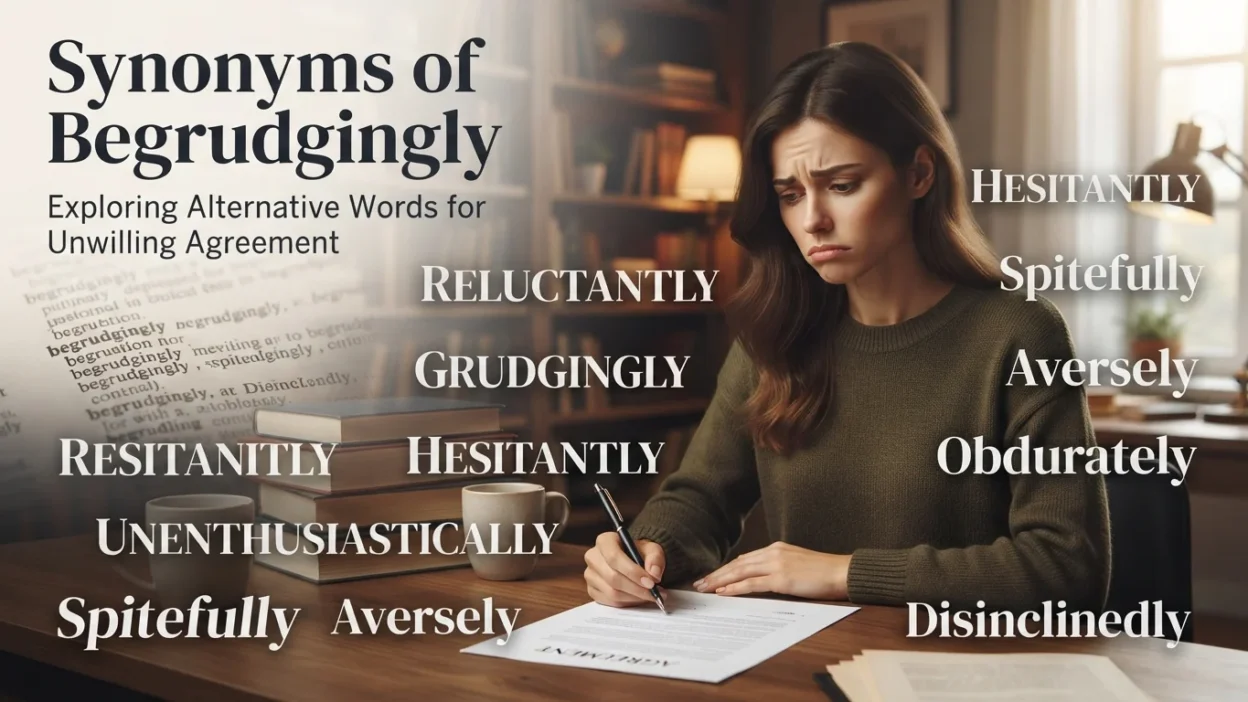
When you do something begrudgingly, you do it unwillingly or without enthusiasm. The word often suggests that a person agrees to do something but does not really want to do it. For example, “She begrudgingly apologized” means she apologized, but she was not happy about doing so.
Learning the synonyms of begrudgingly can help students, ESL learners, writers, and content creators express different shades of reluctance. Some alternatives show mild hesitation, while others suggest resentment, resistance, or a complete lack of enthusiasm.
What Does “Begrudgingly” Mean?
Begrudgingly means doing something unwillingly, reluctantly, or without wanting to do it. It can also suggest that someone feels annoyed or resentful about having to do something.
Simple example:
“She begrudgingly shared her notes with her classmate.”
This means she shared the notes, but she did not really want to.
Tone and Usage
“Begrudgingly” usually has a negative or slightly critical tone. It is useful when someone performs an action because they have to, rather than because they genuinely want to.
It is commonly used with verbs such as:
- agree
- accept
- admit
- apologize
- help
- cooperate
- allow
- acknowledge
- share
- participate
30 Synonyms of Begrudgingly
| # | Synonym | Simple Meaning | Example Sentence | Best Usage Context |
|---|---|---|---|---|
| 1 | Reluctantly | Without wanting to do something | He reluctantly accepted the offer. | General reluctance |
| 2 | Unwillingly | Without being willing | She unwillingly joined the discussion. | Clear lack of willingness |
| 3 | Hesitantly | With uncertainty or doubt | He hesitantly agreed to the plan. | Uncertainty |
| 4 | Grudgingly | Doing something while feeling annoyed | She grudgingly admitted that he was right. | Resentment |
| 5 | Resentfully | With anger about having to do something | He resentfully completed the task. | Strong negative feelings |
| 6 | Unenthusiastically | Without excitement or interest | They unenthusiastically supported the proposal. | Lack of enthusiasm |
| 7 | Half-heartedly | With little effort or feeling | She half-heartedly apologized. | Weak effort |
| 8 | Loathingly | With strong dislike | He loathingly accepted the decision. | Strong dislike; uncommon |
| 9 | Resistantly | In a way that shows resistance | The employee resistantly followed the new procedure. | Resistance |
| 10 | Reluctantly | With hesitation because you do not want to | She reluctantly agreed to help. | Everyday situations |
| 11 | Unenthusiastically | Without excitement | He unenthusiastically attended the meeting. | Neutral-to-negative tone |
| 12 | Passively | Without active interest or involvement | She passively accepted the decision. | Passive behavior |
| 13 | Reluctantingly | — | — | Not standard English; avoid it. |
| 14 | Relucted | — | — | Not a standard synonym; avoid it. |
| 15 | Against one’s will | Without wanting to | He went along against his will. | Strong unwillingness |
| 16 | Under protest | While openly showing disagreement | She signed the document under protest. | Formal disagreement |
| 17 | With reservations | While having doubts | He accepted the proposal with reservations. | Professional/formal writing |
| 18 | Unwillingly | In a way that shows unwillingness | They unwillingly gave up their seats. | Direct replacement |
| 19 | Grudgingly | With reluctant acceptance | He grudgingly praised his competitor. | Reluctant approval |
| 20 | Dutifully | Because it is your duty, not necessarily because you want to | She dutifully completed the assignment. | Responsibility |
| 21 | Mechanically | Without feeling or enthusiasm | He mechanically repeated the instructions. | Emotionless action |
| 22 | Half-heartedly | Without genuine commitment | They half-heartedly supported the campaign. | Weak support |
| 23 | Cautiously | Carefully because of uncertainty | She cautiously agreed to the terms. | Doubt or concern |
| 24 | Tentatively | Without being completely confident | He tentatively accepted the invitation. | Uncertainty |
| 25 | Forcibly | Because of force or pressure | They were forcibly removed from the area. | Physical or external force |
| 26 | Compulsorily | Because something is required | The training was compulsorily completed. | Rules and requirements |
| 27 | Unwilling | Not wanting to do something | He was unwilling to compromise. | Adjective form |
| 28 | Reluctant | Not wanting to do something | She was reluctant to speak. | Adjective form |
| 29 | Resignedly | Accepting something unpleasant because you cannot change it | He resignedly accepted the outcome. | Acceptance of an unpleasant situation |
| 30 | Disapprovingly | Showing that you do not approve | She looked at him disapprovingly. | Negative attitude |
Note: Some words above are better treated as related expressions rather than exact synonyms. In particular, “forcibly,” “compulsorily,” “mechanically,” and “disapprovingly” describe different reasons or manners of action. Also, “reluctantingly” and “relucted” are not standard alternatives and should not be used as synonyms of begrudgingly.
Best Synonyms of Begrudgingly
If you need a natural replacement, these are the strongest choices:
Reluctantly
Reluctantly is probably the closest everyday synonym. It means doing something despite not wanting to.
Example:
“She reluctantly agreed to attend the meeting.”
Grudgingly
Grudgingly is especially close to begrudgingly. It suggests unwilling acceptance, often with annoyance or resentment.
Example:
“He grudgingly admitted that his opponent had a good idea.”
Unwillingly
This is a straightforward choice when you want to emphasize a lack of willingness.
Example:
“They unwillingly accepted the new rules.”
Unenthusiastically
Use this when the person does something but shows little excitement.
Example:
“She unenthusiastically joined the celebration.”
Resentfully
This is stronger because it suggests anger or bitterness.
Example:
“He resentfully completed the extra work.”
Begrudgingly vs. Reluctantly
These two words are very similar, but there is a small difference in tone.
| Word | Main Idea | Emotional Strength |
|---|---|---|
| Begrudgingly | Doing something unwillingly, often with resentment | Strong |
| Reluctantly | Doing something despite hesitation or unwillingness | Moderate |
| Grudgingly | Accepting something while annoyed | Strong |
| Unwillingly | Acting without wanting to | Moderate |
| Hesitantly | Acting with doubt or uncertainty | Mild |
| Unenthusiastically | Acting without excitement | Mild |
| Resentfully | Acting with anger or bitterness | Very strong |
| Half-heartedly | Acting without genuine effort | Moderate |
How to Choose the Right Synonym
Choosing the right synonym depends on why the person is unwilling and what emotion you want to communicate.
For Simple Reluctance
Use:
- reluctantly
- unwillingly
- hesitantly
- tentatively
These are useful when someone does not want to act but does not necessarily feel angry.
Example:
“She reluctantly accepted the invitation.”
For Resentment or Annoyance
Use:
- grudgingly
- resentfully
- under protest
- against one’s will
These choices communicate stronger negative feelings.
Example:
“He grudgingly agreed to apologize.”
For Lack of Enthusiasm
Use:
- unenthusiastically
- half-heartedly
- mechanically
These words focus more on the person’s lack of energy or emotional involvement.
Example:
“She half-heartedly participated in the activity.”
For Formal or Professional Writing
Use:
- with reservations
- under protest
- reluctantly
- tentatively
These expressions can sound more measured and appropriate in formal writing.
Example:
“The committee tentatively approved the proposal.”
For Acceptance of an Unpleasant Situation
Use:
- resignedly
- reluctantly
- dutifully
These work when someone accepts a situation because they feel they have little choice.
Example:
“He resignedly accepted the final decision.”
Common Sentence Patterns
Understanding common patterns can make these synonyms easier to use naturally.
Verb + reluctantly
“She reluctantly agreed.”
Verb + grudgingly
“He grudgingly accepted.”
Verb + unwillingly
“They unwillingly participated.”
Verb + unenthusiastically
“She unenthusiastically supported the idea.”
Verb + resentfully
“He resentfully completed the assignment.”
These patterns are especially useful for ESL learners because they show how the adverbs normally fit into sentences.
Common Mistakes to Avoid
One common mistake is assuming every word related to reluctance has exactly the same meaning as begrudgingly. They do not.
For example, hesitantly usually suggests uncertainty, while resentfully suggests anger. Unenthusiastically means someone lacks excitement, but it does not necessarily mean they strongly oppose the action.
Another mistake is using unusual or incorrect forms such as “relucted” or “reluctantingly.” Natural English uses reluctantly and reluctant instead.
Final Thoughts
The best synonyms of begrudgingly depend on the emotion behind the action. Reluctantly is the safest everyday alternative, while grudgingly is useful when resentment is involved.
For stronger negative feelings, choose resentfully. For uncertainty, hesitantly or tentatively works better. If the person simply lacks excitement, unenthusiastically is more accurate.
Understanding these small differences helps you write clearer sentences and choose vocabulary that communicates exactly what you mean.

Sarah Sophia is the administrator of Biblelsays.com, a platform dedicated to Bible meanings and explanations, where she helps manage content, organization, and educational resources for readers seeking spiritual understanding online.