
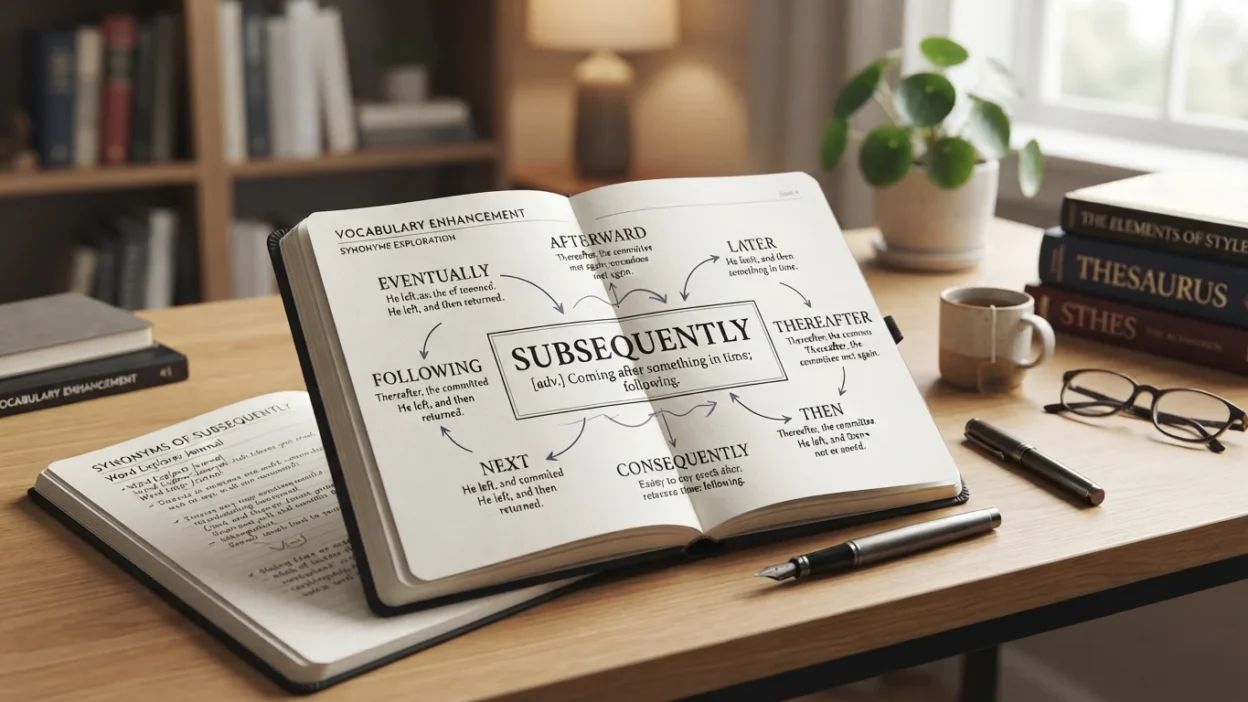
When you want to show that something happened after another event, the word “subsequently” is a useful choice. It is common in formal writing, academic work, reports, news articles, and professional communication.
However, using the same word repeatedly can make writing feel repetitive. Learning the synonyms of subsequently can help students, ESL learners, writers, and content creators express time and sequence more naturally.
What Does “Subsequently” Mean?
Subsequently means after something else happened or later in time. It shows that one event followed another.
Example:
“ She completed her studies and subsequently started working at a publishing company.”
Here, “subsequently” tells us that starting work happened after completing her studies.
Tone and Usage of “Subsequently”
“Subsequently” has a formal and professional tone. It is especially useful in:
- Academic writing
- Business reports
- Legal documents
- Research papers
- News writing
- Professional communication
In casual conversation, simpler alternatives such as later, afterward, or then often sound more natural.
30 Synonyms of Subsequently
Below are 30 useful alternatives. Although they all relate to something happening later, their exact meaning, tone, and best context can differ.
| # | Word/Phrase | Simple Meaning | Example Sentence | Best Usage Context |
|---|---|---|---|---|
| 1 | Later | At a time after something | She moved abroad later. | Everyday writing and speech |
| 2 | Afterward | After something happened | We went home afterward. | Casual and general writing |
| 3 | Afterwards | At a later time | He apologized afterwards. | British English and general use |
| 4 | Then | At that time or after that | She finished dinner, then went outside. | Everyday conversation |
| 5 | Thereafter | After that event | The company thereafter changed its policy. | Formal writing |
| 6 | Following | After a particular event | Following the meeting, they discussed the proposal. | Business and formal writing |
| 7 | After | At a later time than something | We left after the show ended. | General English |
| 8 | Later on | At some later point | Later on, he understood the decision. | Informal writing and speech |
| 9 | Next | Immediately or shortly after | Next, we reviewed the results. | Instructions and sequences |
| 10 | Eventually | Finally, after some time | She eventually found a solution. | Long processes |
| 11 | In time | Before it becomes too late or eventually | In time, the problem was solved. | General and reflective writing |
| 12 | At a later time | At some point afterward | The issue was addressed at a later time. | Formal writing |
| 13 | At a later date | On a future date | The announcement will be made at a later date. | Business and official writing |
| 14 | From then on | Starting at that later point | From then on, he worked independently. | Narratives and explanations |
| 15 | From that point onward | Starting from that time | From that point onward, the rules became stricter. | Formal explanations |
| 16 | After this | Following the event just mentioned | After this, the team began testing the product. | Explanatory writing |
| 17 | After that | Following a previous event | They had lunch and after that went shopping. | Everyday English |
| 18 | Subsequent to | After something | Subsequent to the agreement, changes were introduced. | Very formal writing |
| 19 | In the aftermath | After an important or difficult event | In the aftermath of the storm, repairs began. | Disasters and major events |
| 20 | Later that day | At a later point on the same day | Later that day, she called her manager. | Narratives and reports |
| 21 | Later that year | At a later point in the same year | Later that year, the project was completed. | Historical and chronological writing |
| 22 | At length | Eventually or after a long time | At length, they reached an agreement. | Literary and formal writing |
| 23 | In succession | One after another | Several speakers addressed the audience in succession. | Ordered events |
| 24 | In sequence | In the correct order | The steps must be completed in sequence. | Instructions and technical writing |
| 25 | Following this | After this event | Following this, researchers conducted another test. | Academic and professional writing |
| 26 | Thereupon | Immediately after that | Thereupon, the committee began its discussion. | Formal or literary writing |
| 27 | From there | After reaching that point | From there, the discussion moved to funding. | Explanations and narratives |
| 28 | At a later point | At some time afterward | At a later point, the researchers repeated the experiment. | Academic writing |
| 29 | In due course | Eventually, at the appropriate time | The results were announced in due course. | Formal and professional writing |
| 30 | In the following period | During the time afterward | In the following period, sales increased steadily. | Reports and academic writing |
Understanding the Differences
Not every synonym of subsequently can replace it in every sentence. The best choice depends on tone, timing, and meaning.
For example:
- Later is simple and flexible.
- Afterward clearly means after an event.
- Then is natural for sequences.
- Thereafter sounds formal.
- Eventually suggests that some time passed.
- Following is useful when directly connecting an event to what came next.
- In the aftermath is normally used after a significant or difficult event.
Consider this sentence:
Possible alternatives include:
- “The company introduced a new policy and later changed its hiring process.”
- “The company introduced a new policy and afterward changed its hiring process.”
- “Following the introduction of the new policy, the company changed its hiring process.”
- “Thereafter, the company changed its hiring process.”
Each version has a slightly different tone.
Subsequently vs. Later
Subsequently and later are close in meaning, but they have different levels of formality.
Subsequently:
“The researchers subsequently published their findings.”
Later:
“The researchers later published their findings.”
“Subsequently” sounds more formal and structured, while “later” is simpler and more conversational.
Subsequently vs. Afterwards
Both words can mean after an event.
Subsequently:
“He subsequently became the director.”
Afterwards:
“He became the director afterwards.”
“Afterwards” is usually more natural in everyday English. “Subsequently” is often preferred in formal or academic contexts.
Subsequently vs. Eventually
These words are sometimes confused.
Subsequently means something happened after something else.
Eventually means something happened in the end, usually after some time or delay.
Compare:
- “She graduated and subsequently found a job.”
- “She eventually found a job.”
The first emphasizes sequence. The second emphasizes the final result after a period of time.
Subsequently vs. Thereafter
These two are particularly close.
Thereafter means from that time onward or after that event.
Example:
“Thereafter” is formal and is particularly common in contracts, reports, historical writing, and official documents.
Subsequently vs. Then
“Then” is one of the simplest alternatives.
It works very well in ordinary conversation and straightforward writing.
However, “then” can have several meanings, so subsequently may be more precise in formal writing when you specifically want to indicate chronological order.
How to Choose the Right Synonym
Choosing the right synonym depends on what you want your sentence to communicate.
For Everyday English
Choose:
- Later
- Afterward
- Afterwards
- Then
- After that
- Later on
These words sound natural and easy to understand.
Example:
“She called me later.”
For Academic Writing
Choose:
- Subsequently
- Thereafter
- Following
- Following this
- At a later point
- In the following period
Example:
“The participants subsequently completed a second survey.”
These options help create a clear chronological structure.
For Business Writing
Useful choices include:
- Following
- Thereafter
- At a later date
- At a later time
- Subsequent to
- In due course
Example:
“Following the meeting, the management team reviewed the proposal.”
For Narratives and Storytelling
Try:
- Then
- Afterward
- Later
- Later that day
- Later that year
- From then on
- Thereupon
These choices help events flow naturally.
When You Want to Show a Long Delay
Use:
- Eventually
- At length
- In due course
- In time
These words suggest that something happened after a period of waiting or development.
Example:
“After several attempts, the team eventually solved the problem.”
When Describing a Major Event
In the aftermath can be appropriate.
This phrase is not a direct replacement for “subsequently” in every sentence because it usually suggests the consequences following a serious event.
Common Mistakes When Using Synonyms of Subsequently
Using “Eventually” When You Only Mean “Later”
If you simply mean that something happened afterward, later is usually better.
❌ “She finished school and eventually went to the library.”
This may suggest a long delay.
✅ “She finished school and later went to the library.”
Using Formal Words in Casual Conversation
Words such as thereafter, thereupon, and subsequent to can sound unnecessarily formal in everyday speech.
Instead of:
Natural English would be:
Confusing “Following” With “Eventually”
“Following” identifies what comes after a particular event.
“Eventually” focuses on the final outcome.
The choice depends on whether you want to emphasize sequence or time and outcome.
Examples of Subsequently in Different Sentences
Here are several examples to help you understand how the word works.
Academic:
“The researchers subsequently analyzed the collected data.”
Business:
“The proposal was approved and subsequently implemented.”
Historical:
“The kingdom was defeated and subsequently divided into several regions.”
Professional:
“The employee submitted the documents and subsequently received confirmation.”
General:
“He moved to another city and subsequently started a new career.”
In each example, “subsequently” connects an earlier event with a later one.
Quick Synonym Guide
| If you want to express… | Best choices |
|---|---|
| Simple “later” | Later, afterward, afterwards |
| A clear sequence | Then, next, following |
| Formal “after that” | Thereafter, subsequent to |
| A long process | Eventually, at length |
| A future point | At a later date, at a later time |
| Starting from that point | From then on, from that point onward |
| Consequences after a major event | In the aftermath |
| A formal report sequence | Subsequently, thereafter, following this |
| Ordered steps | Next, in sequence, in succession |
Why Learning Synonyms of Subsequently Matters
Learning alternatives to subsequently can make your writing more flexible and natural.
For students, these words are useful when writing essays, assignments, research papers, and exam answers. Using the correct alternative can also help create stronger transitions between ideas.
For ESL learners, understanding the differences between later, afterward, eventually, thereafter, following, and then makes it easier to recognize these words in books, articles, and professional communication.
For writers and content creators, varied vocabulary can improve readability without changing the original meaning.
The key is not simply to replace “subsequently” with another word. Instead, choose a word that matches the exact timing, tone, and purpose of your sentence.
Final Thoughts
The best synonyms of subsequently include later, afterward, afterwards, then, thereafter, following, eventually, and subsequent to. However, each alternative carries its own tone and meaning.
Use later or afterward for simple, natural English. Choose subsequently, thereafter, or subsequent to for formal writing. Use eventually when you want to emphasize a final result after some time.
Understanding these subtle differences will help you write clearer, more varied, and more confident English—whether you are a student, ESL learner, writer, or content creator.

Sarah Sophia is the administrator of Biblelsays.com, a platform dedicated to Bible meanings and explanations, where she helps manage content, organization, and educational resources for readers seeking spiritual understanding online.