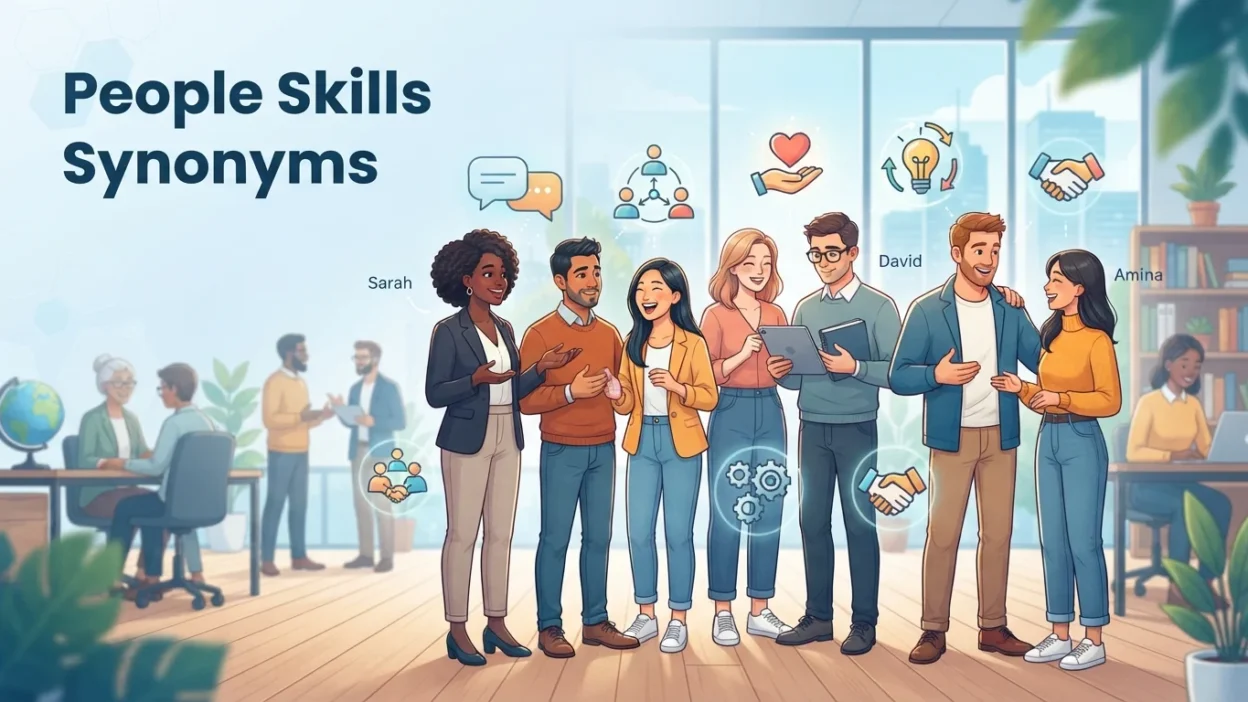
People skills are the abilities we use to communicate, cooperate, understand others, and build positive relationships. They are important in school, the workplace, friendships, leadership, customer service, and everyday life.
If you are looking for people skills synonyms, you may want alternatives that sound more professional, natural, or specific. Depending on the context, words such as interpersonal skills, communication skills, social skills, emotional intelligence, rapport-building, diplomacy, and empathy can express different aspects of being good with people.
Knowing the right synonym helps you describe someone’s abilities more accurately. A resume, essay, cover letter, or professional profile can become much stronger when you choose a word that matches the exact skill you want to highlight.
What Does “People Skills” Mean?
People skills are the abilities that help a person communicate and interact effectively with other people.
Someone with strong people skills may be good at:
- Listening to others
- Communicating clearly
- Working in a team
- Showing empathy
- Resolving disagreements
- Building relationships
- Understanding emotions
- Making others feel comfortable
- Showing respect
- Adapting to different personalities
For example:
This means Sarah can communicate effectively, understand people’s needs, and maintain positive relationships.
Best People Skills Synonyms
Here are some of the most useful alternatives to people skills:
- Interpersonal skills
- Communication skills
- Social skills
- Relationship-building skills
- Emotional intelligence
- Teamwork skills
- Networking skills
- Customer service skills
- Rapport-building skills
- Collaboration skills
- Empathy
- Diplomacy
- Active listening
- Conflict-resolution skills
- Leadership skills
- Cooperation
- Friendliness
- Approachability
- Tact
- Understanding
- Sociability
- Charisma
- Persuasiveness
- Compassion
- Adaptability
- Negotiation skills
- Conversational skills
- Professional communication
- Relationship management
- Emotional awareness
Each term has a slightly different meaning, so the best choice depends on what you are trying to say.
30 People Skills Synonyms With Meanings and Examples
1. Interpersonal Skills
Meaning: The ability to communicate and interact well with other people.
Example: “Her strong interpersonal skills make her an effective manager.”
Best usage: Resumes, workplaces, education, and professional writing.
2. Communication Skills
Meaning: The ability to express ideas clearly and understand what others say.
Example: “Good communication skills are essential for successful teamwork.”
Best usage: Professional, academic, and workplace contexts.
3. Social Skills
Meaning: The abilities used to interact comfortably and appropriately with others.
Example: “Children develop important social skills through group activities.”
Best usage: Everyday, educational, and psychological contexts.
4. Relationship-Building Skills
Meaning: The ability to create and maintain positive relationships.
Example: “His relationship-building skills helped him develop strong client connections.”
Best usage: Business, sales, management, and networking.
5. Emotional Intelligence
Meaning: The ability to understand and manage your own emotions while recognizing the emotions of others.
Example: “Her emotional intelligence helps her handle difficult conversations calmly.”
Best usage: Leadership, management, workplace, and personal development.
6. Teamwork Skills
Meaning: The ability to work effectively with other people toward a shared goal.
Example: “The employer is looking for candidates with excellent teamwork skills.”
Best usage: Resumes, job applications, school, and professional settings.
7. Networking Skills
Meaning: The ability to create useful and professional connections with other people.
Example: “Strong networking skills helped him find new business opportunities.”
Best usage: Careers, business, professional events, and entrepreneurship.
8. Customer Service Skills
Meaning: The ability to communicate with customers politely and effectively.
Example: “Her customer service skills make her an excellent representative.”
Best usage: Retail, hospitality, sales, and service industries.
9. Rapport-Building Skills
Meaning: The ability to create trust and a comfortable connection with someone.
Example: “The therapist quickly built rapport with the new client.”
Best usage: Counseling, sales, healthcare, education, and leadership.
10. Collaboration Skills
Meaning: The ability to work together with others to achieve a goal.
Example: “Successful projects require strong collaboration skills.”
Best usage: Business, education, technology, and team environments.
11. Empathy
Meaning: The ability to understand and share another person’s feelings.
Example: “Her empathy helped her understand why her colleague was upset.”
Best usage: Personal relationships, healthcare, counseling, and leadership.
12. Diplomacy
Meaning: The ability to handle sensitive situations without causing unnecessary conflict.
Example: “He used diplomacy to resolve the disagreement between the two teams.”
Best usage: Management, politics, business, and conflict resolution.
13. Active Listening
Meaning: Giving someone your full attention and making an effort to understand them.
Example: “Active listening can improve communication between coworkers.”
Best usage: Counseling, management, education, and relationships.
14. Conflict-Resolution Skills
Meaning: The ability to solve disagreements in a calm and constructive way.
Example: “Her conflict-resolution skills helped settle the workplace dispute.”
Best usage: Management, human resources, teamwork, and leadership.
15. Leadership Skills
Meaning: The ability to guide, motivate, and support other people.
Example: “His leadership skills helped the team reach its target.”
Best usage: Resumes, management, business, and professional writing.
16. Cooperation
Meaning: The willingness and ability to work together with others.
Example: “The project succeeded because of everyone’s cooperation.”
Best usage: Teams, schools, workplaces, and general writing.
17. Friendliness
Meaning: Being kind, pleasant, and welcoming toward others.
Example: “Her friendliness made new employees feel comfortable.”
Best usage: Casual writing, customer service, and everyday descriptions.
18. Approachability
Meaning: Being easy and comfortable for others to talk to.
Example: “His approachability makes employees feel comfortable sharing concerns.”
Best usage: Leadership, management, teaching, and professional descriptions.
19. Tact
Meaning: The ability to speak carefully without unnecessarily upsetting someone.
Example: “She handled the sensitive topic with great tact.”
Best usage: Professional communication and difficult conversations.
20. Understanding
Meaning: The ability to recognize and appreciate another person’s feelings or situation.
Example: “His understanding nature made him a supportive friend.”
Best usage: Personal relationships and general descriptions.
21. Sociability
Meaning: A natural tendency to enjoy interacting with other people.
Example: “Her sociability helped her make friends quickly.”
Best usage: Personality descriptions and general writing.
22. Charisma
Meaning: A special personal quality that attracts, influences, or inspires others.
Example: “The speaker’s charisma kept the audience interested.”
Best usage: Leadership, public speaking, entertainment, and personality descriptions.
23. Persuasiveness
Meaning: The ability to convince others to accept an idea or take an action.
Example: “His persuasiveness helped the company win new clients.”
Best usage: Sales, marketing, negotiation, leadership, and business.
24. Compassion
Meaning: Caring about another person’s difficulties and wanting to help.
Example: “Her compassion made her an excellent caregiver.”
Best usage: Healthcare, relationships, volunteering, and personal descriptions.
25. Adaptability
Meaning: The ability to adjust to different people, situations, or changes.
Example: “Adaptability is valuable when working with different personalities.”
Best usage: Resumes, workplaces, leadership, and career writing.
26. Negotiation Skills
Meaning: The ability to reach an agreement through discussion.
Example: “Strong negotiation skills helped him secure a better contract.”
Best usage: Business, sales, management, and professional writing.
27. Conversational Skills
Meaning: The ability to communicate naturally and effectively during conversations.
Example: “Practicing conversational skills can make social interactions easier.”
Best usage: ESL learning, social situations, education, and communication advice.
28. Professional Communication
Meaning: The ability to communicate clearly, respectfully, and appropriately in professional settings.
Example: “Professional communication is essential when dealing with clients.”
Best usage: Careers, workplaces, emails, and business writing.
29. Relationship Management
Meaning: The ability to maintain productive and positive relationships with people.
Example: “Effective relationship management is important for account managers.”
Best usage: Business, sales, customer service, and management.
30. Emotional Awareness
Meaning: Understanding your own emotions and recognizing emotional signals in others.
Example: “Emotional awareness can improve workplace communication.”
Best usage: Personal development, psychology, leadership, and relationships.
People Skills Synonyms Comparison Table
| Synonym | Main Meaning | Best Context |
|---|---|---|
| Interpersonal skills | General ability to interact with people | Resume, workplace |
| Communication skills | Expressing and understanding information | Professional, academic |
| Social skills | Interacting appropriately with others | Everyday, education |
| Emotional intelligence | Understanding emotions | Leadership, management |
| Empathy | Understanding another person’s feelings | Healthcare, relationships |
| Diplomacy | Handling sensitive situations tactfully | Workplace, conflict |
| Teamwork | Working effectively with a group | Jobs, school |
| Charisma | Naturally attracting or influencing people | Leadership, speaking |
| Approachability | Being easy to talk to | Management, teaching |
| Networking skills | Building professional connections | Careers, business |
| Persuasiveness | Convincing other people | Sales, marketing |
| Active listening | Paying close attention to others | Counseling, communication |
How to Choose the Right People Skills Synonym
The best synonym depends on the exact quality you want to describe.
For Professional Writing
Choose:
- Interpersonal skills
- Communication skills
- Collaboration skills
- Relationship management
- Professional communication
These sound natural and professional on resumes, applications, and business documents.
For Emotional Understanding
Choose:
- Empathy
- Emotional intelligence
- Emotional awareness
- Compassion
- Understanding
These words focus more on recognizing and responding to people’s feelings.
For Team Environments
Choose:
- Teamwork skills
- Collaboration skills
- Cooperation
- Conflict-resolution skills
- Leadership skills
These are useful when describing someone’s ability to function effectively within a group.
For Social Situations
Choose:
- Social skills
- Sociability
- Friendliness
- Approachability
- Conversational skills
These terms work well when discussing someone’s ability to interact comfortably with others.
For Business and Sales
Choose:
- Networking skills
- Persuasiveness
- Negotiation skills
- Rapport-building skills
- Relationship management
These words emphasize influence, trust, communication, and professional relationships.
What Is the Meaning of “Demure”?
Although demure is not a direct synonym for “people skills,” it is another useful vocabulary word with a very different meaning.
Demure means quiet, modest, reserved, and somewhat shy in behavior or appearance.
A demure person usually does not try to attract a lot of attention. The word can describe someone’s behavior, expression, clothing, or manner.
Example:
“She gave a demure smile when everyone praised her.”
The tone of demure is usually gentle and somewhat formal. It can suggest modesty and good manners, although depending on context, it may also imply that someone is unusually reserved.
30 Synonyms of Demure
1. Modest
Meaning: Not showing off or seeking attention.
Example: “She was modest about her achievements.”
Best usage: General and positive descriptions.
2. Reserved
Meaning: Quiet and unlikely to share feelings openly.
Example: “He is reserved around people he does not know.”
Best usage: Personality descriptions.
3. Shy
Meaning: Nervous or uncomfortable around other people.
Example: “The shy student rarely spoke in class.”
Best usage: Everyday English.
4. Retiring
Meaning: Quiet and avoiding attention.
Example: “Her retiring nature made her uncomfortable at large parties.”
Best usage: Formal personality descriptions.
5. Unassuming
Meaning: Not trying to appear important or impressive.
Example: “Despite his success, he remained unassuming.”
Best usage: Positive descriptions.
6. Meek
Meaning: Very gentle and unlikely to challenge others.
Example: “The meek child spoke softly.”
Best usage: Gentle or submissive behavior.
7. Mild
Meaning: Gentle and not aggressive.
Example: “He has a mild and pleasant personality.”
Best usage: General personality descriptions.
8. Gentle
Meaning: Kind, calm, and soft in behavior.
Example: “She has a gentle manner.”
Best usage: Positive descriptions.
9. Quiet
Meaning: Making little noise or speaking very little.
Example: “He is a quiet person who enjoys reading.”
Best usage: Simple everyday English.
10. Soft-spoken
Meaning: Speaking in a quiet and gentle voice.
Example: “The soft-spoken teacher was easy to approach.”
Best usage: Speech and personality.
11. Modest-Mannered
Meaning: Behaving in a humble and restrained way.
Example: “Her modest-mannered personality impressed the guests.”
Best usage: Descriptive writing.
12. Bashful
Meaning: Shy or easily embarrassed.
Example: “The bashful child hid behind her mother.”
Best usage: Informal and literary contexts.
13. Timid
Meaning: Lacking confidence in unfamiliar or difficult situations.
Example: “The timid student hesitated before answering.”
Best usage: Personality and behavior.
14. Unobtrusive
Meaning: Not attracting attention or disturbing others.
Example: “He chose an unobtrusive seat at the back.”
Best usage: Formal writing and physical presence.
15. Subdued
Meaning: Quiet, restrained, or less energetic than usual.
Example: “She gave a subdued response to the compliment.”
Best usage: Mood, behavior, and reactions.
16. Dignified
Meaning: Calm, serious, and worthy of respect.
Example: “She maintained a dignified manner throughout the ceremony.”
Best usage: Formal and positive writing.
17. Demure-Looking
Meaning: Having a modest, quiet, or reserved appearance.
Example: “She had a demure-looking style.”
Best usage: Appearance descriptions.
18. Composed
Meaning: Calm and in control of one’s emotions.
Example: “She remained composed during the difficult conversation.”
Best usage: Professional and formal writing.
19. Restrained
Meaning: Controlled and not overly expressive.
Example: “His restrained response showed maturity.”
Best usage: Formal writing.
20. Unpretentious
Meaning: Simple and not designed to impress others.
Example: “Her unpretentious personality made everyone comfortable.”
Best usage: Positive descriptions.
21. Humble
Meaning: Not thinking you are better than other people.
Example: “Despite winning the award, she remained humble.”
Best usage: Everyday and professional writing.
22. Discreet
Meaning: Careful about avoiding unnecessary attention or publicity.
Example: “He was discreet when discussing the private matter.”
Best usage: Professional and formal situations.
23. Unassuming
Meaning: Quietly confident without seeking attention.
Example: “The unassuming artist surprised everyone with her talent.”
Best usage: People and personality.
24. Self-effacing
Meaning: Avoiding praise or attention for yourself.
Example: “His self-effacing humor made him easy to like.”
Best usage: Advanced English and formal writing.
25. Proper
Meaning: Behaving in a socially acceptable and respectful way.
Example: “She maintained a proper manner at the formal event.”
Best usage: Formal or traditional contexts.
26. Courteous
Meaning: Polite and respectful toward others.
Example: “The courteous guest thanked everyone before leaving.”
Best usage: Social and professional situations.
27. Polite
Meaning: Showing good manners and respect.
Example: “She was polite to everyone she met.”
Best usage: Everyday English.
28. Ladylike
Meaning: Traditionally associated with graceful, modest, or refined feminine behavior.
Example: “Her ladylike manner suited the formal occasion.”
Best usage: Traditional or literary contexts.
29. Unassertive
Meaning: Not strongly expressing opinions, demands, or needs.
Example: “His unassertive manner sometimes made it difficult to know what he wanted.”
Best usage: Personality and communication contexts.
30. Refined
Meaning: Polished, elegant, and socially graceful.
Example: “Her refined manner impressed the guests.”
Best usage: Formal descriptions of behavior or style.
Demure Synonyms: Quick Comparison
| Word | Main Idea | Tone |
|---|---|---|
| Modest | Not showing off | Positive |
| Reserved | Emotionally quiet | Neutral |
| Shy | Nervous socially | Neutral |
| Timid | Lacking confidence | Often negative |
| Bashful | Easily embarrassed | Gentle |
| Unassuming | Not seeking attention | Positive |
| Composed | Calm and controlled | Positive |
| Restrained | Emotionally controlled | Formal |
| Refined | Elegant and polished | Positive |
| Meek | Very gentle or submissive | Can be negative |
| Soft-spoken | Quiet manner of speaking | Positive |
| Humble | Not boastful | Positive |
| Courteous | Polite and respectful | Positive |
| Dignified | Calm and respectable | Formal |
People Skills vs. Social Skills
People skills and social skills are closely related, but they are not always identical.
Social skills usually refer to the ability to interact appropriately and comfortably with people. They can include starting conversations, taking turns, reading social cues, and behaving appropriately.
People skills is a broader phrase. It can include communication, empathy, teamwork, leadership, conflict resolution, emotional intelligence, and relationship building.
For example, someone may have strong social skills because they are friendly and conversational. Someone with strong people skills may additionally be excellent at managing conflict, leading teams, understanding emotions, and building professional relationships.
People Skills Synonyms for a Resume
When writing a resume, avoid repeating “people skills” too often. More specific terms can make your abilities clearer.
Instead of:
Try:
Or:
Or:
Specific language is usually stronger because it tells the reader exactly what you can do.
People Skills Synonyms for Students and ESL Learners
For beginners, the easiest alternatives are:
- Social skills
- Communication skills
- Teamwork
- Cooperation
- Friendliness
- Listening skills
- Interpersonal skills
- Empathy
These words are easier to understand and can be used in school assignments, presentations, conversations, and everyday writing.
If you are learning English, remember that synonyms are not always interchangeable. Empathy, for example, is one part of people skills, while interpersonal skills is a broader term.
How to Avoid Choosing the Wrong Synonym
A common mistake is assuming that every synonym has exactly the same meaning.
For example:
- Shy suggests discomfort or nervousness.
- Reserved suggests controlled or private behavior.
- Modest suggests a lack of self-promotion.
- Empathetic suggests emotional understanding.
- Charismatic suggests personal appeal.
- Diplomatic suggests skill in handling sensitive situations.
Therefore, choose the word that describes the specific quality you mean.
Final Thoughts
Finding the right people skills synonyms can make your writing more precise, professional, and natural. While interpersonal skills is one of the closest general alternatives, terms such as communication skills, emotional intelligence, empathy, teamwork, diplomacy, and relationship-building skills highlight different aspects of interacting with people.
For resumes and professional writing, choose specific terms rather than relying on the broad phrase “people skills.” For everyday English, simpler choices such as social skills, friendliness, cooperation, and communication skills are often more natural.
Also remember that demure has a completely different meaning. It describes someone or something as modest, reserved, quiet, or shy. Words such as modest, reserved, unassuming, bashful, composed, and refined can work as demure synonyms, but each carries its own tone and meaning.
The best synonym is not simply the word that looks most similar in a dictionary. It is the word that communicates your exact idea, tone, and context.

Henry Isaac is an author at BibleL Says, a platform dedicated to explaining Bible meanings simply. He writes clear, insightful articles to help readers understand scripture and spiritual concepts easily.