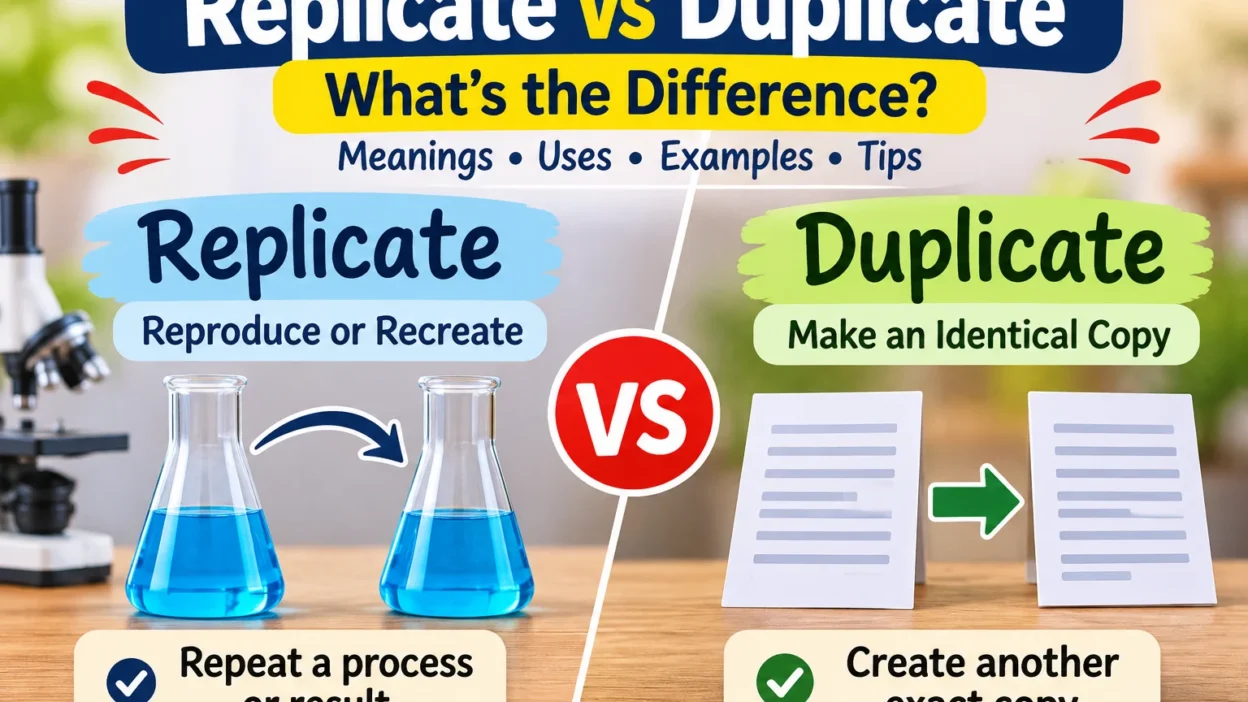
The words replicate vs duplicate are often confused because both describe making something similar to or the same as an existing thing. However, they have slightly different meanings, and choosing the right word depends on what you want to communicate. Understanding the difference can help you write more clearly, avoid common grammar mistakes, and use both words confidently.
Replicate generally means to reproduce something, recreate a process, or make a copy that closely matches an original. Duplicate usually means to make an exact copy of something or create an additional version of an existing item. Although the words sometimes overlap, replicate often emphasizes reproduction or recreation, while duplicate emphasizes sameness or an additional copy.
Quick Answer: Replicate vs Duplicate
Replicate means to reproduce, recreate, or repeat something, such as an experiment, design, or result. Duplicate means to make an identical copy of an existing object, document, file, or record. Use replicate when emphasizing reproduction and duplicate when emphasizing an additional copy. Both words can function as verbs and nouns.
Why Do People Confuse Replicate and Duplicate?
People often confuse replicate and duplicate because their meanings overlap. Both words involve creating something based on an existing object, document, design, or result.
For example, if someone makes another copy of a report, they might say they replicated or duplicated it. Both expressions can be understood, but duplicate is generally more natural when referring to an identical document.
The main difference is the emphasis:
- Replicate: Focuses on reproducing or recreating something.
- Duplicate: Focuses on making an identical copy or an additional version.
Understanding this distinction makes it easier to select the appropriate word in everyday conversations, professional writing, science, technology, and education.
What Does Replicate Mean?
Replicate means to reproduce, recreate, or repeat something so that it closely resembles an original or produces the same result.
It is commonly used when discussing scientific experiments, research findings, designs, processes, patterns, and achievements.
For example, a scientist may replicate an experiment to determine if another researcher can obtain similar results.
Replicate does not always mean creating a perfectly identical physical copy. Sometimes, it means repeating an action or process under similar conditions.
Replicate as a Part of Speech
Replicate can function as both a verb and a noun, although its verb form is much more common in everyday English.
As a verb:
It means to reproduce something or perform an action again.
Example: Researchers attempted to replicate the original experiment.
As a noun:
A replicate is a copy or reproduced version of something, particularly in scientific or technical contexts.
Example: Each replicate was examined separately during the study.
Grammatical Forms of Replicate
Here are the common grammatical forms:
| Form | Example |
|---|---|
| Base form | Replicate |
| Third-person singular | Replicates |
| Past tense | Replicated |
| Present participle | Replicating |
| Noun | Replication |
| Person who reproduces something | Replicator |
5 Examples of Replicate in Sentences
- Scientists tried to replicate the results of the original experiment.
- The designer wants to replicate the appearance of the old building.
- It is difficult to replicate her unique artistic style.
- Researchers successfully replicated the findings in another study.
- The company developed a process to replicate its successful business model.
When Should You Use Replicate?
Use replicate when you want to emphasize reproducing something, repeating a process, or achieving a similar result.
Common situations include:
- Scientific research: Replicate an experiment or study.
- Business: Replicate a successful business strategy.
- Art and design: Replicate a painting, pattern, or design.
- Technology: Replicate data across multiple systems.
- Everyday activities: Replicate someone’s actions or performance.
For example, saying “The researchers replicated the experiment” emphasizes that they performed the experiment again to check its results.
What Does Duplicate Mean?
Duplicate means to make an exact copy of something or create another version that is identical to an existing one.
It is commonly used for documents, photographs, keys, computer files, records, and other items.
For example, if you print the same document twice, you have created a duplicate copy.
Unlike replicate, duplicate often emphasizes that the new item is the same as the original in its relevant details.
Duplicate as a Part of Speech
Duplicate can function as a verb, noun, and adjective.
As a verb:
It means to make an identical copy of something.
Example: Please duplicate this document for the meeting.
As a noun:
It refers to an identical copy or an additional version of something.
Example: I accidentally received a duplicate of the invoice.
As an adjective:
It describes something that is an exact copy or repetition.
Example: The system detected a duplicate entry.
Grammatical Forms of Duplicate
| Form | Example |
|---|---|
| Base form | Duplicate |
| Third-person singular | Duplicates |
| Past tense | Duplicated |
| Present participle | Duplicating |
| Noun | Duplication |
| Adjective | Duplicate |
| Related adjective | Duplicative |
5 Examples of Duplicate in Sentences
- Please duplicate this file before making any changes.
- The office manager ordered duplicate copies of the report.
- I accidentally created a duplicate folder on my computer.
- The bank identified a duplicate transaction in my account.
- She asked the locksmith to duplicate her house key.
When Should You Use Duplicate?
Use duplicate when you want to describe making an identical copy or identifying something that already exists.
Common situations include:
- Documents: Duplicate a contract or certificate.
- Technology: Duplicate a file or folder.
- Business: Identify duplicate customer records.
- Photography: Create duplicate images.
- Everyday life: Duplicate a key or printed document.
For example, saying “Please duplicate this document” clearly communicates that you want another copy of the same document.
Replicate vs Duplicate: Key Differences
Although replicate and duplicate can sometimes be used interchangeably, they are not always suitable in the same situations.
The biggest difference is that replicate emphasizes reproduction, while duplicate emphasizes an identical copy.
Here is a simple comparison:
| Comparison | Replicate | Duplicate |
|---|---|---|
| Main meaning | Reproduce or recreate | Make an identical copy |
| Main focus | Reproduction or repetition | Exactness and additional copies |
| Common usage | Experiments, processes, designs | Documents, files, keys, records |
| Verb form | Replicate | Duplicate |
| Noun form | Replicate | Duplicate |
| Adjective form | Not commonly used as an adjective | Commonly used as an adjective |
| Exactness | May be similar rather than perfectly identical | Usually identical in relevant details |
| Scientific usage | Repeating experiments or findings | Creating copies of materials or data |
| Everyday example | Replicate a performance | Duplicate a document |
The Difference in Simple Examples
Consider these two sentences:
- Replicate: The scientist replicated the experiment.
- Duplicate: The assistant duplicated the research document.
In the first sentence, the scientist performed the experiment again. In the second, the assistant created another copy of an existing document.
Both sentences describe reproduction, but the actions are different.
Replicate vs Duplicate: At Least 10 More Practical Examples
The following examples show how these words work in different situations.
| Situation | Example with Replicate | Example with Duplicate |
|---|---|---|
| Science | The team replicated the experiment. | The team duplicated the research files. |
| Business | The company replicated its successful strategy. | The company duplicated the sales report. |
| Technology | The server replicated the database. | The user duplicated the folder. |
| Education | Students replicated the laboratory procedure. | Students duplicated their notes. |
| Art | The artist replicated the original painting. | The gallery displayed a duplicate artwork. |
| Photography | The photographer replicated the lighting setup. | She duplicated the photograph. |
| Manufacturing | The factory replicated the product design. | The factory produced a duplicate component. |
| Research | The researchers replicated the findings. | The researcher made a duplicate copy of the questionnaire. |
| Daily life | He replicated his father’s cooking technique. | He duplicated his house key. |
| Writing | The author replicated the original writing style. | The editor duplicated the manuscript. |
| Data management | The system replicated information across servers. | The employee deleted duplicate records. |
| Performance | The athlete replicated her previous success. | The video editor duplicated the clip. |
These examples demonstrate why context matters when deciding between replicate and duplicate.
Common Mistakes When Using Replicate and Duplicate
Even fluent English speakers sometimes use these words incorrectly. Understanding common mistakes can help you communicate more naturally.
Mistake 1: Using Replicate When You Mean an Additional Copy
Incorrect: Please replicate this document for everyone.
Better: Please duplicate this document for everyone.
Why? Duplicate is more direct when requesting additional identical copies of a document.
Mistake 2: Using Duplicate When You Mean Repeat an Experiment
Incorrect: The scientists duplicated the experiment to verify the findings.
Better: The scientists replicated the experiment to verify the findings.
Why? Replicate is the established word for repeating an experiment to test if its results can be reproduced.
Mistake 3: Assuming Replicate Always Means an Exact Copy
Incorrect assumption: Every replicated object must be perfectly identical to its original.
Correct understanding: Replicate can describe something reproduced with similar characteristics or results without requiring perfect identity.
Mistake 4: Using Duplicate as a Noun Incorrectly
Incorrect: I received a duplicating of the invoice.
Better: I received a duplicate of the invoice.
Why? Duplicate is the appropriate noun for an additional copy.
Mistake 5: Confusing Replication With Duplication
Incorrect assumption: Replication and duplication always mean exactly the same thing.
Correct understanding: Replication often involves reproduction or repetition, while duplication usually involves creating an identical copy.
Easy Memory Trick: How to Remember the Difference
If you frequently confuse replicate and duplicate, use this simple memory trick:
- Replicate = Repeat or Recreate.
- Duplicate = Double or Copy.
Think about the action you want to describe.
If you are repeating an experiment, recreating a design, or reproducing a successful process, choose replicate.
If you are making another identical document, file, photograph, or key, choose duplicate.
This simple distinction will help you remember which word fits most situations.
American vs. British English: Is There a Difference?
There is no significant difference between American and British English in the meanings or standard spellings of replicate and duplicate.
Both words are used in the United States and the United Kingdom with essentially the same meanings.
Their grammatical forms are also consistent:
- Replicate, replicated, replicating, replication.
- Duplicate, duplicated, duplicating, duplication.
Therefore, you do not need to choose between these words based on if you are writing American or British English. Your choice should depend on the intended meaning and context.
Similar and Related Words
Several English words have meanings related to replicate and duplicate. However, they are not always interchangeable.
| Word | Meaning | Example |
|---|---|---|
| Copy | To make another version of something | Copy the document. |
| Reproduce | To create something again | Reproduce the original design. |
| Imitate | To behave or look like something | He imitates his teacher’s style. |
| Recreate | To make something again | They recreated the historical scene. |
| Repeat | To do something again | Repeat the experiment. |
| Clone | To create an identical or very similar version | Clone the computer drive. |
| Reproduce | To generate similar results or another version | The study reproduced earlier findings. |
| Duplicate | To make an identical copy | Duplicate the photograph. |
| Simulate | To imitate the behavior of something | The software simulates real-world conditions. |
| Emulate | To match or imitate something, often to achieve similar success | The company hopes to emulate its competitor. |
Replicate vs Copy
Copy is a broad everyday word that means making another version of something. Replicate is often more appropriate when discussing reproducing a process, design, or result.
Replicate vs Reproduce
These words are very similar. Reproduce often means creating something again, while replicate can emphasize repeating an existing process or obtaining comparable results.
Duplicate vs Copy
Duplicate usually suggests an identical additional version, whereas copy is a more general term that can describe an exact or modified version.
FAQs:
1. Is replicate the same as duplicate?
Not exactly. Both words describe making something based on an existing thing, but their emphasis differs. Replicate generally means to reproduce or repeat something, while duplicate usually means to create an identical copy. They can overlap in certain situations.
2. Is it better to say replicate or duplicate?
It depends on your intended meaning. Use replicate when discussing experiments, processes, designs, or results. Use duplicate when discussing additional copies of documents, files, keys, photographs, or records. Neither word is universally better.
3. Does replicate mean an exact copy?
Not necessarily. Replicate can mean reproducing something closely or repeating a process to achieve similar results. It does not always require perfect similarity. Duplicate, on the other hand, generally emphasizes an identical copy of an original item.
4. Can duplicate be used as a verb and a noun?
Yes. As a verb, duplicate means to make an identical copy. As a noun, it means an additional copy of something. It can also function as an adjective, as in “duplicate records” or “duplicate files.”
5. What is the noun form of replicate?
The noun form commonly associated with the action of replicating is replication. Replicate can also function as a noun in scientific and technical contexts, referring to a reproduced instance or copy.
6. What is the difference between replication and duplication?
Replication generally refers to reproducing something or repeating a process, while duplication refers to creating an identical copy. For example, scientific replication involves repeating an experiment, whereas document duplication involves making another copy of a document.
7. Can I use replicate and duplicate interchangeably?
Sometimes, yes. For example, both can describe reproducing a design. However, they are not interchangeable in every context. Replicate is more natural for repeating experiments, while duplicate is usually better for making identical copies of files or documents.
Remember This
- Replicate means reproduce, recreate, or repeat.
- Duplicate means make an identical copy.
- Replicate is common in scientific research, experiments, and processes.
- Duplicate is common in documents, files, keys, and records.
- Both words can function as nouns and verbs.
- Duplicate can also function as an adjective.
- Neither word is exclusive to American or British English.
Conclusion
The difference between replicate and duplicate becomes simple when you understand what each word emphasizes. Replicate focuses on reproducing something, repeating a process, or achieving similar results. Duplicate focuses on making another identical copy of an existing item. Although their meanings sometimes overlap, each word has its own natural uses in everyday English, professional communication, science, and technology.
The easiest way to remember the distinction is to think of replicate as “repeat or recreate” and duplicate as “double or copy.” Use replicate when discussing experiments, processes, and reproduced results. Choose duplicate when referring to identical documents, files, photographs, or objects. With this simple rule, you can use both words accurately and confidently.

Sarah Sophia is the administrator of Biblelsays.com, a platform dedicated to Bible meanings and explanations, where she helps manage content, organization, and educational resources for readers seeking spiritual understanding online.