
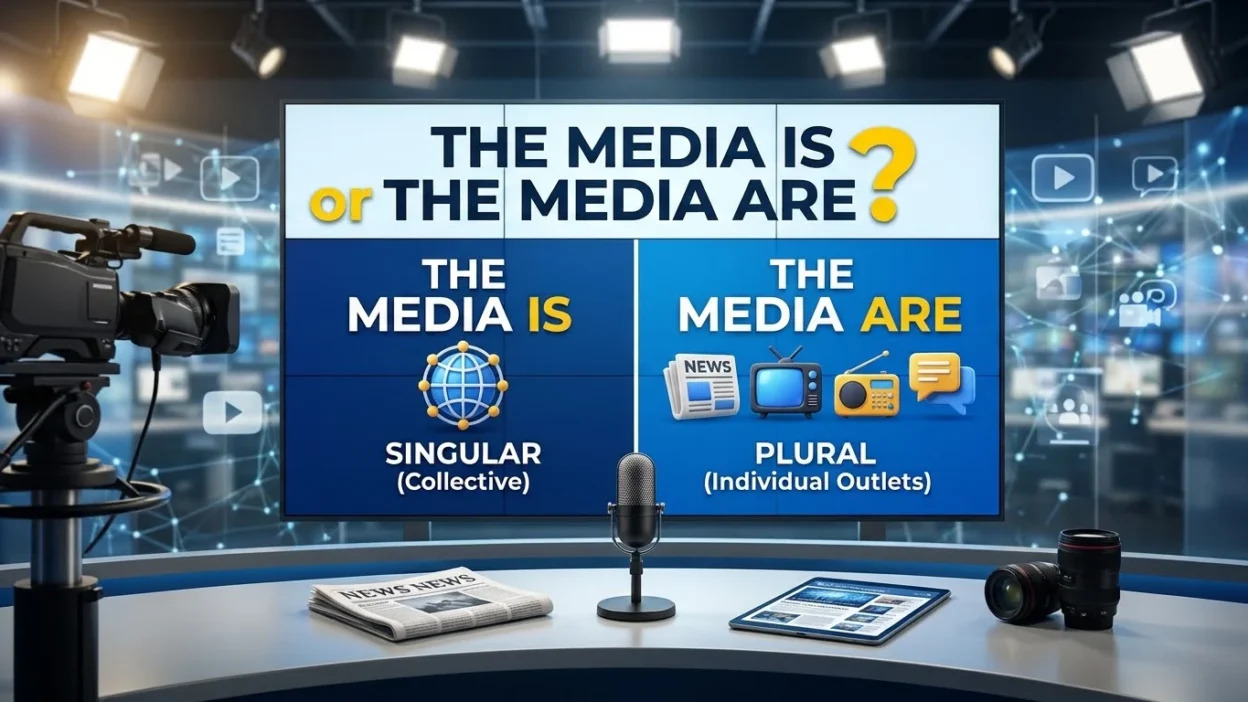
Choosing between “the media is” and “the media are” can be confusing, even for fluent English speakers. Both expressions appear in everyday writing, news reports, academic papers, and professional conversations. However, the correct choice depends on how you understand and use the word media in a sentence.
Traditionally, “the media are” is grammatically correct because media is the plural form of medium. However, modern American English also commonly treats media as a singular collective noun, making “the media is” acceptable in many situations. Understanding this difference helps you choose the right expression based on context, writing style, and intended meaning.
Quick Answer: The Media Is or the Media Are?
Both “the media is” and “the media are” are correct in modern American English. Traditionally, media is plural, so it takes the verb are. However, it is increasingly treated as a singular collective noun, especially when referring to the news industry as a whole. Use are for individual media outlets or plural elements, and is when treating the media as one unified institution.
Why Do People Confuse “The Media Is” and “The Media Are”?
People often confuse these expressions because the word media has two grammatical uses in contemporary English.
Historically, media is the plural form of medium. For example:
- Singular: One medium influences public opinion.
- Plural: Several media influence public opinion.
Following this traditional rule, media should take plural verbs such as are, have, and were.
However, language changes over time. In modern American English, media is also commonly used as a collective noun describing the news and communication industry.
When speakers think of the media as one industry or institution, they often use singular verbs such as is, has, and was.
This difference between traditional grammar and modern usage explains why both expressions appear in published writing.
What Does “Media” Mean?
The word media refers to the different methods, channels, platforms, and organizations used to communicate information, news, entertainment, and ideas.
It can include:
- Television and radio
- Newspapers and magazines
- Websites and online publications
- Social media platforms
- Podcasts and digital publications
- Advertising and communication channels
The word has two common grammatical interpretations.
Media as a Plural Noun
Traditionally, media refers to multiple communication channels or methods.
Examples:
- Different media are used to share information.
- Television and newspapers are traditional media.
- Digital media are changing how people communicate.
In these sentences, media refers to multiple forms or channels of communication.
Media as a Collective Noun
In modern American English, media can describe the news industry or mass communication as one collective entity.
Examples:
- The media is covering the election.
- The media is an important part of modern society.
- The media is responsible for reporting important developments.
Here, media is treated as one unified institution rather than several individual outlets.
What Does “The Media Are” Mean?
“The media are” is the traditional grammatical construction. It uses a plural verb because media originally functions as the plural form of medium.
This expression is particularly useful when discussing different communication channels, news organizations, or individual media outlets.
Examples of “The Media Are” in Sentences
- The media are reporting the latest developments in the election.
- The media are responsible for sharing information with the public.
- The media are becoming more influential in modern society.
- The media are changing the way people understand world events.
- The media are covering the international conference.
When Should You Use “The Media Are”?
Use “the media are” when you want to emphasize the plural nature of media organizations, outlets, or communication channels.
It is especially appropriate in:
- Formal and traditional writing.
- Academic discussions about different media forms.
- British English contexts where plural agreement is more common.
- Sentences discussing several media organizations separately.
- Writing that follows traditional grammatical conventions.
Example:
“The media are competing to publish the latest news.”
This sentence emphasizes multiple news organizations competing with one another.
What Does “The Media Is” Mean?
“The media is” treats media as a singular collective noun. This usage is common in contemporary American English, particularly when referring to the news industry as a whole.
Instead of focusing on individual newspapers, television stations, or websites, the expression describes the media as one general institution.
Examples of “The Media Is” in Sentences
- The media is an important source of public information.
- The media is covering the presidential election.
- The media is becoming increasingly influential.
- The media is changing how people consume news.
- The media is often criticized for its reporting.
When Should You Use “The Media Is”?
Use “the media is” when referring to the media industry as one collective entity.
It works particularly well in:
- Everyday American English.
- Informal conversations.
- General discussions about journalism.
- News commentary and public discussions.
- Writing that treats media organizations as one institution.
Example:
“The media is playing an important role in shaping public opinion.”
The sentence refers to the overall influence of the media industry rather than individual organizations.
The Media Is vs. The Media Are: Key Differences
Although both expressions are acceptable, their grammatical structures and traditional meanings differ.
| Comparison | The Media Is | The Media Are |
|---|---|---|
| Grammatical use | Singular collective noun | Traditional plural noun |
| Verb form | Singular | Plural |
| Meaning | Media as one institution | Media as multiple channels or organizations |
| Common usage | Modern American English | Traditional English |
| Formal writing | Acceptable | Acceptable |
| Example | The media is powerful. | The media are powerful. |
| Emphasis | The industry as a whole | Multiple media outlets or forms |
The most important difference is if you are treating media as one collective institution or as multiple individual elements.
Understanding the Grammar Behind Media
To choose the correct verb, it helps to understand the grammatical forms of medium and media.
Medium: Singular Form
Medium is a singular noun referring to one method, channel, or means of communication.
Examples:
- Television is a powerful medium.
- Radio is an effective advertising medium.
- Social media is a popular communication medium.
Media: Plural Form
Media is traditionally the plural form of medium.
Examples:
- Television and radio are different media.
- Newspapers and magazines are traditional media.
- Digital and print media are widely used.
Media as a Collective Noun
In modern American English, media can also function as a singular collective noun.
Examples:
- The media is influential.
- The media has changed significantly.
- The media was criticized for its coverage.
This singular usage is well established in American English.
Common Mistakes When Using The Media Is or The Media Are
Even experienced writers sometimes make mistakes when choosing between these expressions. Here are some common problems and their corrections.
1. Assuming Media Must Always Take a Plural Verb
Incorrect assumption: The word media is always plural.
Correct understanding: Media can be plural or singular depending on its meaning and context.
- Traditional: The media are reporting the story.
- Modern American usage: The media is reporting the story.
Both constructions can be correct.
2. Mixing Singular and Plural Verbs
Incorrect: The media is reporting their findings individually.
Better: The media are reporting their findings individually.
When referring to several media organizations acting separately, plural agreement is more natural.
3. Using the Wrong Pronoun
Incorrect: The media is changing their approach.
Better: The media is changing its approach.
When media is treated as a singular collective noun, use singular pronouns such as it and its.
When using the traditional plural form, they and their are appropriate.
4. Confusing Medium and Media
Incorrect: Television is one of the most popular medium.
Correct: Television is one of the most popular media.
Even better, depending on the intended meaning:
“Television is one of the most popular mediums.”
Although media is traditionally the plural of medium, mediums is also an established plural, particularly in everyday English.
5. Switching Between Singular and Plural Agreement
Incorrect: The media are influential, and it has a responsibility to inform the public.
Better: The media are influential, and they have a responsibility to inform the public.
Keep your verb and pronoun agreement consistent with your chosen interpretation.
How to Choose Between The Media Is and The Media Are
Choosing the right expression becomes easier when you consider what your sentence communicates.
Use “The Media Is” When:
- You are discussing the news industry as a whole.
- You are describing media as one institution.
- You are writing in contemporary American English.
- You want to emphasize a collective influence.
- You are discussing the media’s general role in society.
Example: The media is an important part of democracy.
Use “The Media Are” When:
- You are following traditional plural grammar.
- You are discussing multiple media organizations.
- You are comparing different communication channels.
- You are writing in a context that prefers plural agreement.
- You want to emphasize separate organizations or elements.
Example: The media are presenting different perspectives on the issue.
American vs. British English: Is There a Difference?
There is a genuine difference in usage tendencies between American and British English.
American English: Speakers commonly treat media as a singular collective noun when referring to the news industry. Therefore, “the media is” is widely accepted.
British English: Traditional plural agreement is generally more common, particularly in formal writing. As a result, “the media are” is frequently preferred.
However, this is a difference in usage preference, not an absolute grammatical rule. Both varieties of English can use singular and plural agreement depending on context.
If you are writing for an American audience, using “the media is” for the news industry is perfectly natural.
Similar and Related Words
Understanding related vocabulary can make it easier to use media correctly.
| Word | Meaning | Example |
|---|---|---|
| Medium | A single communication channel | Television is a medium. |
| Mass media | Communication channels reaching large audiences | Mass media influence public opinion. |
| Social media | Digital platforms for social interaction | Social media is widely used. |
| Journalism | The activity of gathering and reporting news | Journalism plays an important role. |
| Press | Newspapers, journalists, and news organizations | The press is covering the story. |
| News outlets | Organizations that publish news | Several news outlets are reporting the event. |
| Broadcasting | Transmitting programs through radio or television | Broadcasting reaches millions of people. |
| Communication | Sharing information and ideas | Communication is essential. |
These terms are related, but they are not always interchangeable.
Remember This: The Media Is or The Media Are?
Keep these simple points in mind:
- The media is: Use when treating the media as one collective industry or institution.
- The media are: Use when emphasizing multiple media organizations or communication channels.
- Medium: Traditionally the singular form.
- Media: Traditionally the plural form.
- American English: Singular agreement is especially common when discussing the news industry.
- British English: Traditional plural agreement is generally more common.
The easiest memory trick is to ask yourself: Am I talking about one industry or several individual organizations?
If you mean one collective industry, is works. If you mean multiple separate elements, are works.
FAQs:
1. Is “The Media Is” Grammatically Correct?
Yes. “The media is” is grammatically acceptable in modern American English when media refers to the news industry as one collective institution. Although traditionally plural, the word is now frequently treated as a singular collective noun.
2. Is “The Media Are” More Correct Than “The Media Is”?
Not necessarily. “The media are” follows traditional plural grammar, while “the media is” reflects established modern usage. Neither is universally more correct. The best choice depends on meaning, audience, and writing style.
3. Is Media Singular or Plural?
Traditionally, media is the plural form of medium. However, it can also function as a singular collective noun, particularly in American English. Its grammatical number depends on how the writer uses the word.
4. Should I Write “The Media Has” or “The Media Have”?
Both can be correct. Use “the media has” when treating the media as one collective institution. Use “the media have” when following traditional plural agreement or emphasizing multiple organizations.
5. Is “Social Media Is” or “Social Media Are” Correct?
“Social media is” is the standard choice in contemporary American English when referring to social media collectively. “Social media are” can also appear when emphasizing multiple platforms or communication channels, although it is less common.
6. Do British People Say “The Media Are”?
Yes. British English commonly uses “the media are,” especially in formal contexts. However, singular agreement is also possible. The choice depends on if the media is understood as one institution or multiple organizations.
7. What Is the Singular Form of Media?
The traditional singular form of media is medium. For example, television is a medium, while television and radio are different media. However, media can function as a singular collective noun in modern English.
Final Verdict
Both “the media is” and “the media are” are grammatically acceptable in modern English. The traditional plural form is “the media are,” while contemporary American English frequently uses “the media is” when referring to the news industry as a whole. Neither expression is automatically wrong.
For everyday American writing, choose “the media is” when discussing the media as one collective institution. Choose “the media are” when emphasizing separate organizations or communication channels. Most importantly, maintain consistent verb and pronoun agreement throughout your sentence. Understanding this simple distinction will help you write more naturally and confidently.

Henry Isaac is an author at BibleL Says, a platform dedicated to explaining Bible meanings simply. He writes clear, insightful articles to help readers understand scripture and spiritual concepts easily.