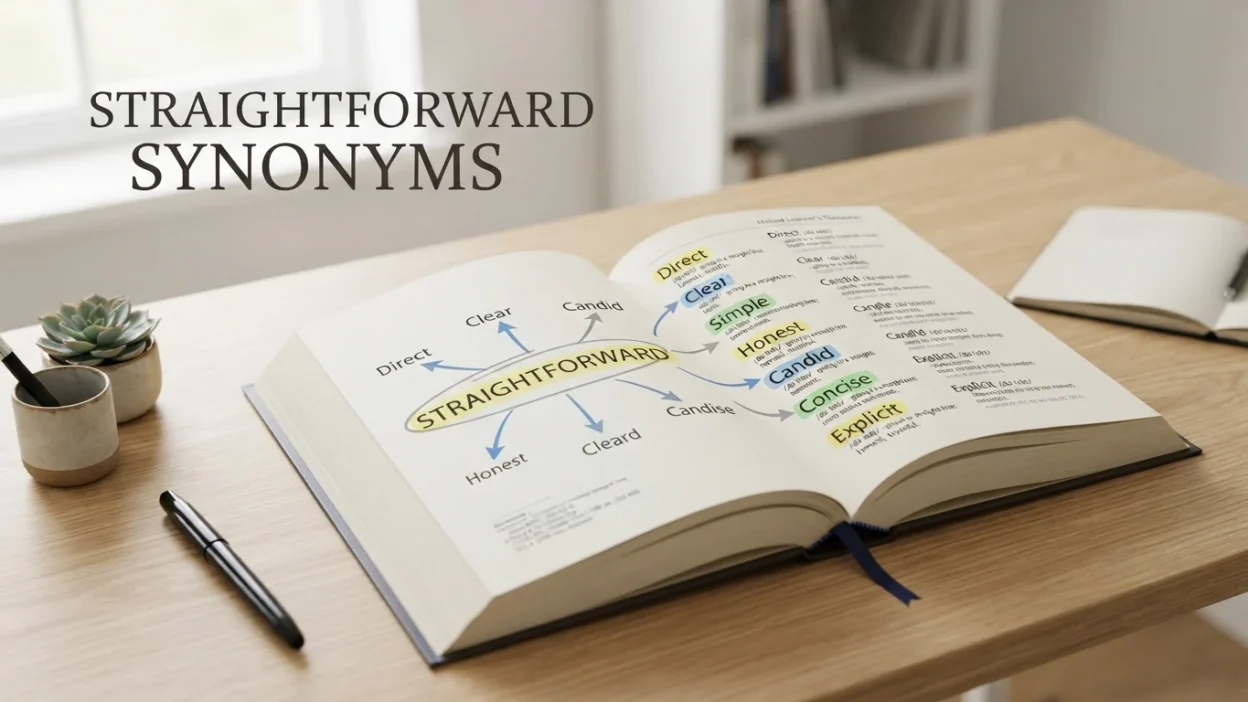
Finding the right straightforward synonyms can make your writing clearer, more natural, and more effective. The word “straightforward” is commonly used to describe something that is simple, direct, honest, or easy to understand. However, its best replacement depends on the exact meaning you want to express.
For students, ESL learners, writers, and content creators, learning related words is useful because synonyms are not always interchangeable. For example, “direct” may describe communication, while “simple” may describe a process or idea. Understanding these small differences helps you choose vocabulary more accurately.
What Does “Straightforward” Mean?
Straightforward means simple, clear, direct, and easy to understand. It can also describe a person who speaks honestly and does not hide their opinions or intentions.
For example:
- “She gave me a straightforward answer.”
- “The instructions are straightforward.”
- “He is a straightforward person.”
Depending on the sentence, straightforward can suggest clarity, honesty, simplicity, openness, or lack of complication.
30 Straightforward Synonyms
Here are 30 useful alternatives, along with simple meanings, examples, and the situations where each word works best.
1. Direct
Meaning: Clear and honest without unnecessary explanation.
Example: “She gave a direct answer to the question.”
Best usage: Communication, answers, instructions, and opinions.
2. Simple
Meaning: Easy to understand or do.
Example: “The process is simple and requires only three steps.”
Best usage: Instructions, processes, ideas, and explanations.
3. Clear
Meaning: Easy to understand and not confusing.
Example: “His explanation was clear and helpful.”
Best usage: Explanations, writing, instructions, and communication.
4. Plain
Meaning: Easy to understand and expressed without complicated language.
Example: “Please explain the issue in plain language.”
Best usage: Everyday communication and accessible writing.
5. Uncomplicated
Meaning: Not difficult, confusing, or complex.
Example: “The application process is uncomplicated.”
Best usage: Processes, situations, tasks, and systems.
6. Honest
Meaning: Truthful and sincere.
Example: “I appreciate your honest opinion.”
Best usage: People, opinions, conversations, and feedback.
7. Frank
Meaning: Open and honest, especially when discussing something difficult.
Example: “She was frank about the problems with the project.”
Best usage: Opinions, criticism, and serious conversations.
8. Candid
Meaning: Honest and open about your thoughts or feelings.
Example: “He gave a candid assessment of the situation.”
Best usage: Professional discussions, interviews, opinions, and feedback.
9. Explicit
Meaning: Stated clearly and in detail.
Example: “The teacher gave explicit instructions.”
Best usage: Rules, instructions, requirements, and explanations.
10. Unambiguous
Meaning: Having only one clear meaning.
Example: “The contract contains an unambiguous statement about payment.”
Best usage: Legal, academic, technical, and formal writing.
11. Transparent
Meaning: Open, clear, and easy to understand.
Example: “The company has a transparent hiring process.”
Best usage: Business, organizations, policies, and decision-making.
12. Open
Meaning: Honest and willing to share information or opinions.
Example: “She was open about her concerns.”
Best usage: Personal communication, discussions, and relationships.
13. Matter-of-fact
Meaning: Calm and practical without showing strong emotion.
Example: “He gave a matter-of-fact explanation of what happened.”
Best usage: Factual descriptions and calm communication.
14. Concise
Meaning: Short but containing the necessary information.
Example: “Her concise response answered all of my questions.”
Best usage: Writing, emails, reports, and professional communication.
15. Succinct
Meaning: Expressed clearly using very few words.
Example: “The manager gave a succinct summary of the meeting.”
Best usage: Formal writing, presentations, and summaries.
16. Coherent
Meaning: Logical, organized, and easy to follow.
Example: “The student presented a coherent argument.”
Best usage: Essays, arguments, explanations, and academic writing.
17. Logical
Meaning: Based on clear reasoning.
Example: “She provided a logical explanation for her decision.”
Best usage: Arguments, decisions, explanations, and problem-solving.
18. Intelligible
Meaning: Clear enough to be understood.
Example: “The speaker made the complicated topic intelligible.”
Best usage: Formal or academic descriptions of communication.
19. Understandable
Meaning: Easy enough to understand.
Example: “The instructions are understandable even for beginners.”
Best usage: Instructions, explanations, educational content, and ESL writing.
20. Accessible
Meaning: Easy for people to understand, use, or approach.
Example: “The website provides accessible information for new users.”
Best usage: Education, websites, information, and public communication.
21. Uncompromising
Meaning: Very firm and unwilling to change a position.
Example: “The company took an uncompromising position on safety.”
Best usage: Strong attitudes, policies, and firm positions.
22. Decisive
Meaning: Clear and firm when making choices or taking action.
Example: “The director made a decisive decision.”
Best usage: Leadership, decisions, and actions.
23. Unpretentious
Meaning: Simple and natural without trying to appear important.
Example: “The restaurant has an unpretentious atmosphere.”
Best usage: People, places, styles, and personalities.
24. Sincere
Meaning: Genuine and honest rather than false or artificial.
Example: “She offered a sincere apology.”
Best usage: Feelings, apologies, statements, and relationships.
25. Genuine
Meaning: Real, authentic, and not fake.
Example: “His interest in the project seemed genuine.”
Best usage: Feelings, people, intentions, and reactions.
26. Transparent-minded
Meaning: Open and easy to understand in one’s intentions or thinking.
Example: “The leader was transparent about the reasons for the change.”
Best usage: Use transparent rather than “transparent-minded” in most standard writing.
27. Unvarnished
Meaning: Presented honestly without making it seem better than it is.
Example: “The report provided an unvarnished account of the failure.”
Best usage: Honest criticism, reports, and serious discussions.
28. Matter-of-fact
Meaning: Practical, factual, and without unnecessary emotion.
Example: “Her matter-of-fact response kept the discussion focused.”
Best usage: Factual conversations and descriptions.
29. To the point
Meaning: Focused on the important information without unnecessary details.
Example: “His presentation was short and to the point.”
Best usage: Speeches, writing, conversations, and presentations.
30. No-nonsense
Meaning: Practical, direct, and not interested in unnecessary complications.
Example: “The manager has a no-nonsense approach to solving problems.”
Best usage: Informal descriptions of people, attitudes, and approaches.
Quick Comparison of Straightforward Synonyms
| Synonym | Main Meaning | Best Context | Tone |
|---|---|---|---|
| Direct | Clear and honest | Communication | Neutral |
| Simple | Easy and uncomplicated | Processes and ideas | Neutral |
| Clear | Easy to understand | Explanations | Neutral |
| Plain | Easy, ordinary language | Everyday writing | Neutral |
| Frank | Very honest | Difficult conversations | Direct |
| Candid | Open and honest | Feedback and opinions | Professional |
| Explicit | Clearly stated | Rules and instructions | Formal |
| Transparent | Open and clear | Business and policies | Professional |
| Concise | Brief and clear | Writing | Formal |
| Succinct | Very brief and precise | Summaries | Formal |
| Logical | Based on reasoning | Arguments | Neutral |
| Sincere | Genuine and honest | Feelings and apologies | Warm |
| Genuine | Real and authentic | People and emotions | Positive |
| Unambiguous | Has one clear meaning | Technical/legal writing | Formal |
| No-nonsense | Practical and direct | People and approaches | Informal |
Straightforward Synonyms by Meaning
Not every synonym for straightforward has exactly the same meaning. Choosing the right word starts with identifying what you mean by “straightforward.”
When You Mean “Easy”
Use:
- Simple
- Clear
- Understandable
- Uncomplicated
- Accessible
Example:
“The instructions are straightforward.”
Possible alternatives:
- “The instructions are simple.”
- “The instructions are clear.”
- “The instructions are easy to understand.”
When You Mean “Honest”
Use:
- Honest
- Frank
- Candid
- Sincere
- Genuine
- Open
Example:
“She gave me a straightforward opinion.”
You could write:
- “She gave me an honest opinion.”
- “She gave me a candid opinion.”
- “She gave me a frank opinion.”
When You Mean “Direct”
Use:
- Direct
- Explicit
- Plain
- To the point
- No-nonsense
Example:
“His response was straightforward.”
A stronger alternative might be:
“His response was direct and to the point.”
When You Mean “Clear and Precise”
Use:
- Clear
- Concise
- Succinct
- Unambiguous
- Coherent
These words are especially useful in academic, professional, and technical writing.
How to Choose the Right Synonym
For Academic Writing
Choose words such as:
- Clear
- Explicit
- Concise
- Succinct
- Coherent
- Logical
- Unambiguous
These words sound precise without being overly conversational.
Example:
Instead of:
“The author gives a straightforward explanation.”
Try:
“The author provides a clear and coherent explanation.”
For Professional Writing
Good choices include:
- Direct
- Clear
- Transparent
- Concise
- Explicit
- Candid
For example:
“The manager gave a straightforward response.”
can become:
“The manager gave a direct response.”
For Casual Conversation
Use:
- Simple
- Plain
- Direct
- Honest
- Open
- No-nonsense
These words sound natural in everyday English.
For Describing a Person
The best choice depends on the person’s behavior.
Use honest when the person tells the truth.
Use direct when the person communicates without avoiding the point.
Use frank when the person speaks openly, even about uncomfortable topics.
Use candid when the person shares genuine opinions or feelings.
Use no-nonsense when the person is practical and does not tolerate unnecessary complications.
For Describing Instructions
The strongest options are:
- Clear
- Simple
- Explicit
- Uncomplicated
- Understandable
For example:
“The instructions are straightforward.”
could become:
“The instructions are clear and easy to follow.”
Straightforward vs. Direct
“Straightforward” and “direct” are closely related, but they are not always identical.
Straightforward often suggests that something is simple, uncomplicated, or easy to understand.
Direct focuses more strongly on communication without indirect language.
Compare:
- “The assignment is straightforward.” → The assignment is easy to understand or complete.
- “The teacher was direct.” → The teacher communicated clearly and openly.
Straightforward vs. Simple
These words are also similar but have different uses.
Simple usually means not complicated.
Straightforward can mean simple, but it can also mean direct or honest.
For example:
“The solution is simple.”
This focuses on the lack of complexity.
“The manager gave a straightforward answer.”
This focuses on clarity and directness.
Straightforward vs. Honest
“Honest” is mainly connected to truthfulness.
“Straightforward” can suggest honesty, but it can also describe something that is easy or uncomplicated.
For example:
“She is honest about her mistakes.”
This emphasizes truthfulness.
“She is straightforward when discussing mistakes.”
This emphasizes her direct communication style.
Why Use Synonyms for Straightforward?
Using synonyms makes your writing more precise and interesting. Repeating “straightforward” in every sentence can make an article, essay, or conversation sound repetitive.
Instead, select a synonym based on your intended meaning.
For example:
- Simple → when something is easy.
- Direct → when communication is clear.
- Candid → when someone is openly honest.
- Concise → when information is brief.
- Unambiguous → when something has only one clear meaning.
- Transparent → when information is openly shared.
This approach improves vocabulary without forcing complicated words into your writing.
Common Mistakes When Using Straightforward Synonyms
One common mistake is assuming that every synonym can replace “straightforward” in every sentence. Synonyms usually share a general meaning but differ in tone and context.
For example, replacing “straightforward” with “uncompromising” can change the meaning significantly. “Uncompromising” suggests firmness and unwillingness to change, rather than simple or clear communication.
Another mistake is choosing formal words when a simple word would sound more natural. “Unambiguous” may be suitable for a legal document, but “clear” is often better for everyday communication.
The best synonym is not necessarily the most sophisticated word. It is the word that communicates your intended meaning most accurately.
Final Thoughts
Learning straightforward synonyms is a practical way to improve English vocabulary and make your writing more precise. Words such as direct, clear, simple, honest, candid, concise, explicit, transparent, and unambiguous can all relate to straightforwardness, but each has its own tone and purpose.
For ESL learners and students, start with common alternatives such as clear, simple, direct, honest, and understandable. As your vocabulary develops, you can use more precise choices such as candid, succinct, coherent, unambiguous, and unvarnished.
The key is to focus on meaning rather than simply replacing one word with another. When you understand the small differences between synonyms, your writing becomes clearer, more natural, and more effective.
FAQs:
What is the best synonym for straightforward?
Direct is one of the closest synonyms when straightforward means clear and honest. However, simple or clear may be better when describing something easy to understand.
What is another word for straightforward communication?
Useful alternatives include direct communication, clear communication, honest communication, open communication, and candid communication.
What is a professional synonym for straightforward?
Depending on context, direct, clear, concise, explicit, transparent, or unambiguous can work well in professional writing.
What is a simple synonym for straightforward?
The easiest alternatives are simple, clear, easy, and understandable.
Is straightforward positive or negative?
“Straightforward” is usually neutral or positive. It often suggests clarity, honesty, simplicity, and practicality, although a very direct person may sometimes be perceived as blunt.
Can straightforward mean honest?
Yes. When describing a person or communication style, “straightforward” can mean open, direct, and honest. However, honest, frank, or candid may be more precise when truthfulness is the main idea.

Sarah Sophia is the administrator of Biblelsays.com, a platform dedicated to Bible meanings and explanations, where she helps manage content, organization, and educational resources for readers seeking spiritual understanding online.