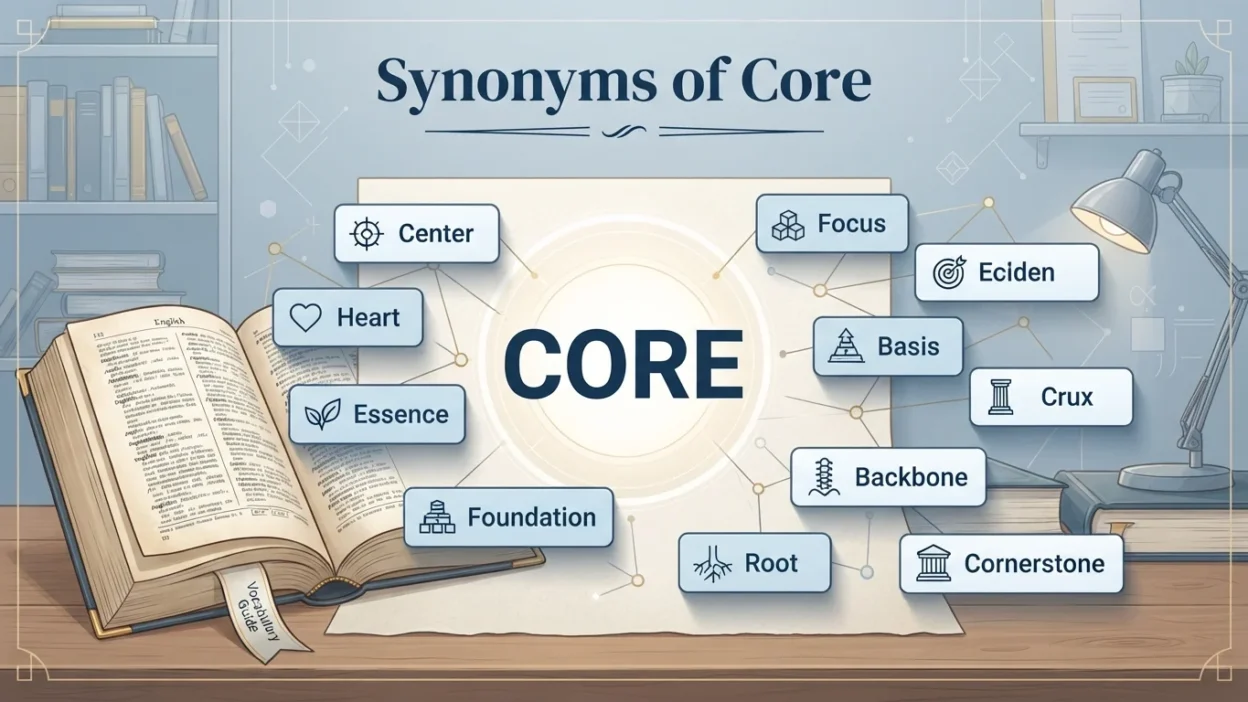
Finding the right synonyms of core can make your writing clearer, more precise, and more interesting. The word core is common in everyday English, academic writing, business communication, and creative content. However, its best synonym depends on what you mean.
“Core” can refer to the central part of something, its most important idea, or the fundamental principles behind it. For example, you can say “the core of the problem,” “the core team,” or “the core of an apple.” Each meaning may require a different alternative.
Learning related words helps students, ESL learners, writers, and content creators avoid repetition while choosing vocabulary that matches the intended meaning and tone.
What Does “Core” Mean?
In simple English, core means the central, most important, or essential part of something.
For example:
- The core of an apple is the hard center containing the seeds.
- Trust is at the core of a strong friendship.
- Mathematics is a core subject at the school.
- The core issue is the main problem that needs attention.
The word can describe something physical or something abstract. Because of this, its synonyms can vary depending on the sentence.
30 Synonyms of Core
Here are 30 useful alternatives to core, with simple meanings, examples, and usage contexts.
1. Center
Meaning: The middle or most central part of something.
Example: The park is located at the center of the city.
Best usage: Physical location or central position.
2. Heart
Meaning: The most important or central part of something.
Example: Communication is at the heart of a successful relationship.
Best usage: Emotional, personal, or figurative writing.
3. Essence
Meaning: The basic or most important quality of something.
Example: Kindness is the essence of her personality.
Best usage: Abstract ideas, qualities, and philosophical writing.
4. Crux
Meaning: The most important or difficult part of an issue.
Example: The crux of the argument is the lack of reliable evidence.
Best usage: Formal, academic, and analytical writing.
5. Gist
Meaning: The main idea or basic meaning.
Example: I understood the gist of the presentation.
Best usage: Conversations and informal explanations.
6. Substance
Meaning: The important or meaningful content of something.
Example: The article has plenty of style but little substance.
Best usage: Writing, arguments, discussions, and ideas.
7. Foundation
Meaning: The basic support on which something is built.
Example: Trust is the foundation of a healthy partnership.
Best usage: Systems, relationships, organizations, and ideas.
8. Basis
Meaning: The main reason or starting point for something.
Example: Evidence formed the basis of the investigation.
Best usage: Academic, professional, and formal writing.
9. Nucleus
Meaning: The central or most important group or part.
Example: A small nucleus of researchers continued the project.
Best usage: Scientific, technical, or formal contexts.
10. Focus
Meaning: The main thing receiving attention.
Example: Customer satisfaction is the focus of the new strategy.
Best usage: Business, education, projects, and discussions.
11. Mainstay
Meaning: A person or thing that provides essential support.
Example: Local businesses are a mainstay of the community.
Best usage: Describing important support or stability.
12. Backbone
Meaning: The main support or strength of something.
Example: Small businesses are the backbone of many communities.
Best usage: Organizations, systems, economies, and groups.
13. Pillar
Meaning: An important person, principle, or element that supports something.
Example: Honesty is a key pillar of effective leadership.
Best usage: Formal and figurative writing.
14. Cornerstone
Meaning: An essential part on which something depends.
Example: Education is a cornerstone of social development.
Best usage: Formal, academic, and professional writing.
15. Kernel
Meaning: The central or essential part of an idea.
Example: There was a kernel of truth in his explanation.
Best usage: Ideas, arguments, and abstract concepts.
16. Nucleus
Meaning: The central part around which other things develop.
Example: The nucleus of the organization consisted of five experienced members.
Best usage: Scientific or formal contexts.
17. Pivot
Meaning: A central point around which something changes or develops.
Example: The new product became the pivot of the company’s strategy.
Best usage: Business, strategy, and change.
18. Focus
Meaning: The main point or area of attention.
Example: Safety should remain the focus of the project.
Best usage: Goals, projects, discussions, and planning.
19. Main Part
Meaning: The most important section of something.
Example: The main part of the report discusses the research findings.
Best usage: Simple everyday English.
20. Central Point
Meaning: The most important idea or issue.
Example: The central point of the lesson was effective communication.
Best usage: Essays, lessons, presentations, and explanations.
21. Central Idea
Meaning: The main thought or message.
Example: The central idea of the story is the importance of friendship.
Best usage: Literature, essays, and educational writing.
22. Principle
Meaning: A basic belief, rule, or idea.
Example: Equality is one of the core principles of the organization.
Best usage: Values, ethics, rules, and beliefs.
23. Fundamental
Meaning: Basic and extremely important.
Example: Reading is a fundamental skill for academic success.
Best usage: Education, academic writing, and formal contexts.
24. Essential
Meaning: Absolutely necessary or extremely important.
Example: Clear communication is essential to teamwork.
Best usage: General, professional, and academic writing.
25. Mainstay
Meaning: Something that provides dependable support.
Example: Tourism is a mainstay of the local economy.
Best usage: Economics, communities, and organizations.
26. Root
Meaning: The basic cause or source of something.
Example: The root of the problem was poor communication.
Best usage: Problems, causes, and analysis.
27. Source
Meaning: The place, person, or thing from which something begins or comes.
Example: Researchers identified the source of the problem.
Best usage: Causes, origins, information, and resources.
28. Hub
Meaning: A central place where activity or communication happens.
Example: The city has become a major technology hub.
Best usage: Places, business, transportation, and technology.
29. Core Element
Meaning: A basic and necessary part of something.
Example: Creativity is a core element of the design process.
Best usage: Professional, educational, and explanatory writing.
30. Integral Part
Meaning: A necessary part that belongs naturally to a whole.
Example: Teamwork is an integral part of the company’s culture.
Best usage: Formal and professional writing.
Quick Comparison of Synonyms for Core
| Synonym | Simple Meaning | Best Context | Tone |
|---|---|---|---|
| Center | Middle part | Physical or general | Neutral |
| Heart | Most important part | Emotional/figurative | Warm |
| Essence | Basic quality | Abstract ideas | Formal |
| Crux | Most important issue | Analysis | Formal |
| Gist | Main idea | Conversation | Informal |
| Foundation | Basic support | Systems/ideas | Neutral |
| Basis | Starting reason | Academic/business | Formal |
| Backbone | Main support | Organizations | Figurative |
| Cornerstone | Essential foundation | Professional/academic | Formal |
| Root | Basic cause | Problems | Analytical |
| Hub | Central place | Business/technology | Modern |
| Focus | Main area of attention | Projects | Neutral |
| Nucleus | Central group/part | Science/formal | Technical |
| Substance | Meaningful content | Writing/arguments | Formal |
| Integral part | Necessary component | Professional | Formal |
How to Choose the Right Synonym
Not every synonym of core works in every sentence. The meaning and tone of your sentence should guide your choice.
For “Most Important Part”
Use:
- Heart
- Essence
- Center
- Crux
- Central point
Example:
Here, “heart” sounds more natural than “center.”
For “Basic Support”
Use:
- Foundation
- Basis
- Backbone
- Cornerstone
- Pillar
Example:
These words work especially well when something supports or strengthens another thing.
For “Main Idea”
Use:
- Gist
- Central idea
- Central point
- Essence
- Substance
Example:
“Gist” is particularly useful when you want a simple, conversational expression.
For “Cause or Origin”
Use:
- Root
- Source
- Basis
Example:
These words are useful in analytical and problem-solving contexts.
For Formal or Academic Writing
Consider:
- Crux
- Essence
- Foundation
- Basis
- Cornerstone
- Nucleus
- Integral part
Example:
For Business and Professional Writing
Useful choices include:
- Focus
- Foundation
- Backbone
- Cornerstone
- Hub
- Pillar
- Integral part
Example:
Core vs. Its Closest Synonyms
The word core is flexible because it can describe both physical objects and abstract ideas.
Core vs. Center:
“Center” usually emphasizes location, while “core” often emphasizes importance.
Core vs. Essence:
“Essence” refers to the basic quality or nature of something.
Core vs. Heart:
“Heart” often has a warmer or more emotional tone.
Core vs. Crux:
“Crux” specifically refers to the most important or difficult point in an issue.
Core vs. Foundation:
“Foundation” emphasizes support, while “core” emphasizes central importance.
Core vs. Root:
“Root” often refers to the underlying cause or origin.
Common Phrases With “Core”
Understanding common expressions can also help you use the word naturally.
- At the core of — at the most important part
- Core values — basic beliefs that guide a person or organization
- Core issue — the main problem
- Core principle — a fundamental belief or rule
- Core skills — essential abilities
- Core members — the most important or central members
- Core subject — an essential subject in a course or curriculum
- Core concept — a basic and important idea
For example:
Why Learning Synonyms of Core Matters
Knowing alternatives to core improves your vocabulary and helps you communicate more precisely.
Instead of repeatedly writing “core,” you can select a word that expresses the exact relationship you mean. Crux can highlight a difficult issue, foundation can show support, and essence can describe the basic nature of something.
For ESL learners, this distinction is especially useful because English synonyms are rarely identical in every situation. Learning the context and tone of each word is more valuable than simply memorizing a list.
Final Thoughts
The best synonyms of core depend on the meaning you want to express. Words such as center, heart, essence, crux, foundation, basis, backbone, cornerstone, root, focus, and nucleus can all replace “core” in certain contexts.
The key is to consider if you mean the middle, main idea, essential quality, supporting structure, or underlying cause. Choosing the right synonym makes your writing more natural, accurate, and engaging.
For everyday English, words such as center, heart, focus, and main part are easy choices. For formal writing, crux, essence, foundation, cornerstone, and basis can provide greater precision.

Henry Isaac is an author at BibleL Says, a platform dedicated to explaining Bible meanings simply. He writes clear, insightful articles to help readers understand scripture and spiritual concepts easily.