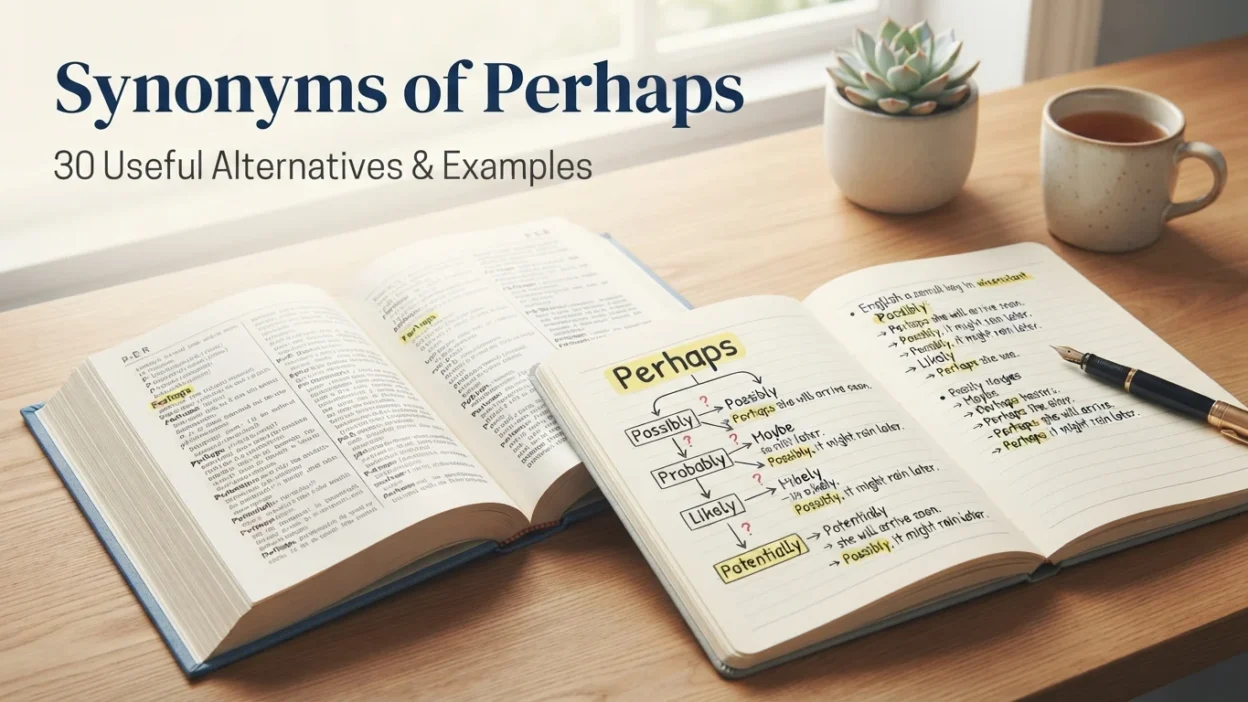
Perhaps is a common English word used when something is possible but not certain. It can mean “maybe,” “possibly,” or “it may be true.” For example, “Perhaps we should leave early” means that leaving early is one possible idea.
Learning the synonyms of perhaps can help students, ESL learners, writers, and content creators express uncertainty in more natural and varied ways. Although many alternatives have similar meanings, they do not always have the same tone or level of formality.
Choosing the right word depends on the situation. Maybe sounds casual, possibly is more neutral or formal, and expressions such as it is conceivable that sound much more formal. Understanding these small differences can make your English clearer and more precise.
What Does “Perhaps” Mean?
Perhaps is an adverb that shows uncertainty or possibility. It is used when you do not want to say that something is definitely true or definitely going to happen.
Simple meaning
Examples
- Perhaps she will call tonight.
- Perhaps we should try another approach.
- He is perhaps the most experienced person on the team.
Tone and usage
“Perhaps” is generally neutral and polite. It can work in casual conversations, academic writing, professional communication, and creative writing.
Compared with “maybe,” perhaps can sometimes sound slightly more polished or formal.
30 Synonyms of Perhaps
Below are 30 useful alternatives to “perhaps,” with simple meanings, examples, and guidance on when to use them.
1. Maybe
Meaning: Something may be true or may happen, but you are not certain.
Example: Maybe we should wait until tomorrow.
Best usage: Everyday conversation and casual writing.
2. Possibly
Meaning: Something could happen or could be true.
Example: She could possibly arrive before noon.
Best usage: Neutral, professional, and academic contexts.
3. Potentially
Meaning: Something could happen or become possible under certain circumstances.
Example: This decision could potentially save the company money.
Best usage: Business, academic, and professional writing.
4. Conceivably
Meaning: Something is possible, even though it may not seem very likely.
Example: Conceivably, the project could be completed within a month.
Best usage: Formal writing and careful discussion of possibilities.
5. Perchance
Meaning: Perhaps or by chance.
Example: Perchance you will meet an old friend during your travels.
Best usage: Literary, poetic, or old-fashioned writing.
6. It may be
Meaning: There is a possibility that something is true.
Example: It may be that we misunderstood the instructions.
Best usage: Formal or thoughtful writing.
7. It might be
Meaning: Something is possible but uncertain.
Example: It might be better to postpone the meeting.
Best usage: Everyday and professional English.
8. It could be
Meaning: There is one possible explanation or outcome.
Example: It could be that the train has already left.
Best usage: Conversation and explanatory writing.
9. In all likelihood
Meaning: Something is probably true or likely to happen.
Example: In all likelihood, they will accept the proposal.
Best usage: Formal writing when the possibility is fairly strong.
Note: This is closer to “probably” than “perhaps,” so it should not replace “perhaps” in every sentence.
10. Probably
Meaning: Something is likely to happen or be true.
Example: She will probably arrive later.
Best usage: Everyday and general writing.
Note: “Probably” expresses more confidence than “perhaps.”
11. Likely
Meaning: Something has a good chance of happening or being true.
Example: The weather is likely to improve tomorrow.
Best usage: Professional, academic, and everyday English.
12. Presumably
Meaning: You believe something is probably true based on what you know.
Example: Presumably, they have already received the message.
Best usage: Formal and analytical writing.
13. Apparently
Meaning: Something seems to be true based on information you have heard or seen.
Example: Apparently, the store is closing next month.
Best usage: Conversation, journalism, and general writing.
Note: “Apparently” is not a perfect synonym for “perhaps” because it often suggests that there is evidence or information behind the statement.
14. Seemingly
Meaning: Something appears to be true, although you are not completely certain.
Example: The seemingly simple task took several hours.
Best usage: Formal, descriptive, and analytical writing.
15. Arguably
Meaning: Something can reasonably be considered true, although people may disagree.
Example: She is arguably the best player on the team.
Best usage: Essays, academic writing, criticism, and persuasive writing.
16. Alternatively
Meaning: Another possibility or choice is available.
Example: Alternatively, we could meet on Friday.
Best usage: Presenting another option rather than expressing simple uncertainty.
17. Perhaps so
Meaning: It may be true.
Example: “Do you think he is right?” “Perhaps so.”
Best usage: Short replies and conversational English.
18. Perhaps not
Meaning: Something may not be true or may not happen.
Example: Perhaps not everyone will agree with the decision.
Best usage: Conversation and cautious writing.
19. At a guess
Meaning: Based on an uncertain estimate or guess.
Example: At a guess, I would say the journey takes about three hours.
Best usage: Informal conversation.
20. For all I know
Meaning: You do not have enough information to know whether something is true.
Example: For all I know, they may have already left.
Best usage: Informal conversation.
21. For all we know
Meaning: The available information does not tell us whether something is true.
Example: For all we know, the package could arrive today.
Best usage: Conversation and informal writing.
22. It is possible
Meaning: Something could happen or be true.
Example: It is possible that prices will increase next year.
Best usage: Academic, professional, and formal writing.
23. There is a chance
Meaning: Something may happen.
Example: There is a chance that we will finish early.
Best usage: Everyday and professional communication.
24. There is a possibility
Meaning: Something might happen or be true.
Example: There is a possibility that the event will be canceled.
Best usage: Formal and professional writing.
25. By any chance
Meaning: Used when asking whether something might be true or possible.
Example: Do you have, by any chance, a copy of the report?
Best usage: Polite questions.
26. If possible
Meaning: Used when something may be possible under the circumstances.
Example: If possible, please send the document today.
Best usage: Requests, instructions, and professional communication.
27. It is conceivable
Meaning: Something is possible to imagine or consider.
Example: It is conceivable that technology will change the industry completely.
Best usage: Formal and academic writing.
28. It could happen
Meaning: An event is possible, although it is uncertain.
Example: It could happen if the weather becomes worse.
Best usage: Everyday explanations and conversations.
29. There is a possibility that
Meaning: Something may happen or be true.
Example: There is a possibility that the results will be delayed.
Best usage: Formal reports and professional writing.
30. For all we can tell
Meaning: Based on the information currently available, something may be true.
Example: For all we can tell, the problem has already been fixed.
Best usage: Formal or careful discussion when information is limited.
Quick Comparison: Which Synonym of Perhaps Should You Use?
| Word or phraseLevel of certaintyToneBest context | |||
|---|---|---|---|
| Maybe | Uncertain | Casual | Conversation |
| Perhaps | Uncertain | Neutral/polite | General use |
| Possibly | Uncertain | Neutral/formal | Academic & professional |
| Potentially | Possible | Professional | Business & reports |
| Conceivably | Possible but sometimes unlikely | Formal | Academic writing |
| Probably | Fairly likely | Neutral | General use |
| Likely | Fairly likely | Neutral/formal | General & professional |
| Presumably | Probably true based on evidence | Formal | Analytical writing |
| Apparently | Seems true from information | Neutral | Conversation & reporting |
| Arguably | Reasonably defensible | Formal | Essays & arguments |
| Perchance | Uncertain | Literary | Creative writing |
| There is a chance | Possible | Neutral | General communication |
| It is possible | Possible | Formal | Academic/professional |
| By any chance | Possible | Polite | Questions |
The most important distinction is certainty. “Maybe” and “perhaps” show uncertainty, while “probably” and “likely” suggest a stronger possibility.
How to Choose the Right Synonym of Perhaps
The best synonym depends on your intention, audience, and tone.
For casual conversation
Use:
- Maybe
- It might be
- It could be
- At a guess
- For all I know
Example:
“Maybe we can go tomorrow.”
These choices sound natural and relaxed.
For academic writing
Use:
- Possibly
- Potentially
- Conceivably
- It is possible
- Arguably
Example:
“This result could potentially indicate a change in consumer behavior.”
These expressions can make academic writing more precise without sounding overly conversational.
For professional writing
Use:
- Possibly
- Potentially
- It is possible
- There is a possibility
- Presumably
Example:
“There is a possibility that the deadline will need to be extended.”
For literary or creative writing
Use:
- Perchance
- Conceivably
- Perhaps
- Seemingly
Example:
“Perchance, they would meet again beneath the old oak tree.”
“Perchance” is especially useful when you want an old-fashioned or poetic atmosphere.
When you want to sound more certain
Use:
- Probably
- Likely
- In all likelihood
Example:
“She will probably join us later.”
Remember that these are not always exact replacements for “perhaps.” They communicate a higher degree of confidence.
“Perhaps” vs. “Maybe”
“Perhaps” and “maybe” are among the closest synonyms.
Perhaps
“Perhaps” can sound slightly more polished or formal.
Example:
“Perhaps we should reconsider the plan.”
Maybe
“Maybe” is extremely common in everyday English.
Example:
“Maybe we should reconsider the plan.”
Both sentences are correct. The choice mainly depends on tone and personal style.
“Perhaps” vs. “Possibly”
These words are also very close, but “possibly” is often more useful when discussing whether something can happen.
Perhaps:
“Perhaps she will come.”
Possibly:
“She could possibly come later.”
In formal or academic writing, possibly can sometimes sound more precise than “maybe.”
“Perhaps” vs. “Probably”
These words should not be treated as exact synonyms.
- Perhaps = it is possible.
- Probably = it is likely.
Compare:
This means rain is one possibility.
This suggests you think rain is more likely than not.
Understanding this difference is important for ESL learners because using “probably” when you only mean “perhaps” can unintentionally make your statement sound more confident.
What Does “Demure” Mean?
Although demure is a different word from “perhaps,” it is useful to understand because it is sometimes confused with words such as modest, shy, reserved, and quiet.
Demure is an adjective describing someone who behaves in a quiet, modest, reserved, and sometimes shy-looking way.
Simple meaning
Example:
“She gave a demure smile when everyone complimented her.”
The word often describes a person’s appearance, manner, expression, or behavior. It can have a positive or slightly old-fashioned tone depending on the context.
For example:
- a demure dress = a modest, not overly revealing dress
- a demure smile = a modest or shy-looking smile
- a demure manner = a quiet and reserved way of behaving
Common Words Related to Demure
If your goal is specifically to find alternatives to demure, useful words include:
- Modest
- Reserved
- Shy
- Bashful
- Unassuming
- Quiet
- Retiring
- Restrained
- Subdued
- Mild
- Meek
- Gentle
- Dignified
- Proper
- Decorous
- Ladylike
- Prim
- Coy
- Discreet
- Understated
- Conservative
- Refined
- Composed
- Soft-spoken
- Unpretentious
- Self-effacing
- Modest-looking
- Reserved-looking
- Shy-looking
- Well-mannered
These are related alternatives rather than perfect one-for-one synonyms. For example, “shy” focuses on a person’s lack of confidence, while “demure” often focuses on a quiet, modest outward manner.
Final Takeaways
Learning the synonyms of perhaps is more than memorizing a list of replacement words. The most useful skill is understanding the difference in tone, certainty, and context.
For casual English, maybe is usually the easiest choice. For professional or academic writing, possibly, potentially, and it is possible can sound more appropriate. When you want to express a stronger possibility, choose probably or likely. For creative writing, perchance can provide a distinctive literary feel.
The key is to choose the word that communicates exactly how uncertain you are. Using synonyms carefully will make your English more natural, your writing more varied, and your vocabulary more precise.

Henry Isaac is an author at BibleL Says, a platform dedicated to explaining Bible meanings simply. He writes clear, insightful articles to help readers understand scripture and spiritual concepts easily.