Finding the right synonyms for overarching can make your writing clearer, more precise, and more engaging. The word overarching is commonly used to describe something broad, important, or connected to many smaller parts. It appears frequently in academic writing, essays, reports, business communication, and everyday explanations.
For students, ESL learners, writers, and content creators, understanding the subtle differences between similar words is important. A synonym may have a similar dictionary meaning but a different tone, level of formality, or context. Choosing the right alternative can therefore make your sentence sound much more natural.
This guide explains overarching in simple English and provides useful alternatives. It also includes a separate vocabulary section covering demure, because demure is a different word with a completely different meaning.
What Does “Overarching” Mean?
Overarching means something that is broad, general, or important enough to cover several smaller ideas, topics, goals, or situations.
In simple English, you can think of overarching as “covering everything underneath it” or “connecting several smaller things under one main idea.”
Examples of “overarching”
- The overarching goal of the project is to improve customer service.
- Climate change is an overarching issue affecting many countries.
- The report presents an overarching strategy for future growth.
- The teacher explained the overarching theme of the novel.
The best synonym depends on what you want to emphasize. For example, broad focuses on range, while comprehensive suggests that something covers many or all important parts.
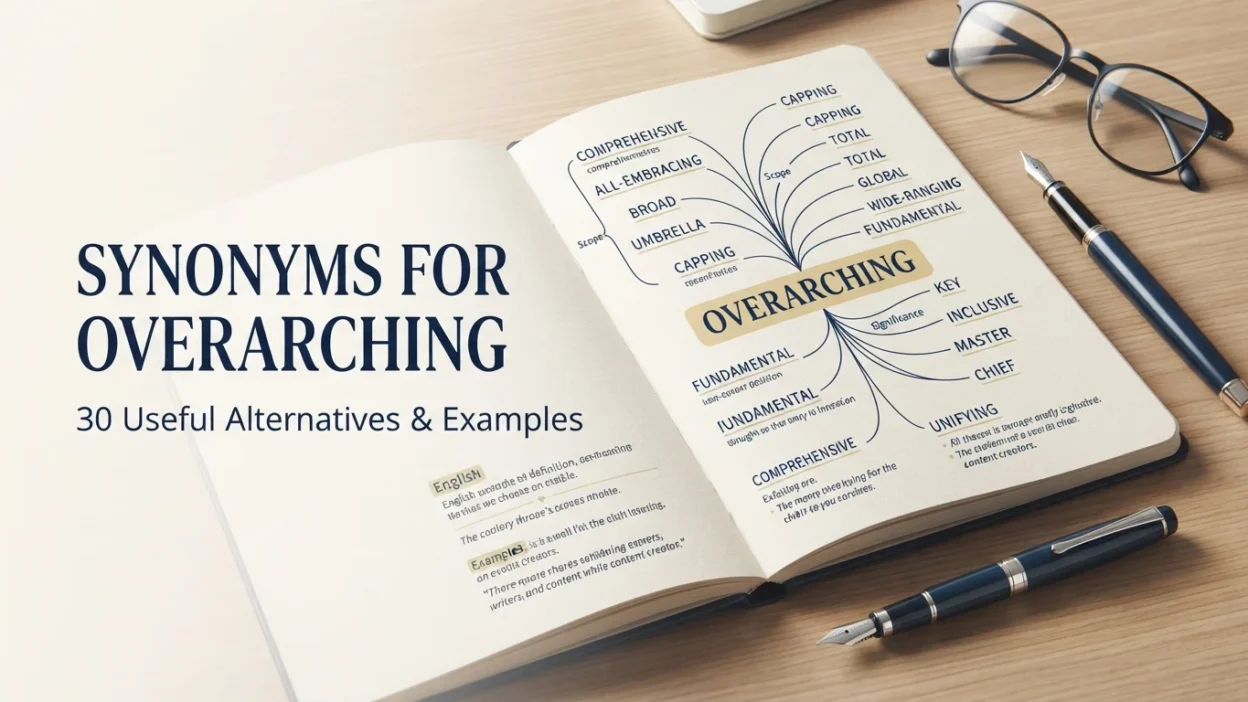
30 Synonyms for “Overarching”
Here are 30 useful alternatives, with simple meanings, examples, and usage notes.
| # | Synonym | Simple Meaning | Best Usage |
|---|---|---|---|
| 1 | Broad | Covering a wide range | General writing |
| 2 | General | Not limited to one specific thing | Everyday and academic writing |
| 3 | Comprehensive | Including many or all important parts | Reports and formal writing |
| 4 | Wide-ranging | Covering many different areas | Academic and professional writing |
| 5 | All-encompassing | Including almost everything | Formal or descriptive writing |
| 6 | Inclusive | Including different people or things | Social, business, and academic contexts |
| 7 | Universal | Applying to everyone or everything | General principles |
| 8 | Main | Most important | Simple, everyday English |
| 9 | Primary | Most important or first in importance | Academic and professional writing |
| 10 | Central | At the heart of something | Essays and analysis |
| 11 | Dominant | More powerful or noticeable than others | Analysis and discussion |
| 12 | Prevailing | Most common or widely accepted | Formal writing |
| 13 | Fundamental | Basic and very important | Academic explanations |
| 14 | Principal | Most important | Formal writing |
| 15 | Major | Very important or significant | General writing |
| 16 | Global | Relating to the whole system or world | International contexts |
| 17 | Sweeping | Covering a large area or range | Descriptive and formal writing |
| 18 | Extensive | Large in range or amount | Reports and research |
| 19 | Holistic | Considering the whole rather than parts | Education, health, and research |
| 20 | Overall | Considering everything together | Everyday and academic writing |
| 21 | Encompassing | Covering or including something | Formal writing |
| 22 | Far-reaching | Having effects over a large area or period | Academic and analytical writing |
| 23 | Strategic | Related to a larger plan or goal | Business and management |
| 24 | Guiding | Providing direction | Plans, principles, and policies |
| 25 | Unifying | Bringing separate things together | Themes and ideas |
| 26 | Foundational | Providing a basic foundation | Education and academic writing |
| 27 | Overriding | More important than other considerations | Formal and argumentative writing |
| 28 | Pervasive | Present throughout something | Academic and analytical writing |
| 29 | All-inclusive | Including everything or nearly everything | General and professional writing |
| 30 | Long-term | Continuing or affecting something over a long period | Goals and planning |
1. Broad
Meaning: Covering a wide range of subjects, ideas, or areas.
Example:
The course provides a broad introduction to modern literature.
Best usage: Use broad when you want a simple and natural alternative to overarching.
2. General
Meaning: Relating to something as a whole rather than to a specific detail.
Example:
The speaker gave a general explanation of the problem.
Best usage: Good for everyday English and beginner-friendly writing.
3. Comprehensive
Meaning: Including many or all important parts of something.
Example:
The researchers created a comprehensive plan for improving public transportation.
Best usage: Especially useful in reports, essays, research, and professional writing.
4. Wide-Ranging
Meaning: Covering many different subjects or areas.
Example:
The article discusses the wide-ranging effects of technology.
Best usage: Use it when emphasizing variety and scope.
5. All-Encompassing
Meaning: Including almost everything connected with a subject.
Example:
The organization developed an all-encompassing environmental policy.
Best usage: Formal or emphatic writing.
6. Inclusive
Meaning: Including different people, ideas, or things rather than leaving them out.
Example:
The school introduced an inclusive approach to education.
Best usage: Particularly useful when discussing people, groups, policies, and participation.
7. Universal
Meaning: Applying to everyone or everything.
Example:
Respect is considered a universal human value.
Best usage: Use carefully because universal is stronger than overarching and suggests something applies everywhere.
8. Main
Meaning: The most important.
Example:
The main goal of the project is to reduce waste.
Best usage: Excellent for simple English and ESL learners.
9. Primary
Meaning: Most important or first in importance.
Example:
The primary objective is to improve student performance.
Best usage: Academic, professional, and formal writing.
10. Central
Meaning: Most important to a subject or situation.
Example:
Trust is a central theme in the novel.
Best usage: Excellent for essays, literary analysis, and discussions of ideas.
11. Dominant
Meaning: More powerful, noticeable, or influential than others.
Example:
Economic growth was the dominant concern during the debate.
Best usage: Use when one idea or influence is stronger than others.
12. Prevailing
Meaning: Most common, accepted, or influential at a particular time.
Example:
The prevailing view was that the policy needed reform.
Best usage: Formal and academic writing.
13. Fundamental
Meaning: Extremely important and forming a basic part of something.
Example:
Communication is a fundamental part of successful teamwork.
Best usage: Use when the idea is essential, not merely broad.
14. Principal
Meaning: The most important.
Example:
The principal reason for the change was rising costs.
Best usage: Formal writing, reports, and academic work.
15. Major
Meaning: Very important, large, or significant.
Example:
The company identified three major challenges.
Best usage: A flexible alternative for everyday and professional writing.
16. Global
Meaning: Relating to the whole world or an entire system.
Example:
The organization has a global strategy for reducing emissions.
Best usage: International issues or systems with worldwide scope.
17. Sweeping
Meaning: Covering a large range or area.
Example:
The government introduced sweeping reforms to the education system.
Best usage: Strong, descriptive writing, especially when discussing major changes.
18. Extensive
Meaning: Large in size, range, or amount.
Example:
The study involved extensive research into consumer behavior.
Best usage: Reports, research, and professional writing.
19. Holistic
Meaning: Considering the whole system instead of focusing only on individual parts.
Example:
The school uses a holistic approach to student development.
Best usage: Education, healthcare, personal development, and research.
20. Overall
Meaning: Considering everything together.
Example:
The overall purpose of the program is to improve community health.
Best usage: One of the easiest alternatives for ESL learners.
21. Encompassing
Meaning: Covering or including many different things.
Example:
The course offers an encompassing view of world history.
Best usage: Formal writing when several elements are included.
22. Far-Reaching
Meaning: Having effects that extend over a large area, group, or period.
Example:
The decision could have far-reaching consequences.
Best usage: Excellent for discussing consequences, effects, and decisions.
23. Strategic
Meaning: Connected to a larger plan designed to achieve an important goal.
Example:
The company developed a strategic plan for long-term growth.
Best usage: Business, management, planning, and organizational writing.
24. Guiding
Meaning: Giving direction or helping determine what should be done.
Example:
The company’s guiding principle is to put customers first.
Best usage: Principles, values, rules, and policies.
25. Unifying
Meaning: Bringing separate ideas, people, or parts together.
Example:
The theme provides a unifying idea throughout the novel.
Best usage: Essays, literature, teamwork, and discussions of connected ideas.
26. Foundational
Meaning: Providing the basic support on which something is built.
Example:
Reading skills are foundational to academic success.
Best usage: Education, learning, research, and development.
27. Overriding
Meaning: More important than other considerations.
Example:
Safety remained the overriding concern during the operation.
Best usage: Use when one concern has greater importance than competing concerns.
28. Pervasive
Meaning: Present throughout a particular place, group, or situation.
Example:
Technology has a pervasive influence on modern communication.
Best usage: Academic and analytical writing. It often describes an influence that appears everywhere.
29. All-Inclusive
Meaning: Including everything or nearly everything.
Example:
The guide provides an all-inclusive overview of the application process.
Best usage: Guides, services, plans, and broad descriptions.
30. Long-Term
Meaning: Continuing for or affecting a long period.
Example:
The organization developed a long-term strategy for sustainable growth.
Best usage: Goals, plans, effects, and strategies that extend into the future.
Quick Comparison: Which Synonym for “Overarching” Should You Use?
Different synonyms work better in different situations.
| If you mean… | Best choices |
|---|---|
| A wide range | Broad, wide-ranging, extensive |
| Everything or nearly everything | All-encompassing, all-inclusive, encompassing |
| The most important idea | Main, primary, principal, major |
| The center of an idea | Central, unifying |
| A basic and essential idea | Fundamental, foundational |
| A complete approach | Comprehensive, holistic |
| A powerful influence | Dominant, pervasive |
| A larger plan | Strategic, long-term |
| A major effect | Far-reaching, sweeping |
| Something that gives direction | Guiding |
| Something that applies everywhere | Universal, global |
“Overarching” vs. Similar Words
Although these words can sometimes replace overarching, they are not always exact synonyms.
Overarching vs. Broad
Overarching usually describes a main idea, goal, theme, or principle that connects smaller parts.
Broad simply means covering a wide range.
Overarching vs. Comprehensive
Comprehensive suggests completeness.
The first focuses on the big picture; the second suggests detailed coverage.
Overarching vs. Central
Central means very important or at the center of an issue.
Overarching emphasizes an idea that extends across multiple parts.
Related Vocabulary: What Does “Demure” Mean?
Demure is unrelated to overarching, but it is an important vocabulary word for students, ESL learners, and writers.
Demure means quiet, modest, reserved, and not wanting to attract a lot of attention.
It is commonly used to describe someone’s appearance, behavior, or manner.
Example
The word often suggests calmness, modesty, and reserved behavior. Depending on the context, it can describe clothing, facial expressions, personality, or manners.
30 Synonyms for “Demure”
1. Modest
Meaning: Not showing off and not trying to attract attention.
Example:
She wore a modest dress to the formal event.
Best usage: Clothing, behavior, and personality.
2. Reserved
Meaning: Quiet and not openly showing feelings.
Example:
He was reserved during the first meeting.
Best usage: Personality and social behavior.
3. Shy
Meaning: Nervous or uncomfortable around other people.
Example:
The shy student rarely spoke in class.
Best usage: Personality and social situations.
4. Bashful
Meaning: Easily embarrassed or shy.
Example:
She gave a bashful smile when everyone complimented her.
Best usage: Friendly or slightly literary descriptions.
5. Retiring
Meaning: Quiet and avoiding attention.
Example:
Despite his talent, he had a retiring personality.
Best usage: Formal or literary descriptions of personality.
6. Unassuming
Meaning: Not trying to appear important or impressive.
Example:
The successful author was surprisingly unassuming.
Best usage: Personality and behavior.
7. Quiet
Meaning: Not loud, talkative, or attention-seeking.
Example:
She was a quiet and thoughtful person.
Best usage: Everyday English.
8. Gentle
Meaning: Calm, kind, and soft in manner.
Example:
He had a gentle way of speaking.
Best usage: Personality, voice, and behavior.
9. Mild
Meaning: Calm and not aggressive or extreme.
Example:
She had a mild and pleasant personality.
Best usage: Personality, behavior, and temperament.
10. Unobtrusive
Meaning: Not attracting attention or disturbing others.
Example:
She chose an unobtrusive style for the ceremony.
Best usage: Appearance, design, behavior, and style.
11. Subdued
Meaning: Quiet, restrained, or not very noticeable.
Example:
Her outfit had a subdued elegance.
Best usage: Fashion, colors, moods, and style.
12. Coy
Meaning: Shy or pretending to be shy, often in a playful way.
Example:
She gave a coy smile before answering.
Best usage: Social or romantic contexts; use carefully because it can imply deliberate behavior.
13. Meek
Meaning: Very quiet and unlikely to argue or resist.
Example:
The meek child rarely complained.
Best usage: Personality and behavior, although it can sound negative.
14. Soft-Spoken
Meaning: Speaking quietly and gently.
Example:
The soft-spoken teacher was easy to listen to.
Best usage: Voice and communication style.
15. Unpretentious
Meaning: Natural and not trying to impress others.
Example:
The actress was known for her unpretentious personality.
Best usage: Personality, lifestyle, and behavior.
16. Unassuming
Meaning: Humble and not demanding attention.
Example:
He remained unassuming despite his success.
Best usage: Character and personality.
17. Restrained
Meaning: Controlled and not showing strong emotion.
Example:
Her response was polite and restrained.
Best usage: Emotions, speech, reactions, and behavior.
18. Composed
Meaning: Calm and in control of your emotions.
Example:
She remained composed during the interview.
Best usage: Professional and formal situations.
19. Dignified
Meaning: Calm, serious, and worthy of respect.
Example:
She maintained a dignified appearance throughout the ceremony.
Best usage: Formal situations and respectful descriptions.
20. Proper
Meaning: Behaving in a socially acceptable or appropriate way.
Example:
The character was expected to behave in a proper manner.
Best usage: Formal, traditional, or social contexts.
21. Prim
Meaning: Very proper, neat, and sometimes overly concerned with manners.
Example:
She had a prim appearance.
Best usage: Literary descriptions; may sound slightly critical.
22. Demure-Looking
Meaning: Having a quiet, modest, or reserved appearance.
Example:
The model had a demure-looking style.
Best usage: Informal descriptions of appearance.
23. Timid
Meaning: Lacking confidence or easily frightened.
Example:
The timid student hesitated before answering.
Best usage: Personality and confidence; often more negative than demure.
24. Introverted
Meaning: More comfortable with quiet environments and limited social interaction.
Example:
She was introverted and preferred reading to large parties.
Best usage: Personality; it is not an exact synonym for demure.
25. Modest-Mannered
Meaning: Behaving in a humble and restrained way.
Example:
He was modest-mannered despite receiving several awards.
Best usage: Character descriptions.
26. Ladylike
Meaning: Traditionally considered graceful, polite, and well-mannered.
Example:
Her ladylike manners impressed the guests.
Best usage: Traditional or literary descriptions; can sound old-fashioned.
27. Reserved-Looking
Meaning: Appearing quiet, private, or restrained.
Example:
The new employee seemed reserved-looking at first.
Best usage: Informal descriptions of appearance.
28. Self-Effacing
Meaning: Avoiding praise and not drawing attention to yourself.
Example:
His self-effacing humor made him popular with his colleagues.
Best usage: Personality and communication.
29. Discreet
Meaning: Careful not to attract attention or reveal private information.
Example:
She was discreet about her personal life.
Best usage: Behavior and handling sensitive matters. It is related to demure but is not an exact synonym.
30. Modulated
Meaning: Controlled or softened in tone, expression, or behavior.
Example:
She answered in a modulated voice.
Best usage: Voice, speech, and controlled expression.
How to Choose the Right Synonym
The best synonym depends on the meaning you want to emphasize.
For a simple, everyday tone
Choose:
- Main
- Broad
- General
- Overall
- Major
These are easy for ESL learners and work well in everyday writing.
For academic writing
Choose:
- Comprehensive
- Fundamental
- Principal
- Central
- Wide-ranging
- Holistic
- Extensive
These words are useful in essays, research papers, and academic discussions.
For business and professional writing
Choose:
- Strategic
- Primary
- Overall
- Guiding
- Long-term
- Comprehensive
For example:
can become:
When emphasizing completeness
Choose:
- Comprehensive
- All-encompassing
- All-inclusive
- Encompassing
These words suggest that many or nearly all relevant parts are included.
When emphasizing importance
Choose:
- Main
- Primary
- Principal
- Major
- Central
- Fundamental
These are best when overarching means “most important.”
When emphasizing influence or effect
Choose:
- Dominant
- Pervasive
- Far-reaching
- Sweeping
These choices are especially useful in analytical writing.
Tips for Using “Overarching” Naturally
Avoid using overarching simply because it sounds formal. A simpler word can often make your writing clearer.
Instead of:
write:
Likewise, don’t use universal when you only mean broad. Universal suggests that something applies to everyone or everything.
The goal is not to use the most complicated synonym. The goal is to use the most accurate word for your meaning.
FAQs:
What is the simplest synonym for “overarching”?
Main, overall, and broad are among the simplest alternatives. The best choice depends on the sentence.
What is a formal synonym for “overarching”?
Comprehensive, encompassing, all-encompassing, and wide-ranging can work well in formal writing.
Is “overall” a synonym for “overarching”?
Sometimes. Overall means considering something as a whole, while overarching often describes a major idea, goal, theme, or principle that connects smaller elements.
What is the difference between “overarching” and “comprehensive”?
Overarching focuses on the big picture or a central idea. Comprehensive emphasizes covering many or all relevant details.
What does “demure” mean?
Demure describes someone or something that appears quiet, modest, reserved, or restrained.
Is “shy” an exact synonym for “demure”?
No. Shy usually describes discomfort or nervousness around other people. Demure more often suggests modest, quiet, or restrained behavior and appearance.
Conclusion
Learning synonyms for overarching can help you make your writing more precise and varied. Words such as broad, comprehensive, central, primary, overall, holistic, strategic, and far-reaching can replace overarching in certain contexts, but each carries a slightly different meaning.
The key is to consider what you want to emphasize. Use broad for range, comprehensive for completeness, central for importance, strategic for planning, and far-reaching for effects.
For ESL learners and students, remember that a good synonym is not necessarily the most advanced word. The best synonym is the one that expresses your exact meaning naturally and clearly. Understanding these small differences will make your essays, articles, reports, and everyday communication stronger.

Sarah Sophia is the administrator of Biblelsays.com, a platform dedicated to Bible meanings and explanations, where she helps manage content, organization, and educational resources for readers seeking spiritual understanding online.