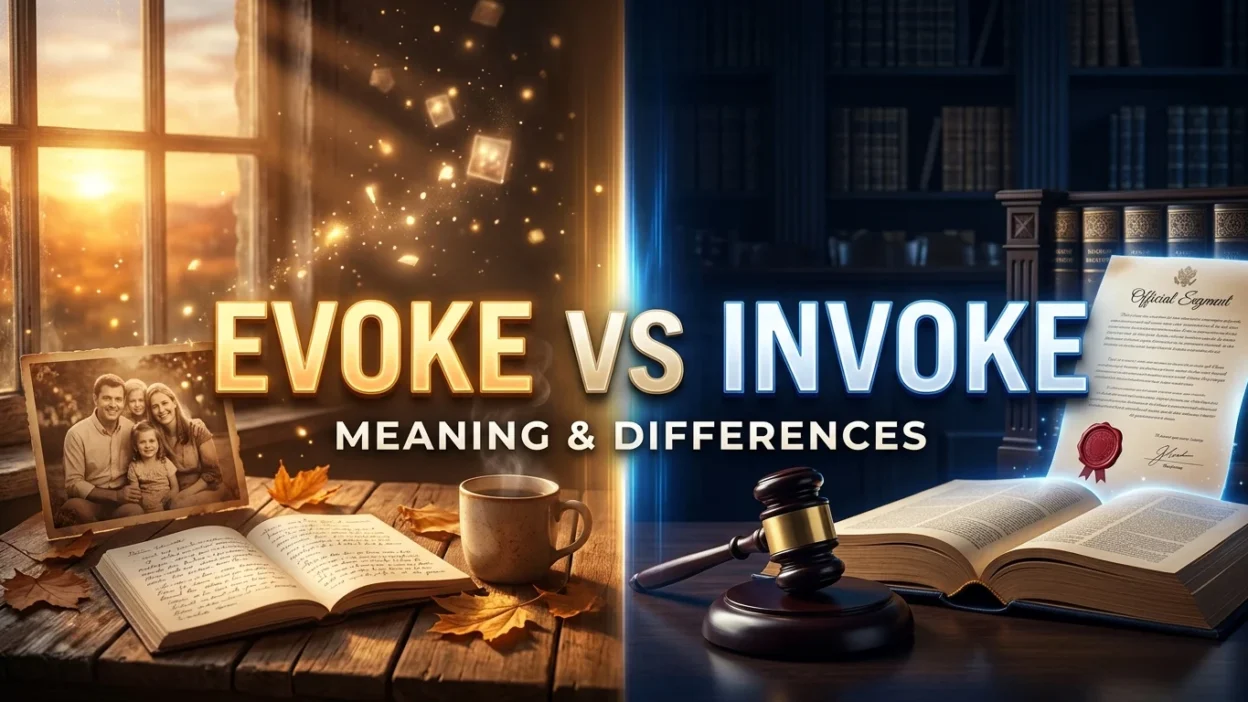
Understanding the difference between evoke vs. invoke can make your English clearer, more accurate, and more natural. Although these two words look and sound similar, they have different meanings and are used in different situations. Both are verbs, but they describe different actions.
The main difference is that evoke means to bring a feeling, memory, image, or reaction to mind, while invoke means to call upon something or someone for help, support, authority, or effect. For example, a photograph can evoke happy memories, while a person might invoke the law to defend their rights. Learning when to use each word will help you avoid common writing mistakes and choose the right expression in everyday conversations, academic assignments, and professional communication.
Quick Answer: Evoke vs. Invoke
Evoke means to bring a feeling, memory, image, or response into someone’s mind. Invoke means to call upon a person, rule, law, power, or authority for assistance or support. Use evoke when something creates an emotional or mental response. Use invoke when someone calls upon something for a particular purpose.
Why Do People Confuse Evoke and Invoke?
The words evoke and invoke are easy to confuse because they have similar spellings, pronunciation patterns, and grammatical functions. Both begin with the letter combination “ev” or “in” followed by “voke,” and both are commonly used in formal writing.
Another reason for the confusion is that both words can describe bringing something into a situation. However, what they bring into that situation is different.
- Evoke: Brings a thought, feeling, memory, or reaction to mind.
- Invoke: Calls upon something for assistance, authority, protection, or influence.
For example, a beautiful song may evoke childhood memories, while a lawyer may invoke a constitutional right during a legal argument.
Remember that the difference is not simply about spelling. It is about the action each word describes.
What Does Evoke Mean?
Evoke is a verb that means to bring something into someone’s mind or create a particular emotional or mental response.
It is commonly used when talking about memories, emotions, feelings, images, associations, and reactions.
Something can evoke a feeling without directly asking anyone to experience it. A smell, photograph, movie, piece of music, or familiar place can naturally evoke an emotional response.
Examples of Evoke in Sentences
- The old photograph evoked memories of her childhood.
- This beautiful song evokes feelings of happiness and peace.
- The painting evokes a sense of mystery.
- His speech evoked strong emotions among the audience.
- The smell of fresh bread evokes memories of my grandmother’s kitchen.
When to Use Evoke
Use evoke when you want to describe something that brings a mental or emotional response.
Common situations include:
- Memories: A familiar smell can evoke memories of childhood.
- Emotions: A touching story can evoke sadness or happiness.
- Images: A poem can evoke images of the countryside.
- Reactions: A controversial statement can evoke criticism.
- Feelings: A peaceful landscape can evoke a sense of calm.
Common Expressions With Evoke
Here are some common combinations that can help you use the word naturally:
| Expression | Example |
|---|---|
| Evoke memories | The song evokes old memories. |
| Evoke emotions | The movie evokes deep emotions. |
| Evoke feelings | Her words evoke feelings of hope. |
| Evoke sympathy | The story evoked sympathy. |
| Evoke an image | The description evokes an image of summer. |
| Evoke a response | His comments evoked a strong response. |
| Evoke nostalgia | The old photographs evoke nostalgia. |
What Does Invoke Mean?
Invoke is a verb that means to call upon someone or something for help, support, authority, protection, or a particular effect.
It is often used in legal, religious, academic, political, and formal contexts.
For example, someone might invoke the law to protect their rights, invoke a religious tradition during a ceremony, or invoke a person’s name to support an argument.
Unlike evoke, which generally describes creating a mental or emotional response, invoke describes actively calling upon something.
Examples of Invoke in Sentences
- The lawyer invoked the Constitution to defend her client.
- She invoked the support of her colleagues during the difficult situation.
- The speaker invoked historical examples to support his argument.
- The ceremony invoked ancient religious traditions.
- The manager invoked company policy when explaining the decision.
When to Use Invoke
Use invoke when someone calls upon a person, principle, authority, or power for a specific purpose.
Common situations include:
- Legal authority: A lawyer may invoke a constitutional right.
- Rules and regulations: An employee may invoke company policy.
- Support: A leader may invoke the support of their community.
- Traditions: A speaker may invoke an ancient tradition.
- Principles: A writer may invoke the principle of fairness.
- Names or authority: Someone may invoke an expert’s name to support an argument.
Common Expressions With Invoke
| Expression | Example |
|---|---|
| Invoke the law | The lawyer invoked the law. |
| Invoke a right | She invoked her legal right. |
| Invoke authority | The officer invoked his authority. |
| Invoke tradition | They invoked an old tradition. |
| Invoke support | He invoked public support. |
| Invoke a principle | The speaker invoked a principle of equality. |
| Invoke a name | The politician invoked the leader’s name. |
Evoke vs. Invoke: Key Differences Explained
Although evoke and invoke are both verbs, their meanings, purposes, and typical contexts are different.
The easiest way to understand the difference is to remember that evoke is generally about producing a response, while invoke is about calling upon something.
Evoke vs. Invoke Comparison Table
| Feature | Evoke | Invoke |
|---|---|---|
| Meaning | Bring something to mind | Call upon something |
| Part of speech | Verb | Verb |
| Main purpose | Create a mental or emotional response | Seek support, authority, or assistance |
| Common objects | Memories, emotions, feelings, images | Laws, rights, rules, names, traditions |
| Common context | Literature, art, emotions, everyday speech | Legal, formal, religious, academic contexts |
| Example | The song evokes memories. | She invoked the law. |
| Main idea | Trigger a response | Call upon something |
The Difference in Simple English
Think about these two examples:
- The movie evoked feelings of sadness.
- The lawyer invoked the law.
In the first sentence, the movie creates an emotional response. In the second sentence, the lawyer actively calls upon legal authority.
This distinction makes it easier to select the correct word.
Parts of Speech and Grammatical Forms
Both evoke and invoke function as verbs. They can be used in different tenses and grammatical structures depending on the sentence.
Forms of Evoke
The common grammatical forms of evoke are:
| Form | Word |
|---|---|
| Base form | Evoke |
| Third-person singular | Evokes |
| Past tense | Evoked |
| Past participle | Evoked |
| Present participle | Evoking |
Examples:
- I evoke memories through my stories.
- This painting evokes happiness.
- Her speech evoked strong emotions.
- The song has evoked many childhood memories.
- The photograph is evoking feelings of nostalgia.
Forms of Invoke
The common grammatical forms of invoke are:
| Form | Word |
|---|---|
| Base form | Invoke |
| Third-person singular | Invokes |
| Past tense | Invoked |
| Past participle | Invoked |
| Present participle | Invoking |
Examples:
- They invoke their rights when necessary.
- The judge invokes the relevant law.
- The lawyer invoked the Constitution.
- The organization has invoked its emergency policy.
- The speaker is invoking historical examples.
Are Evoke and Invoke Transitive Verbs?
Yes. Both words are generally used as transitive verbs, meaning they usually take a direct object.
For example:
- She evoked memories.
- He invoked the law.
The bold words are the direct objects of their respective verbs.
When Should You Use Evoke?
Choose evoke when the subject of your sentence brings a feeling, memory, image, or reaction into someone’s mind.
Here are some practical situations:
1. When discussing memories
Use evoke to describe something that reminds someone of a past experience.
Example: The old house evokes memories of my childhood.
2. When describing emotions
Use evoke when something creates an emotional response.
Example: Her performance evoked feelings of joy.
3. When discussing literature and art
Writers often use evoke to describe how creative work creates images or feelings in the audience.
Example: The author’s words evoke a powerful sense of loneliness.
4. When describing reactions
Use evoke when an action or statement produces a response.
Example: The announcement evoked criticism from the public.
When Should You Use Invoke?
Choose invoke when someone actively calls upon something or someone for a specific reason.
Here are some common situations:
1. When discussing legal matters
Use invoke when someone relies on a law, right, or legal authority.
Example: The defendant invoked his right to remain silent.
2. When discussing rules or policies
Use invoke when someone refers to a rule or policy as a basis for action.
Example: The supervisor invoked the company’s safety policy.
3. When discussing traditions
Use invoke when someone calls upon an established custom or tradition.
Example: The speaker invoked an ancient cultural tradition.
4. When supporting an argument
Use invoke when someone refers to a principle, example, or authority to strengthen a point.
Example: The researcher invoked previous studies to support the conclusion.
10+ Additional Practical Examples of Evoke and Invoke
Understanding examples in different situations can help you remember how to use these words correctly.
More Examples of Evoke
- The sound of rain evokes a feeling of relaxation.
- Her perfume evoked memories of their first meeting.
- The documentary evoked sympathy for the affected families.
- The artist’s work evokes images of a peaceful village.
- His words evoked a strong emotional response.
- The old building evokes a sense of history.
- The novel evokes nostalgia for simpler times.
More Examples of Invoke
- The attorney invoked the client’s constitutional rights.
- The president invoked emergency powers.
- The organization invoked its official guidelines.
- She invoked the principle of equal treatment.
- The teacher invoked school rules to explain the decision.
- The speaker invoked the wisdom of previous generations.
- The company invoked a contractual provision to resolve the dispute.
Common Mistakes When Using Evoke and Invoke
Even experienced English speakers sometimes mix up these words. The following mistakes show how to correct them.
| Incorrect sentence | Correct sentence | Explanation |
|---|---|---|
| The song invoked childhood memories. | The song evoked childhood memories. | A song brings memories to mind. |
| The lawyer evoked the Constitution. | The lawyer invoked the Constitution. | A lawyer calls upon legal authority. |
| Her story invoked feelings of sadness. | Her story evoked feelings of sadness. | A story creates an emotional response. |
| The judge evoked the law. | The judge invoked the law. | The judge relies on legal authority. |
| The painting invoked nostalgia. | The painting evoked nostalgia. | The painting creates a feeling of nostalgia. |
Mistake 1: Using Invoke for Every Kind of Reminder
Not everything that reminds you of something invokes it.
Incorrect: The smell of coffee invoked memories of home.
Correct: The smell of coffee evoked memories of home.
Mistake 2: Using Evoke for Legal Authority
When someone refers to a law or right as a source of authority, invoke is usually the better choice.
Incorrect: The lawyer evoked the client’s legal rights.
Correct: The lawyer invoked the client’s legal rights.
Mistake 3: Assuming Both Words Are Interchangeable
Although the words share similar spelling, they cannot usually replace each other without changing the meaning.
Always consider if the sentence describes creating a response or actively calling upon something.
Easy Memory Trick: How to Remember Evoke vs. Invoke
A simple memory trick can help you remember the difference without memorizing complicated definitions.
- Evoke = Emotion: Think of evoking feelings, memories, and images.
- Invoke = Involve or call upon: Think of invoking laws, rights, authority, and support.
Another way to remember:
Evoke brings something to mind. Invoke calls something into action.
For example:
- A beautiful song evokes happiness.
- A lawyer invokes the law.
If you remember these two examples, choosing the correct word becomes much easier.
Evoke vs. Invoke in American and British English
There is no meaningful difference between American and British English in the basic meanings, spelling, or grammatical forms of evoke and invoke.
Both varieties of English use these words in the same general way.
For example:
- American English: The photograph evokes childhood memories.
- British English: The photograph evokes childhood memories.
- American English: The lawyer invoked the law.
- British English: The lawyer invoked the law.
The choice between evoke and invoke depends on meaning and context, not regional spelling or pronunciation rules.
Similar and Related Words
Learning related vocabulary can help you understand the differences between evoke and invoke more clearly.
Words Similar to Evoke
These words are useful when discussing memories, emotions, or mental associations.
| Word | Meaning |
|---|---|
| Trigger | Cause a particular reaction |
| Elicit | Draw out a response |
| Recall | Bring something back to mind |
| Stimulate | Encourage an activity or response |
| Summon | Call something up or bring it forth |
| Conjure | Bring an image or idea to mind |
| Inspire | Encourage a feeling or action |
| Prompt | Cause someone to think or act |
These words are not always interchangeable with evoke. Their meanings and grammatical uses depend on context.
Words Similar to Invoke
These words are useful when discussing authority, support, or calling upon something.
| Word | Meaning |
|---|---|
| Appeal to | Ask for support or refer to authority |
| Call upon | Request help or assistance |
| Cite | Refer to a source or authority |
| Refer to | Mention or direct attention to something |
| Summon | Call someone or something |
| Enlist | Obtain help or support |
| Petition | Make a formal request |
| Plead | Make an emotional or formal appeal |
For example, you can appeal to a principle or invoke a principle, but the exact sentence structure and meaning may differ.
FAQs:
1. What is the main difference between evoke and invoke?
Evoke means to bring a feeling, memory, image, or reaction to mind. Invoke means to call upon something or someone for support, authority, or assistance. A song can evoke memories, while a lawyer can invoke the law.
2. Is it evoke or invoke emotions?
The correct word is generally evoke when talking about emotions. For example, a powerful speech can evoke emotions among listeners. Invoke is more commonly used when someone calls upon an authority, principle, or source of support.
3. Can evoke and invoke be used interchangeably?
No. Although they look similar, they have different meanings. Evoke describes producing a response, while invoke describes calling upon something. Replacing one with the other can make a sentence confusing or change its intended meaning.
4. Is invoke a positive or negative word?
Invoke is neither inherently positive nor negative. Its meaning depends on the context. Someone can invoke a legal right for protection, invoke an emergency rule, or invoke a principle to support an argument.
5. What is the past tense of evoke and invoke?
The past tense of evoke is evoked, while the past tense of invoke is invoked. Both verbs follow the regular English pattern of adding “-ed” to form the simple past tense.
6. Can a person evoke or invoke something?
Yes. A person can evoke emotions or memories through their words and actions. A person can also invoke a law, right, tradition, or principle when referring to it for a particular purpose.
7. What is an easy way to remember evoke and invoke?
Remember that evoke is associated with emotions and memories, while invoke is associated with calling upon authority or support. A song evokes memories, but a lawyer invokes the law.
Remember This
- Evoke means to bring a feeling, memory, image, or reaction to mind.
- Invoke means to call upon something or someone for support, authority, or assistance.
- Use evoke with emotions, memories, nostalgia, and images.
- Use invoke with laws, rights, traditions, principles, and authority.
- Neither word is inherently positive or negative.
- Both words have the same basic meanings in American and British English.
Conclusion
Understanding evoke vs. invoke is easier when you focus on the action behind each word. Evoke describes something that creates a mental or emotional response, such as a song evoking memories or a story evoking sympathy. Invoke describes calling upon something for a particular purpose, such as invoking a law, right, tradition, or principle. Although the words look similar, they serve different purposes in English sentences.
The simplest rule is to use evoke when talking about feelings, memories, and reactions, and invoke when talking about calling upon authority, support, or established principles. With regular practice and attention to context, you can use both words confidently in everyday conversations, academic writing, and professional communication.

Henry Isaac is an author at BibleL Says, a platform dedicated to explaining Bible meanings simply. He writes clear, insightful articles to help readers understand scripture and spiritual concepts easily.