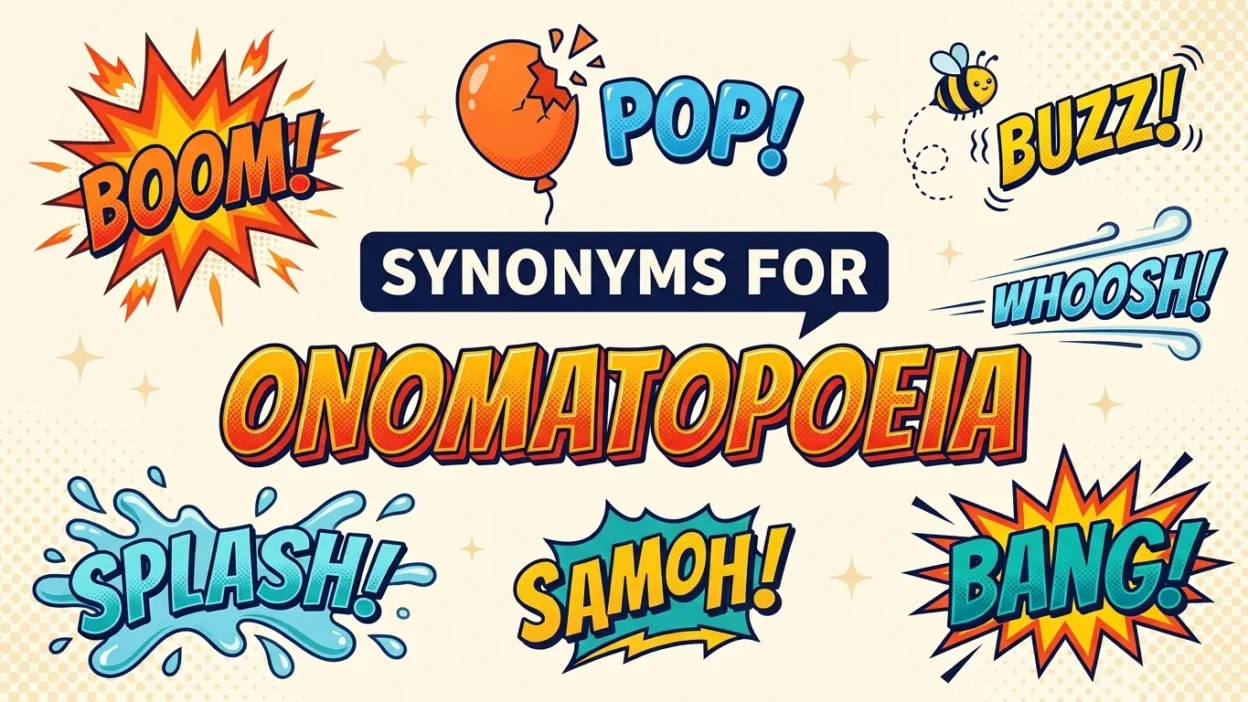
Onomatopoeia is a fascinating part of language that makes writing more expressive, vivid, and engaging. It refers to words that imitate real sounds, such as buzz, bang, hiss, and meow. These words help readers imagine sounds as they read, making stories, poems, and descriptions feel more realistic.
If you are searching for synonyms for onomatopoeia, you may want alternative terms to describe sound-related words or explain this literary device in different ways. Although onomatopoeia has no perfect synonym, several related words and phrases can help you communicate the same general idea.
In this guide, you will discover 30 related terms, their simple meanings, example sentences, and the best contexts for using them. If you are a student, ESL learner, writer, or content creator, this list will help you understand sound-based language more clearly.
What Does Onomatopoeia Mean?
Onomatopoeia is a word that imitates or resembles the sound it describes.
For example:
- Buzz: The sound made by a bee.
- Boom: A loud, deep sound.
- Splash: The sound of something hitting water.
- Tick-tock: The sound of a clock.
- Woof: The sound a dog makes.
Writers use onomatopoeia to make descriptions more lively and help readers imagine what is happening.
Tone and usage: Onomatopoeia is a neutral literary term. It is commonly used in creative writing, poetry, children’s books, comic strips, advertising, and language studies.
Are There Exact Synonyms for Onomatopoeia?
There is no single word that perfectly replaces onomatopoeia in every context. However, related terms such as sound imitation, echoic word, and sound symbolism can help explain the concept.
Some alternatives describe the words themselves, while others refer to the sounds they represent or the literary techniques used to create sound effects.
30 Synonyms and Related Terms for Onomatopoeia
The following words and expressions are useful alternatives, related concepts, and descriptive phrases. They are not all exact synonyms, so choose one according to your intended meaning.
1. Sound Imitation
Meaning: Copying or reproducing a sound through words or other methods.
Example: The word buzz is an example of sound imitation.
Best usage: Simple explanations, classroom lessons, and beginner-friendly writing.
2. Sound Word
Meaning: A word that represents or imitates a particular sound.
Example: The author used the sound word crash to describe the falling plates.
Best usage: Informal explanations and children’s educational materials.
3. Echoic Word
Meaning: A word that imitates or resembles a sound.
Example: Hiss is an echoic word that resembles the sound of escaping air.
Best usage: Linguistics and more technical discussions of language.
4. Sound Symbolism
Meaning: The relationship between speech sounds and the meanings or impressions they suggest.
Example: The writer explored sound symbolism to make the character’s name feel gentle.
Best usage: Linguistics, phonetics, and language analysis.
5. Phonetic Imitation
Meaning: Using speech sounds to reproduce or resemble an actual sound.
Example: The comic used phonetic imitation to represent a machine sputtering.
Best usage: Phonetics, writing techniques, and sound descriptions.
6. Auditory Imagery
Meaning: Descriptive language that helps readers imagine what something sounds like.
Example: The author’s auditory imagery brought the storm’s thunder to life.
Best usage: Literary analysis, poetry, and creative writing.
7. Sound Effect
Meaning: A sound used to represent an action, event, or atmosphere.
Example: The illustrator added a pow sound effect to the comic panel.
Best usage: Comics, films, games, and storytelling.
8. Vocal Imitation
Meaning: Reproducing a sound using the human voice.
Example: Her vocal imitation of a bird’s call made the children laugh.
Best usage: Performance, acting, and animal-sound demonstrations.
9. Mimetic Word
Meaning: A word that imitates or represents a sound, movement, or sensory experience.
Example: The writer chose a mimetic word to capture the character’s quick movement.
Best usage: Linguistics and discussions of expressive language.
10. Imitative Word
Meaning: A word that copies or resembles a sound or other feature of something.
Example: Pop is an imitative word that resembles a short, sudden sound.
Best usage: General explanations and vocabulary lessons.
11. Acoustic Representation
Meaning: A representation of a sound or its characteristics.
Example: The novel’s acoustic representation of the bell made the scene feel realistic.
Best usage: Technical writing, sound studies, and literary criticism.
12. Verbal Sound Effect
Meaning: A spoken or written expression that represents a sound.
Example: The word whoosh served as a verbal sound effect when the superhero flew past.
Best usage: Comics, fiction, and informal writing.
13. Expressive Word
Meaning: A word that communicates an idea or sensation in a vivid way.
Example: The expressive word squelch helped readers imagine walking through mud.
Best usage: Creative writing and vocabulary development.
14. Sound Representation
Meaning: The use of language or another medium to represent a sound.
Example: The sound representation of the engine’s roar made the passage more dramatic.
Best usage: Literary discussion and sound design.
15. Acoustic Imitation
Meaning: The reproduction or imitation of a sound.
Example: The performer used acoustic imitation to recreate the sound of a ringing telephone.
Best usage: Sound studies, performance, and technical explanations.
16. Sound Mimicry
Meaning: The act of copying or imitating a sound.
Example: The child’s sound mimicry of a cat’s meow was surprisingly accurate.
Best usage: Everyday conversation, education, and performance.
17. Phonological Iconicity
Meaning: A relationship in which speech sounds suggest or resemble aspects of meaning.
Example: The researcher studied phonological iconicity in words that suggest size or movement.
Best usage: Academic linguistics and language research.
18. Acoustic Imagery
Meaning: Language that creates a mental impression of sound.
Example: The poem’s acoustic imagery captured the gentle patter of rain.
Best usage: Poetry, fiction, and literary analysis.
19. Sound Description
Meaning: Words or phrases that explain what a sound is like.
Example: The sound description compared the wind to a low whistle.
Best usage: General writing, reviews, and descriptive passages.
20. Imitative Expression
Meaning: A word or phrase that imitates a sound, action, or manner.
Example: The phrase clip-clop is an imitative expression for the sound of hooves.
Best usage: Storytelling, children’s books, and language learning.
21. Reproduced Sound
Meaning: A sound that is recreated or played back.
Example: The reproduced sound of thunder added atmosphere to the performance.
Best usage: Audio production and sound engineering. This is not a direct synonym for the literary device.
22. Sound Pattern
Meaning: An arrangement or repetition of sounds in speech or writing.
Example: The poet used a repeated sound pattern to create a musical effect.
Best usage: Poetry, phonology, and literary analysis.
23. Phonetic Symbolism
Meaning: The suggestion of meaning or feeling through speech sounds.
Example: The author explored phonetic symbolism to make the invented word sound sharp and harsh.
Best usage: Linguistics, branding, and creative naming.
24. Verbal Mimicry
Meaning: The imitation of sounds or speech through words.
Example: His verbal mimicry of the buzzing machine made the story entertaining.
Best usage: Performance, dialogue, and informal descriptions.
25. Sound Evocation
Meaning: Language that brings a sound to mind.
Example: The phrase the distant rumble achieved a powerful sound evocation.
Best usage: Literary criticism and descriptive writing.
26. Auditory Representation
Meaning: A way of representing or communicating how something sounds.
Example: The passage offered an auditory representation of a busy marketplace.
Best usage: Academic writing and sensory description.
27. Sonic Expression
Meaning: An expression that communicates an idea or feeling through sound.
Example: The artist used sonic expression to convey excitement in the performance.
Best usage: Music, sound art, and creative discussions.
28. Sound-Based Language
Meaning: Language that uses sound as an important part of its meaning or effect.
Example: The children’s story relied on sound-based language to keep young readers engaged.
Best usage: Education, storytelling, and general explanations.
29. Imitative Sound
Meaning: A sound that resembles another sound it is intended to represent.
Example: The actor made an imitative sound to represent a creaking door.
Best usage: Acting, performance, and sound demonstrations.
30. Sound-Expressive Language
Meaning: Language that communicates sound vividly or expressively.
Example: The writer used sound-expressive language to describe the clattering train.
Best usage: Creative writing, poetry, and language instruction.
Comparison Table: Which Alternative Should You Use?
Different terms work better in different situations. This table helps you choose the most appropriate alternative to onomatopoeia.
| Word or phrase | Main focus | Best context |
|---|---|---|
| Sound imitation | Copying sounds | Simple explanations |
| Sound word | Words representing sounds | ESL learning |
| Echoic word | Words resembling sounds | Linguistics |
| Sound symbolism | Sounds suggesting meaning | Language research |
| Auditory imagery | Imagining sounds | Poetry and literature |
| Sound effect | Representing an event’s sound | Comics and media |
| Phonetic imitation | Reproducing sounds through speech | Phonetics |
| Mimetic word | Imitating sound or sensation | Linguistics |
| Imitative expression | Sound-representing words or phrases | Storytelling |
| Sound description | Explaining a sound | Descriptive writing |
Quick tip: If you need a simple replacement in an educational article, use sound imitation or sound word. If you are writing a literary analysis, echoic word or sound symbolism may be more suitable, depending on your meaning.
How to Choose the Right Synonym for Onomatopoeia
Choosing the best alternative depends on your audience, purpose, and writing style. Because most alternatives describe a related concept rather than exactly the same thing, consider what you want to communicate.
1. For Simple English and ESL Learners
Use familiar phrases that are easy to understand.
- Sound word: A beginner-friendly label for words like buzz and pop.
- Sound imitation: A clear explanation of how a word copies a sound.
- Imitative word: Useful when teaching how words resemble sounds.
Example: “The word meow is a sound word that imitates a cat.”
2. For Academic or Linguistic Writing
Choose more technical expressions when discussing how language works.
- Echoic word: Useful for words that resemble sounds.
- Sound symbolism: Appropriate when sounds suggest meaning beyond direct imitation.
- Phonological iconicity: Useful for discussing relationships between sound structure and meaning.
Example: “The researcher examined sound symbolism in words associated with size.”
3. For Creative Writing and Poetry
Choose terms that emphasize the reader’s sensory experience.
- Auditory imagery: Highlights the sounds readers imagine.
- Acoustic imagery: Emphasizes sound-based description.
- Sound evocation: Focuses on language that brings sounds to mind.
- Expressive word: Useful for vivid, emotionally effective language.
Example: “The poem uses auditory imagery to recreate the sound of waves crashing against the shore.”
4. For Comics, Films, and Games
Use terms that focus on representing sounds in a scene.
- Sound effect: Best for sounds such as bang, pow, and whoosh.
- Verbal sound effect: Useful when a sound is written as a word.
- Sound mimicry: Appropriate when someone imitates a sound aloud.
Example: “The comic uses BAM! as a verbal sound effect.”
5. For Formal Descriptions
When you want to explain how sound is represented without using a technical term, consider these options:
- Sound representation: A broad, neutral phrase.
- Acoustic representation: Suitable for technical or analytical writing.
- Sound description: A straightforward way to explain an audible event.
Example: “The passage uses sound representation to make the scene more vivid.”
Examples of Onomatopoeia in Sentences
Understanding onomatopoeia through examples makes it easier to recognize and use.
- Buzz: The bee began to buzz around the flowers.
- Clang: The metal gate closed with a loud clang.
- Whisper: The leaves seemed to whisper in the wind. In this sentence, whisper is used figuratively rather than as a strict imitation of a sound.
- Splash: The child jumped into the pool with a splash.
- Crackle: The dry wood began to crackle in the fire.
- Thud: The heavy box landed on the floor with a thud.
- Whoosh: The ball flew past with a whoosh.
- Drip-drop: Water made a steady drip-drop sound from the tap.
These examples show how sound-related words can make sentences more specific and engaging.
Common Mistakes When Using Alternatives to Onomatopoeia
Although related terms can help explain onomatopoeia, they are not always interchangeable.
Mistake 1: Treating auditory imagery as an exact synonym.
Auditory imagery describes language that helps readers imagine sounds. It may include onomatopoeia, but it can also use ordinary descriptive words.
Mistake 2: Confusing sound symbolism with sound imitation.
Onomatopoeia imitates a sound, while sound symbolism describes broader relationships between sounds and meanings.
Mistake 3: Using technical terms in beginner-friendly writing.
Words such as phonological iconicity may confuse readers who simply want to understand words like bang or hiss. Use plain English when possible.
Mistake 4: Assuming every sound-related word is onomatopoeic.
A word can describe a sound without imitating it. For example, loud describes volume but does not reproduce a sound.
FAQs:
1. What is the closest synonym for onomatopoeia?
Sound imitation is one of the closest plain-English alternatives. The phrase describes words that imitate or resemble real sounds.
2. What is another word for onomatopoeia in simple English?
You can say sound word or sound imitation. These expressions are easy to understand and work well in educational writing.
3. Is sound symbolism the same as onomatopoeia?
No. Onomatopoeia imitates sounds, while sound symbolism refers more broadly to connections between speech sounds and meanings or impressions.
4. What are five examples of onomatopoeia?
Five common examples are buzz, bang, hiss, splash, and meow. Each resembles a sound associated with an action, object, or animal.
5. Why do writers use onomatopoeia?
Writers use onomatopoeia to create vivid descriptions, improve storytelling, establish atmosphere, and help readers imagine sounds more clearly.
6. Is onomatopoeia a literary device?
Yes. Onomatopoeia is a literary device in which words imitate or resemble the sounds they describe. It is frequently used in poetry, fiction, comics, and children’s literature.
Conclusion
Learning synonyms for onomatopoeia helps you describe sound-related language more accurately and creatively. Although there is no perfect synonym for the term, alternatives such as sound imitation, sound word, echoic word, and sound symbolism can explain different aspects of the concept.
For everyday writing, choose simple expressions like sound word or sound imitation. For academic discussions, consider echoic word or phonological iconicity. When analyzing poetry or storytelling, auditory imagery may be the better choice.
The most important point is to select a term that matches your intended meaning. Understanding these differences will help you improve your vocabulary, write more clearly, and communicate ideas with confidence.

Henry Isaac is an author at BibleL Says, a platform dedicated to explaining Bible meanings simply. He writes clear, insightful articles to help readers understand scripture and spiritual concepts easily.