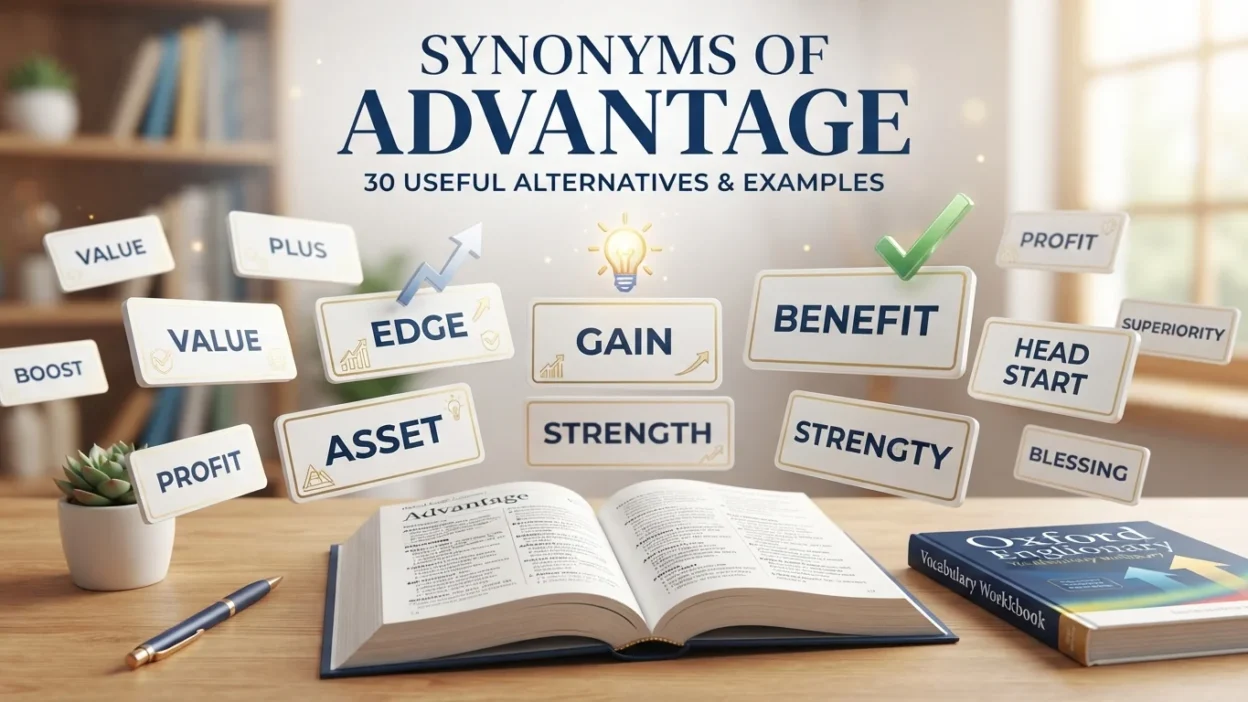
When you want to improve your English vocabulary, learning synonyms of advantage can help you express ideas more clearly and naturally. The word advantage can describe a benefit, a favorable condition, a useful feature, or a position that gives someone an edge.
Understanding related words is especially useful for students, ESL learners, writers, and content creators. Instead of repeating advantage in every sentence, you can choose a more precise word based on the meaning and tone you want.
In this guide, we will also explain the word demure because it is sometimes confused with other descriptive vocabulary. You will find 30 synonyms of demure, along with simple meanings, example sentences, and the best context for using each word.
What Does “Advantage” Mean?
Advantage means a condition or quality that makes someone or something more likely to succeed.
Example:
Depending on the context, advantage can mean:
- A benefit or positive feature
- A favorable position
- An opportunity to succeed
- An edge over someone else
- A useful quality or circumstance
Common Synonyms of Advantage
Some common synonyms include:
benefit, gain, edge, profit, asset, strength, merit, upside, privilege, opportunity, leverage, superiority, favor, convenience, value, usefulness, improvement, reward, assistance, and plus.
The best choice depends on the sentence and intended meaning.
What Does “Demure” Mean?
Demure is an adjective used to describe someone who behaves in a quiet, modest, reserved, or somewhat shy way.
In simple English, a demure person usually appears calm, modest, and not overly confident or attention-seeking.
Example:
The word often describes someone’s appearance, behavior, expression, or manner. It can suggest modesty and quietness, although its exact tone depends on the context.
30 Synonyms of Demure
Here are 30 useful alternatives to demure, with simple explanations and examples.
1. Modest
Meaning: Not showing off; behaving in a humble or reserved way.
Example:
Best usage: General descriptions of humble behavior or appearance.
2. Shy
Meaning: Nervous or uncomfortable around other people.
Example:
Best usage: Everyday conversations about social behavior.
3. Reserved
Meaning: Quiet and not showing emotions or opinions openly.
Example:
Best usage: Formal descriptions of personality.
4. Bashful
Meaning: Easily embarrassed or shy.
Example:
Best usage: Friendly or slightly playful descriptions.
5. Retiring
Meaning: Quiet and unwilling to attract attention.
Example:
Best usage: Formal or literary writing.
6. Quiet
Meaning: Not loud, talkative, or attention-seeking.
Example:
Best usage: Everyday English.
7. Unassuming
Meaning: Not trying to appear important or impressive.
Example:
Best usage: Praising someone’s humble personality.
8. Humble
Meaning: Not thinking you are better than others.
Example:
Best usage: Character and personal qualities.
9. Mild
Meaning: Gentle and not aggressive or extreme.
Example:
Best usage: Describing gentle personalities or behavior.
10. Gentle
Meaning: Kind, calm, and careful in behavior.
Example:
Best usage: Personality and behavior.
11. Meek
Meaning: Very quiet, gentle, and unlikely to argue.
Example:
Best usage: Describing very submissive or quiet behavior.
12. Timid
Meaning: Lacking confidence and easily frightened or nervous.
Example:
Best usage: People or animals that lack confidence.
13. Coy
Meaning: Shy or pretending to be shy, sometimes in a playful way.
Example:
Best usage: Playful, romantic, or flirtatious situations.
14. Unobtrusive
Meaning: Not attracting unnecessary attention.
Example:
Best usage: People, objects, or actions that do not draw attention.
15. Subdued
Meaning: Quiet, restrained, or less energetic than usual.
Example:
Best usage: Emotions, behavior, colors, and atmosphere.
16. Soft-spoken
Meaning: Speaking in a quiet and gentle voice.
Example:
Best usage: Describing someone’s voice or speaking style.
17. Reticent
Meaning: Unwilling to speak freely about thoughts or feelings.
Example:
Best usage: Formal writing and personality descriptions.
18. Introverted
Meaning: More comfortable with quiet environments and limited social interaction.
Example:
Best usage: Personality descriptions; not necessarily a synonym for shy.
19. Demure-looking
Meaning: Having a modest, quiet, or reserved appearance.
Example:
Best usage: Informal descriptions of appearance.
20. Proper
Meaning: Behaving in a socially acceptable and respectable way.
Example:
Best usage: Formal or traditional social contexts.
21. Prim
Meaning: Very proper, neat, and somewhat overly formal.
Example:
Best usage: Often literary and sometimes slightly critical.
22. Sedate
Meaning: Calm, serious, and not energetic.
Example:
Best usage: Formal descriptions of people, places, or moods.
23. Unpretentious
Meaning: Not trying to seem more important, stylish, or impressive than you are.
Example:
Best usage: People, places, lifestyles, and writing.
24. Self-effacing
Meaning: Avoiding praise or attention toward yourself.
Example:
Best usage: Writing about humble personalities.
25. Restrained
Meaning: Controlled and not overly expressive.
Example:
Best usage: Formal writing about emotions and behavior.
26. Composed
Meaning: Calm and in control of your emotions.
Example:
Best usage: Professional and formal situations.
27. Calm
Meaning: Peaceful and not nervous or excited.
Example:
Best usage: Everyday English.
28. Gentle-mannered
Meaning: Behaving in a polite, kind, and quiet way.
Example:
Best usage: Descriptive writing and character descriptions.
29. Unassertive
Meaning: Not forceful about expressing opinions or demands.
Example:
Best usage: Personality and workplace discussions.
30. Demurely
Meaning: In a quiet, modest, or reserved manner.
Example:
Best usage: Describing an action or manner rather than a person.
Advantage vs. Similar Words
Not every synonym of advantage works in every situation. Choosing the right word depends on the exact meaning.
| Word | Main Meaning | Best Context | Example |
|---|---|---|---|
| Advantage | General benefit or favorable condition | General English | Experience is an advantage. |
| Benefit | Something helpful or useful | Work, health, services | The job offers many benefits. |
| Edge | A small advantage over others | Competition | She has an edge over her competitors. |
| Asset | A valuable quality or resource | Business, people, skills | Her experience is a valuable asset. |
| Gain | Something obtained or achieved | Progress, business | The company made a significant gain. |
| Profit | Financial benefit | Business and money | The company earned a profit. |
| Strength | A strong quality | Skills and abilities | Communication is his greatest strength. |
| Merit | A good or valuable quality | Formal writing | The proposal has several merits. |
| Upside | A positive aspect | Informal English | The main upside is the flexible schedule. |
| Leverage | Power gained from a favorable position | Business, negotiation | Experience gives her leverage. |
How to Choose the Right Synonym
Choosing a synonym is not simply about finding a word with a similar dictionary definition. You should consider meaning, tone, audience, and context.
For General Benefits
Use:
- Advantage
- Benefit
- Plus
- Gain
- Value
These are useful in everyday writing and conversations.
For Competition
Use:
- Edge
- Superiority
- Lead
- Upper hand
- Advantage
These words work well when one person or group has a better position than another.
For Business and Professional Writing
Use:
- Asset
- Benefit
- Leverage
- Merit
- Gain
- Profit
These alternatives can make professional writing more precise.
For Skills and Personal Qualities
Use:
- Strength
- Asset
- Merit
- Benefit
- Quality
For example:
This sounds more natural than repeating advantage.
For Informal Writing
Use:
- Plus
- Upside
- Edge
- Benefit
For example:
For Formal Writing
Use:
- Benefit
- Merit
- Asset
- Superiority
- Favorable position
These words are often more suitable for academic or professional writing.
Why Learning Synonyms Matters
Learning synonyms improves your vocabulary, but it also helps you communicate more accurately.
For ESL learners, synonyms provide different ways to express the same general idea. For writers, they reduce repetition and make sentences more engaging.
For example, instead of writing:
You can write:
The second version is more natural and precise.
Common Mistakes When Using Synonyms
One common mistake is assuming that every synonym can replace the original word in every sentence.
For example, profit is related to advantage, but it usually refers to financial gain. Similarly, edge normally suggests an advantage over a competitor.
Another mistake is ignoring tone. Words such as leverage and superiority may sound more formal than plus or upside.
Always ask yourself:
- What exactly does the sentence mean?
- Is the writing formal or informal?
- Am I talking about money, skills, competition, or general benefits?
- Does the synonym sound natural in the sentence?
Quick Guide to Synonyms of Advantage
If you need a word for a general positive feature, use benefit.
If you mean a competitive advantage, use edge.
If you mean a valuable quality or resource, use asset.
If you mean a financial advantage, use profit or gain.
If you mean a personal ability, use strength.
If you mean a positive side of something, use upside.
If you mean power in a negotiation, use leverage.
If you need a formal word for a valuable quality, consider merit.
Final Thoughts
Learning the synonyms of advantage is an excellent way to expand your English vocabulary and make your writing more precise. Words such as benefit, edge, asset, strength, gain, merit, upside, profit, and leverage share related meanings but are used in different situations.
It is also important to remember that synonyms are not always perfect replacements. The best word depends on the sentence, intended meaning, audience, and tone.
For students, ESL learners, writers, and content creators, learning these distinctions can make everyday communication and professional writing clearer, more natural, and more interesting.

Sarah Sophia is the administrator of Biblelsays.com, a platform dedicated to Bible meanings and explanations, where she helps manage content, organization, and educational resources for readers seeking spiritual understanding online.