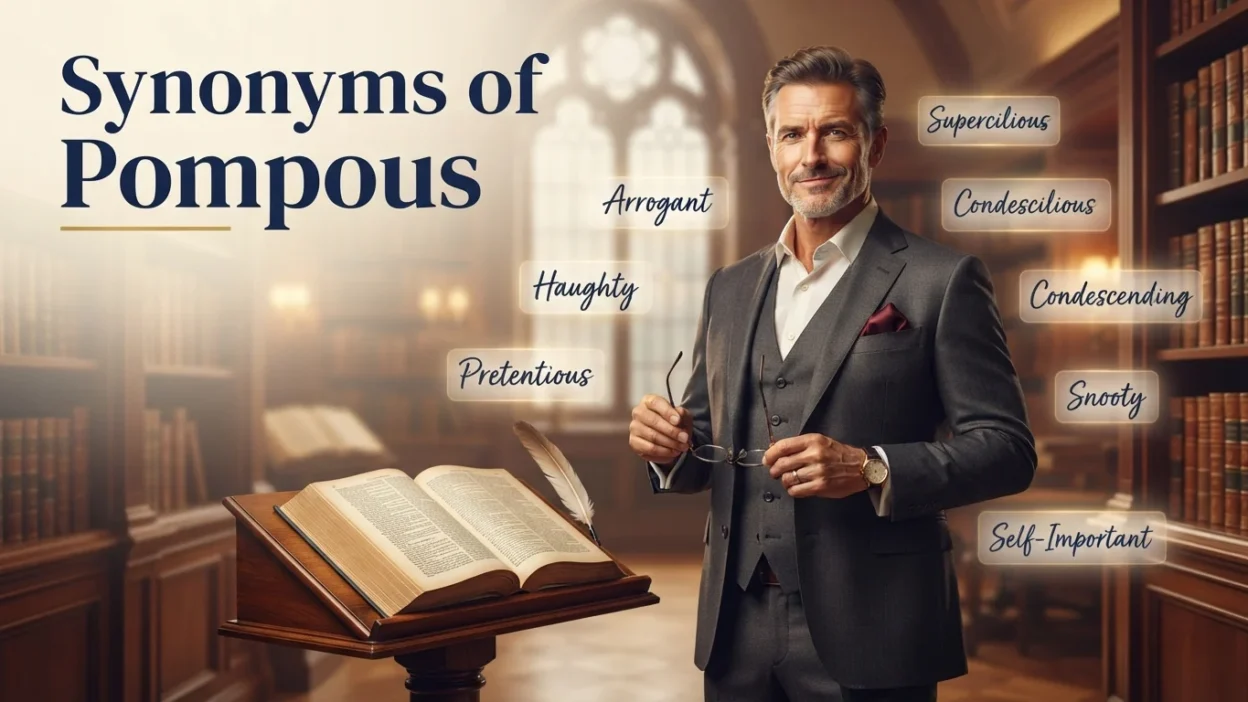
Finding the right word can make your writing clearer, more natural, and more expressive. If someone speaks or behaves as though they are more important, intelligent, or impressive than they really are, pompous is often a suitable word.
Learning the synonyms of pompous can help students, ESL learners, writers, and content creators choose language that matches the exact tone they want. Some alternatives describe an overly proud person, while others focus on formal speech, self-importance, arrogance, or an exaggerated style.
Note: Your keyword says “synonyms of pompous,” but the instructions also mention explaining “demure.” Since pompous and demure have very different meanings, this article focuses on pompous and its appropriate synonyms.
What Does “Pompous” Mean?
Pompous describes someone or something that seems overly important, impressive, or grand, especially in a way that feels unnatural or annoying.
In simple English, a pompous person often acts as if they are more important or intelligent than everyone else.
For example:
The word can describe people, speech, writing, behavior, or style. Its tone is usually negative because it suggests unnecessary pride or exaggerated importance.
30 Synonyms of Pompous
Here are 30 useful alternatives, with simple meanings, examples, and guidance on when to use each one.
| # | Synonym | Simple Meaning | Example Sentence | Best Usage Context |
|---|---|---|---|---|
| 1 | Arrogant | Thinking you are better than others | He sounded arrogant during the meeting. | People and behavior |
| 2 | Pretentious | Trying to seem more important or cultured than you are | His pretentious language was difficult to understand. | Speech, writing, style |
| 3 | Conceited | Having an overly high opinion of yourself | She is too conceited to accept criticism. | Personality |
| 4 | Self-important | Believing you are more important than you really are | His self-important attitude annoyed his coworkers. | Behavior and personality |
| 5 | Haughty | Acting as if you are superior to others | The haughty manager barely spoke to the staff. | Formal or literary writing |
| 6 | Overbearing | Too controlling or forceful | His overbearing manner made everyone uncomfortable. | Personality and behavior |
| 7 | Grandiose | Too ambitious, impressive, or elaborate | They presented a grandiose plan with little detail. | Ideas, plans, language |
| 8 | Egotistical | Thinking excessively about your own importance | His egotistical behavior frustrated the team. | Personality |
| 9 | Snobbish | Believing you are better because of status or taste | His snobbish attitude kept him from making friends. | Social behavior |
| 10 | Supercilious | Behaving as though you are superior | She gave him a supercilious smile. | Formal writing |
| 11 | Overblown | Made to seem more important than it is | The article used overblown language. | Writing and descriptions |
| 12 | Highfalutin | Using unnecessarily fancy or complicated language | He filled the presentation with highfalutin expressions. | Informal criticism |
| 13 | Bombastic | Using powerful-sounding words without much meaning | The politician’s speech was bombastic. | Speeches and writing |
| 14 | Self-satisfied | Too pleased with yourself | He looked self-satisfied after winning the debate. | Attitude and behavior |
| 15 | Vainglorious | Extremely proud of achievements or abilities | His vainglorious remarks bored the audience. | Literary or formal writing |
| 16 | Overweening | Showing excessive confidence or pride | Her overweening confidence caused problems. | Formal writing |
| 17 | Imperious | Expecting others to obey you | His imperious tone upset the employees. | Authority and behavior |
| 18 | Snobby | Acting as if certain people or things are beneath you | He seemed snobby at the party. | Everyday conversation |
| 19 | Pretentious-looking | Appearing unnecessarily fancy or important | The restaurant had a pretentious-looking interior. | Appearance and style |
| 20 | Ostentatious | Designed to attract attention through showiness | He wore an ostentatious gold watch. | Appearance and possessions |
| 21 | Affected | Artificial rather than natural | Her affected accent sounded unusual. | Speech and manner |
| 22 | Airs-and-graces | Artificially superior behavior | His airs-and-graces irritated his friends. | Informal British English |
| 23 | Domineering | Trying to control others | Her domineering personality discouraged discussion. | Leadership and relationships |
| 24 | Lofty | Showing an attitude of superiority | He spoke in a lofty manner. | Formal writing |
| 25 | Magniloquent | Using very grand and impressive language | The speech was filled with magniloquent phrases. | Formal or literary writing |
| 26 | Ritzy | Very fancy or expensive-looking | They chose a ritzy hotel for the celebration. | Places and lifestyle |
| 27 | Showy | Intended to attract attention | His showy clothes attracted everyone’s attention. | Appearance and style |
| 28 | ** pompous-minded** | Excessively focused on one’s own importance | His pompous-minded approach made collaboration difficult. | Descriptive writing |
| 29 | Pretentious-sounding | Seeming unnecessarily sophisticated or important | The title sounded pretentious-sounding and complicated. | Writing and speech |
| 30 | Bombastic | Grand in words but lacking sincerity or substance | The advertisement made several bombastic claims. | Speeches, advertising, writing |
Some alternatives above are context-specific rather than exact replacements in every sentence. Words such as arrogant, pretentious, and conceited overlap with “pompous,” but their meanings are not identical.
The Most Useful Synonyms of Pompous
Although there are many alternatives, a few are especially useful in everyday English.
Arrogant
Arrogant describes someone who believes they are better, smarter, or more important than other people.
Example:
“His arrogant behavior made it difficult to work with him.”
Use arrogant when the main idea is superiority.
Pretentious
Pretentious describes someone or something that tries too hard to appear sophisticated, intelligent, cultured, or important.
Example:
“The restaurant’s pretentious menu used complicated names for simple dishes.”
Use pretentious when the main idea is trying to impress.
Conceited
Conceited means having an excessively positive opinion of yourself.
Example:
“He is so conceited that he rarely listens to anyone else’s advice.”
Use conceited when the focus is self-admiration.
Self-important
Self-important means believing that you deserve special attention or respect.
Example:
“Her self-important attitude irritated the rest of the group.”
Use it when you want a clear, everyday expression.
Bombastic
Bombastic is particularly useful for language or speeches that sound impressive but contain little substance.
Example:
“The report was filled with bombastic statements.”
Use bombastic when discussing speech, writing, or rhetoric.
Pompous vs. Arrogant
These words are closely related but are not exactly the same.
Pompous often focuses on how someone speaks, behaves, or presents themselves. It suggests exaggerated importance.
Arrogant focuses more directly on a person’s belief that they are superior to others.
Compare:
- “The professor’s pompous speech lasted an hour.”
- “The professor was arrogant toward his students.”
The first emphasizes his manner of speaking. The second emphasizes his attitude toward other people.
Pompous vs. Pretentious
Pompous and pretentious frequently overlap.
Someone pompous may behave as though they are extremely important. Someone pretentious may deliberately try to appear more sophisticated or impressive than they really are.
For example:
Choose pompous for exaggerated importance and pretentious for artificial sophistication.
Pompous vs. Grandiose
Grandiose usually describes something excessively ambitious, elaborate, or impressive.
For example:
Here, grandiose describes the scale of the plan rather than a person’s personality.
Pompous vs. Bombastic
Bombastic is particularly useful when criticizing language.
A pompous speaker may act overly important, while a bombastic speech may use dramatic, powerful, or impressive words without enough substance.
For example:
Quick Comparison Guide
| Word | Main Idea | Commonly Describes |
|---|---|---|
| Pompous | Excessively important or grand | People, speech, behavior |
| Arrogant | Feeling superior | People |
| Pretentious | Trying too hard to impress | People, language, style |
| Conceited | Excessively proud of yourself | People |
| Self-important | Thinking you deserve special importance | People |
| Haughty | Acting superior | People |
| Grandiose | Excessively ambitious or elaborate | Plans, ideas, style |
| Bombastic | Grand language with little substance | Speech, writing |
| Ostentatious | Excessively showy | Clothes, possessions, lifestyle |
| Domineering | Controlling others | People, behavior |
How to Choose the Right Synonym
Choosing the right synonym depends on what exactly you want to criticize.
For Someone Who Thinks They Are Superior
Choose:
- Arrogant
- Haughty
- Conceited
- Supercilious
- Self-important
These words work well when the person’s attitude toward others is the main issue.
For Someone Trying to Impress Others
Choose:
- Pretentious
- Affected
- Highfalutin
- Ostentatious
- Showy
These words suggest that someone is making an unnecessary effort to appear impressive.
For Speech or Writing
Choose:
- Bombastic
- Overblown
- Magniloquent
- Highfalutin
- Pompous
These alternatives are useful when someone’s language sounds unnecessarily grand or complicated.
For Fancy or Excessive Appearance
Choose:
- Ostentatious
- Showy
- Ritzy
- Grandiose
These words are more suitable for possessions, clothing, buildings, events, or visual style.
For Controlling Behavior
Choose:
- Overbearing
- Domineering
- Imperious
These emphasize a person’s tendency to control or command others rather than simply acting important.
How to Use “Pompous” in a Sentence
Here are several natural examples:
- “His pompous manner made a simple discussion unnecessarily difficult.”
- “The article used pompous language instead of explaining the subject clearly.”
- “She disliked his pompous attitude.”
- “The speech sounded formal but also somewhat pompous.”
- “The writer avoided pompous expressions and used simple language instead.”
Common Mistakes When Using Synonyms of Pompous
Not every synonym can replace pompous in every sentence.
For example, arrogant is mainly about superiority, while ostentatious is mainly about excessive display. Similarly, bombastic is especially useful for speech and writing.
Consider this sentence:
Ostentatious works naturally because the sentence focuses on a showy possession.
But:
Here, arrogant, haughty, or supercilious would be more appropriate.
Understanding these differences will make your writing more precise.
Why Learning Synonyms of Pompous Matters
Learning synonyms is not simply about memorizing a long list of alternative words. It is about understanding small differences in meaning, tone, and context.
For ESL learners, these distinctions can make everyday communication sound more natural. For writers, they can help create more precise descriptions of characters, dialogue, behavior, and ideas.
Instead of repeatedly using “pompous,” you can choose a word that communicates exactly what you mean.
Final Thoughts
The synonyms of pompous include words such as arrogant, pretentious, conceited, haughty, self-important, bombastic, grandiose, ostentatious, and overbearing. Each has a slightly different meaning and works best in particular situations.
Use arrogant when someone considers themselves superior, pretentious when someone tries too hard to appear impressive, conceited for excessive self-admiration, and bombastic for overly grand language.
The key is to choose a synonym based on the exact idea and tone you want to communicate. Understanding these differences can make your vocabulary richer, clearer, and more natural.

Henry Isaac is an author at BibleL Says, a platform dedicated to explaining Bible meanings simply. He writes clear, insightful articles to help readers understand scripture and spiritual concepts easily.